
Dutch prime minister Mark Rutte is received by Jan Peumans, the speakers of the Flemish parliament, in Brussels, October 15, 2015 (Vlaams Parlement)
The Dutch prime minister, Mark Rutte, may have little choice but to ally with the left-wing Labor Party and Greens after next week’s provincial elections, even if his own and competing right-wing parties make gains.
Rutte’s liberal VVD (of which I am a member) is up in the polls, as is Geert Wilders’ Freedom Party (PVV) and the new Farmer-Citizen Movement (BBB).
JA21, a conservative offshoot of the far-right Forum for Democracy, would also win seats.
Their views on climate, farm and immigration policy could make it hard for Rutte to do deals with right-wing senators, who are elected by provincial deputies in May. (more…)
Jan Huitema, a member of the European Parliament for the Dutch liberal party, answers questions from reporters in Brussels, October 28, 2022 (European Parliament/Philippe Buissin)
German liberals have thrown a wrench in the EU’s plan to phase out diesel and petrol cars, arguing a 2035 deadline is too strict.
“It is contradictory when the EU Commission calls for high climate protection targets on the one hand, but on the other hand makes it more difficult to achieve these targets through overambitious regulation,” transport minister Volker Wissing told the Bundestag on Friday.
A vote of EU transport ministers planned for Tuesday has been postponed. European Commission president Ursula von der Leyen is attending a German cabinet meeting on Sunday to discuss their about-face.
Wissing’s change of heart is a stab in the back of fellow liberal Jan Huitema, who steered the car legislation through the European Parliament. Wissing’s FDP and Huitema’s VVD are the fourth- and fifth-largest parties in the Renew group. (more…)
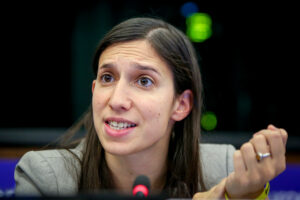
Elly Schlein, a member of the European Parliament for Italy, answers questions from reporters in Strasbourg, December 12, 2018 (European Parliament/Fred Marvaux)
When Italy’s Democratic Party lost the election in September, I told Newsweek they had made a mistake running on abortion, LGBT and immigration rights:
That helped the right more than it helped the left. Social justice resonates with university-educated Italians in big cities like Bologna and Florence. It doesn’t convince the garbage collector in Naples or the unemployed single mother in Palermo that the left has their interests at heart.
American president Joe Biden visits Customs and Border Protection in El Paso, Texas, January 8 (White House/Adam Schultz)
Immigrants who enter the United States illegally may soon be disqualified from applying for asylum.
President Joe Biden proposed the change after a record illegal border crossings were counted in the fiscal year that ended in September: 2.4 million, up from 1.7 million a year earlier.
By refusing asylum to some immigrants altogether, Biden would go further than his Republican predecessor. Donald Trump returned applicants to Mexico, where they had to wait for months or even years while their asylum request was reviewed.
Biden would also speed up deportations of illegal aliens who have not applied for asylum.
Unlike Trump, the Democrat is at the same time making it easier for specific groups of refugees to come to America. (more…)
Manhattan, New York at night, April 2, 2020 (Unsplash/Peter Olexa)
A panel of external experts has advised the American Food and Drug Administration (FDA) to approve over-the-counter sales of naloxone nasal spray.
Naloxone is an affordable and risk-free way to save drug users from an overdose. The spray costs $250 without insurance and prevents deaths from fentanyl, heroin and painkillers. Naloxone has no effect on people who are sober.
Only 29 states allow pharmacists to sell naloxone without a prescription. Even in the states that allow over-the-counter sales, there isn’t enough of the stuff. A study published in The Lancet estimates that 1,270 more naloxone kits are needed for every 100,000 residents to avoid 80 percent of opioid overdose deaths. (more…)
Dutch prime minister Mark Rutte arrives to a meeting of the European Council in Brussels, October 20, 2022 (European Council)
Prime Minister Mark Rutte’s liberal VVD is projected to gain seats in the Netherlands’ upper house elections in May. His Christian democratic coalition partners would lose seats to a new agrarian party.
An Ipsos survey for EenVandaag, a nightly news program, shows Rutte’s center-right party gaining three seats in the 75-seat chamber, going from twelve to fifteen.
The left-liberal D66, the second party in Rutte’s government, would remain at seven seats.
The other two ruling parties are down: the Christian Democratic Appeal would fall from nine to five seats, the Christian Union from four to two.
Seventeen parties and one independent senator are projected to win seats altogether. (more…)
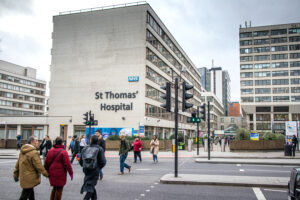
St Thomas’ Hospital in London, England, January 31, 2019 (iStock/Ray Lipscombe)
Ambulance workers and nurses are planning to strike in England and Wales on Monday in what could become the largest walkout in the National Health Service’s history.
Emergency care will still be provided, but planned operations and outpatient services are being postponed.
Unions says nurses and paramedics are overworked and underpaid. They are demanding a 5 percent increase in wages over inflation, which is 14 percent. The governments of England and Wales have given an average of 4.75 percent with a guaranteed minimum income of £1,400 per month.
Health workers deserve a raise, but this won’t solve the NHS’s many other problems. At some point Britain has to accept the NHS is the problem. (more…)
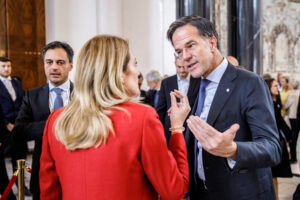
Roberta Metsola, the president of the European Parliament, speaks with Prime Minister Mark Rutte of the Netherlands in Prague, Czech Republic, October 7, 2022 (European Council)
Dutch prime minister Mark Rutte is arguing for stricter European asylum rules and finding a listening ear in Brussels.
“What you see is that everyone fell asleep a little during corona,” he said after meeting with European Commission president Ursula von der Leyen, whose proposals match his own. “At the time, the asylum figures were very low.”
An increase in applications after COVID overwhelmed the Dutch immigration system. Several hundred asylum seekers had to camp and sleep outside the application center in Ter Apel, where there weren’t enough beds free. (more…)
Dutch housing minister Hugo de Jonge visits a building site in Rijswijk, January 14, 2022 (BZK)
The Dutch government wants to make it easier to build new homes — after it made it harder.
Housing minister Hugo de Jonge, a Christian Democrat in a coalition of four parties that includes my own, told parliament he wants to defeat NIMBYism with four proposals:
We owe it to all those looking for a house to do whatever we can to speed up home construction.
I wish he had thought of that a year ago, when he started the job. (more…)
French president Emmanuel Macron listens to European Council president Ursula von der Leyen during a summit in Prague, Czech Republic, October 6, 2022 (European Council)
77 percent of all state aid approved in the EU last year went to French and German companies, according to figures from the European Commission.
The two countries, which have 40 percent of the European economy between them, benefited from a suspension of antitrust rules first put in place during COVID-19.
France would make the suspension permanent. Two years ago, the European Commission rejected such a French proposal. Now it is more sympathetic.
I have a story in the Netherlands’ Wynia’s Week about what France wants, why the European Commission changed its mind, and how France and Germany were able to take advantage of exemptions to the rules of the single market. Here is a summary for English readers. (more…)
Prime Minister Pedro Sánchez speaks at a congress of the Spanish Socialist Workers’ Party in Huesca, October 1, 2019 (PSOE/Eva Ercolanese)
The constitutional crisis triggered by Spain’s highest court a week before New Year’s has ended with a whimper.
The Constitutional Court suspended a debate in parliament for the first time since the end of the dictatorship. Prime Minister Pedro Sánchez spoke of “an unprecedented situation in our democracy.”
At stake were reforms of the Constitutional Court itself. Sánchez’ left-wing coalition had proposed to lower the threshold needed to appoint justices from three-fifths to a simple majority in order to override a veto by the conservative People’s Party.
A majority in Congress, the Spanish lower house, approved the reforms. The People’s Party then asked the court to stop a debate in the Senate, arguing the changes were improperly introduced: as an amendment to penal reforms rather than a separate law. The six justices appointed by the People’s Party, including two whose terms had expired and who refused to recuse themselves, agreed this technicality warranted an historic breach of the separation of powers. The five appointed by Sánchez’ Socialist Workers’ Party sided with the government.
It was a new low in the politicization of the Spanish judiciary. After Sánchez became prime minister in 2018, a minority of conservative lawmakers blocked every judicial appointment they could. Their hope was to overturn the social democrat’s liberalizations, including the legalization of euthanasia and recognition of transgenders, and prevent the Constitutional Court from changing hands before the election in December.
Conservatives finally relented, and agreed to confirm three progressive judges, in order to avoid a permanent lowering of the required majority. That means Sánchez’ other reforms are probably safe. (more…)
United States Capitol in Washington DC, January 15, 2017 (DoD/William Lockwood)
American lawmakers managed to cram everything from a TikTok ban on government phones to a delay in fishing regulations (really) into this year’s $1.7 trillion omnibus spending bill, but somehow drug reforms that had bipartisan support in the House of Representatives were omitted from the Senate version.
Tori Otten reports for The New Republic that proposals to allow cannabis stores to open bank accounts and end sentencing disparities between crack and powder cocaine were taken out at the last minute. (more…)
French president Emmanuel Macron confers with his staff in the Elysée Palace in Paris, February 5, 2020 (Elysée/Soazig de la Moissonniere)
Emmanuel Macron’s government has proposed to raise the French pension age from 62 to 64 and abolish early retirement in the public sector.
Pension reform was one of the reasons I endorsed Macron for a second term. French pensions are among the most generous in the world, yet Macron’s predecessors balked at raising the retirement age for fear of protests.
I have an op-ed in EUobserver arguing Macron is doing the right thing. I will summarize my arguments here and also give the arguments against reform. (more…)
America could ban noncompete clauses by the end of this year. The Federal Trade Commission has proposed to void existing agreements and ban companies from including any in future contracts.
It’s a seemingly simple change that could have massive repercussions.
Economists suspect noncompetes are one reason middle-class wages have stagnated and productivity growth has stalled. At least one in five — 30 million — workers are bound by them.
Once limited to high-paid professionals with access to sensitive company information, noncompete clauses are now routinely inserted into contracts for even fast-food workers and hairstylists.
Paired with weak protections against dismissal, noncompetes give American employers too much power in labor relations. (more…)
Patients wait to see a general practitioner in Westmaas, the Netherlands (LHV)
Rural France is running out of doctors. Politico Europe reports that 7 out of 68 million French citizens don’t have a referring general practitioner. 30 percent live in a region where access to physicians is poor.
France is not alone. Small towns in the Netherlands and the United States are also medically underserved.
Partly the shortage is due to young doctors and nurses preferring to live and work in cities, much like young professionals in general.
Higher-than-usual burnout rates during the pandemic exacerbated the shortage.
But government policy also plays a role. All three countries for years kept the supply of doctors low while demand for health care, as a result of longevity and advances in medicine, went up. (more…)