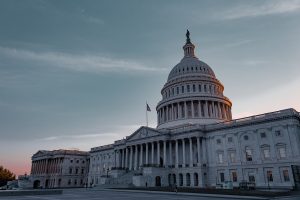

United States Capitol in Washington DC (Shutterstock/Orhan Cam)
Americans vote in midterm elections on Tuesday. All 435 seats in the House of Representatives and 35 of the 100 seats in the Senate are contested. President Joe Biden’s Democratic Party is projected to lose its majority in at least one and possibly both chambers of Congress.
This guide explains how the elections work, why Republicans are up in the polls, why Democrats may yet defend their majority in the Senate, and which states will decide the outcome. (more…)
Agrifirm animal feed factory in Veghel, the Netherlands (Brabants Dagblad/Domien van der Meijden)
The international alt-right has picked the wrong side in the Dutch farm crisis.
Former American president Donald Trump, French National Rally leader Marine Le Pen, Danish climate-change sceptic Bjørn Lomborg and media like Breitbart, The Federalist, Fox News and The Spectator may think they’re backing the little guy against out-of-touch political elites, but they’re doing the bidding of Big Ag.
In Areo Magazine, I point out that the farmers protesting in the Netherlands are funded by three of the largest animal feed companies in the world as well as dairy and meat processors. They stand to lose the most from a reduction in livestock farming. (more…)
Meat sold in a Whole Foods Market in Los Angeles, California, July 7, 2021 (Unsplash/Tommao Wang)
Increases in the sale of plant-based meat substitutes aren’t leading to one-on-one reductions in meat consumption.
Studies in the Netherlands and the United Kingdom found that meat consumption is falling slower than the rise of vegetarians and “flexitarians” would suggest. Which puts a heavier burden on farmers to cut emissions from animal agriculture. (more…)
German health minister Karl Lauterbach (Bundesministerium für Gesundheit)
Germany plans to legalize the sale of recreational cannabis in 2024.
Germany allows medical use of cannabis, but it is seldom prescribed. Karl Lauterbach, the health minister, wants to license the production, distribution and sale of recreational cannabis. Consumers would be allowed to buy up to 30 grams in specialized stores and they could grow three cannabis plants at home. All criminal cases would be closed.
There would be quality requirements, but no price regulation. Lauterbach left open the possibility of a cannabis tax on top of sales tax (19 percent), but cautioned that legal cannabis must be competitive with the black market. (more…)
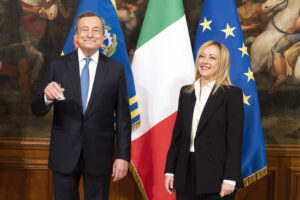
Outgoing Italian prime minister Mario Draghi poses for photos with his successor, Giorgia Meloni, in Rome, October 23 (Palazzo Chigi)
Giorgia Meloni has set out her program in an inaugural address to the Italian parliament.
The far-right party leader, who won the election a month ago to become Italy’s first woman prime minister, was sworn in by President Sergio Mattarella on Sunday. She leads a coalition of three right-wing parties.
She gave the top posts in her cabinet to centrists:
Finance: Giancarlo Giorgetti, a member of Matteo Salvini’s far-right League. Was minister of economic development under Mario Draghi.
Foreign Affairs: Antonio Tajani, the former president of the European Parliament and a member of former prime minister Silvio Berlusconi’s center-right Forza Italia.
Interior: Matteo Piantedosi, a former civil servant without party affiliation. Salvini had hoped to return to Interior, but was given Infrastructure. (Queue jokes about the far right making the trains run on time.)
Justice: Carlo Nordio, a 75 year-old former prosecutor who investigated corruption in Italy’s once-dominant Christian Democracy party in the 1990s. Belongs to Meloni’s own Brothers of Italy.
Meloni’s speech was also reassuring. In place of the fiery culture-war rhetoric of her campaign came sensible proposals for family policy and immigration, empty gestures on climate policy and the environment, and firm commitments to the Atlantic alliance, EU and Ukraine. (more…)
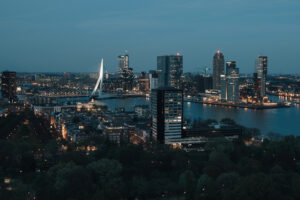
Rotterdam, the Netherlands at night, May 16, 2018 (Unsplash/Stijn Hanegraaf)
The Netherlands has a housing shortage of 300,000. The government’s ambition is to build 100,000 homes per year to keep up with population growth (which is entirely driven by immigration), but there is doubt it will meet this goal.
75,000 homes were built last year. Only 33,000 building permits were issued in the first half of 2022.
For a story in Wynia’s Week, I asked builders, developers, the construction lobby, economists and housing corporations why the going is so slow. They gave me ten reasons.
Some are Netherlands-specific. Provincial governments, which must parcel in building locations, underestimated population growth. Municipalities, which issue building permits, are understaffed. Judges won’t approve permits if construction causes nitrogen pollution and emissions from farms and industry aren’t reduced. (More on the Netherlands’ farm and nitrogen crisis here.)
Others are hopefully temporary: high prices of fuel, steel and wood caused by the war in Ukraine.
The remaining four explanations are relevant to other countries. (more…)
The United States Capitol in Washington DC, December 10, 2019 (Unsplash/Julien Gaud)
Two years ago, Republicans avoided a debate about their party’s principles by copy-pasting their 2016 manifesto and slapping Donald Trump’s name on it.
I had hoped Trump’s defeat might repudiate what he stood for, and bring Republicans back to the center-right, but that hasn’t happened.
Worse, the Trump wing is the only one with a plan to move forward. Senate leader Mitch McConnell has resisted outlining a governing agenda for a Republican Congress. House leader Kevin McCarthy’s “Commitment to America” — modeled on Newt Gingrich’s “Contract with America” that returned Republicans to a majority in 1994 — is a summary of ambitions few could disagree with: create good-paying jobs, curb wasteful government spending, fund border security, lower the price of gasoline, strengthen Medicare and Social Security. But none of McCarthy’s “plans” answer the obvious question: how? Which means they aren’t plans, but slogans.
Only the Republican Study Committee, formerly a fringe faction in the House of Representatives that has come to encompass three in four members, has made concrete proposals in the form of a counterbudget.
I read all its 122 pages, so you don’t have to. But first: why Republicans need a plan. (more…)
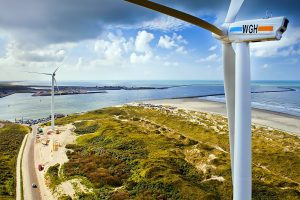
Wind turbines in the dunes of Holland (Vattenfall)
Should we sacrifice wildlife to fight climate change? Whether it’s toads being uprooted by geothermal plants or birds being killed by wind turbines, the question vexes politicians in America and the Netherlands.
So far, the Americans have been more likely to answer “no”.
West Virginia senator Joe Manchin has angered many in his Democratic Party with a plan to speed up energy permits. He would set a two-year target for environmental reviews and a 150-day statute of limitations on court challenges. (The average review takes four-and-a-half years, costs $4.2 million and is 600 pages long. I’ve argued the reforms don’t go far enough, and the two-year “target” should be made into a deadline.)
In the Netherlands, the left-liberal climate and energy minister, Rob Jetten, has licensed the construction of 1,700 wind turbines in the North Sea, which would increase Dutch offshore energy generation by a factor of eight. Environmentalists warn the impact of this expansion on birds and marine life is understudied. (more…)
Catalan president Pere Aragonès speaks at a distribution center in Oliana, Spain, July 22 (Generalitat de Catalunya)
Members of Catalonia’s ruling center-right party have voted to quit the government. Both ruling parties — Together for Catalonia on the right and the Republicans on the left — want independence from Spain. They disagree about how to achieve it.
56 percent of Together’s 6,500 members voted to end the coalition. 79 percent took part in the vote, which was called after regional president, and Republican party leader, Pere Aragonès fired his Together deputy, Vice President Jordi Puigneró.
Neither man revealed the details of their dispute, but the Republicans and Together have been at odds for months. The former want to give talks with the Spanish government, which is also center-left, a chance. Together has lost what little faith they had in Prime Minister Pedro Sánchez. (more…)
Dutch justice minister Dilan Yeşilgöz-Zegerius listens to a debate in parliament in The Hague, June 2 (ANP/Sem van der Wal)
A consortium of Dutch investigate journalists discovered that the country spent €900 million to fight organized drug crime in the last five years without making a single arrest.
I write for Normaal Over Drugs, a campaign to normalize the drug debate, that the five-year failure is the umpteenth failure of repression, and the more reasonable policy is legalization. (more…)
Brothers of Italy party leader Giorgia Meloni makes a speech in Cagliari, September 2 (Fratelli d’Italia)
Giorgia Meloni’s call for a “naval blockade” of illegal immigration across the Mediterranean Sea has got plenty of attention, but the likely future prime minister of Italy has another, more humane idea: create European asylum application centers in North Africa, so migrants — many don’t qualify for asylum — don’t attempt a futile and perilous sea journey.
Italy receives an unusually high (for Europe) share of asylum seekers from safe African countries: Ivory Coast, Mali, Morocco, Nigeria, Senegal, Tunisia. Unless they fear persecution in their home country for their political beliefs, religion or sexuality, those asylum seekers are usually sent back.
That doesn’t mean they leave. Immigration authorities don’t have the manpower to escort every rejected asylum seeker back home. Some countries refuse to take their people back. A share — we don’t know how many — remain in Italy illegally. Others try for asylum in another European country.
Since illegal aliens cannot legally work, many end up either exploited or as criminals, and often homeless. (more…)
French president Emmanuel Macron speaks with European Commission president Ursula von der Leyen in the Elysée Palace in Paris, June 3 (European Commission/Christophe Licoppe)
Emmanuel Macron is moving forward with pension reform, and he’s right to.
Macron’s promise to reform pensions was one of the reasons the Atlantic Sentinel endorsed him for a second term. He has asked his government for a bill by Christmas, so the changes could go into effect next year. (more…)
Impossible burgers made from plants (Impossible Foods)
Reducing dairy and meat consumption is the easiest thing Westerners can do to slow down climate change and improve the lives of animals.
Livestock farming causes 15 percent of greenhouse gas emissions. We could quit fossil fuels tomorrow, and animal agriculture would still push us past 1.5˚C of global warming.
Environmentalists feel guilty about flying, but eating meat and yoghurt every day causes more pollution. And no animals are harmed in building airplanes.
We should eat more seafood and vegetables anyway. Europeans eat twice as much meat as the rest of the world. Spaniards top the list with 100 kilograms per year, which is about the same as Americans. Nutritionists recommend between a quarter and a third of that.
Meat is a source of iron, protein and nutrients, like vitamin B12 and zinc. But most can be found in fish and vegetables as well. Eating too much — especially red — meat can cause bowel cancer and raise cholesterol levels, which increases the risk of heart disease and stroke. Even carnivores who care little about animals or the environment should give that vegaburger a try for the sake of their own heart.
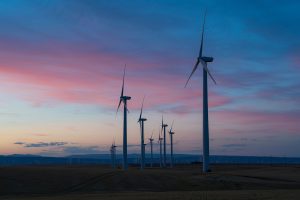
Wind turbines outside Wasco, Oregon, July 1, 2019 (Unsplash/Dan Meyers)
West Virginia Democrat Joe Manchin, the most conservative in the Senate, has proposed to make it easier to build energy plants and infrastructure.
Manchin was promised permitting reforms for supporting the Inflation Reduction Act; really a health-care and green-energy spending plan.
But other Democrats are skeptical, arguing Manchin’s Energy Independence and Security Act would benefit fossil fuels and nuclear power in addition to renewables. Republicans don’t think the reforms go far enough.
Which would normally suggest to me Manchin had found the right balance, but in this case the right has the better of the argument. (If you agree America must massively expand clean energy, which unfortunately few Republicans do.) (more…)
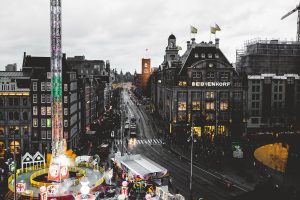
View from the Dam Square in Amsterdam, the Netherlands, October 15, 2019 (Antonio Molinari)
Regular readers may remember I wrote in May about Amsterdam’s plan to ban the sale of cannabis to tourists. At the time, Mayor Femke Halsema argued a ban would help reduce drug tourism.
Studies have since found it won’t, so the mayor has found a new argument: licensed cannabis retailers are linked to organized crime.
Cannabis expert Nicole Maalsté and I have written a joint op-ed in response for Het Parool, the newspaper of Amsterdam. I’ll summarize our arguments here for non-Dutch readers.
Maalsté does research into medical marijuana at the University of Utrecht and runs the advisory Acces Interdit. (more…)