
Author: Nick Ottens

  • Rutte Calls Early Election After Failed Push to Reform Asylum

    Sigrid Kaag Mark Rutte
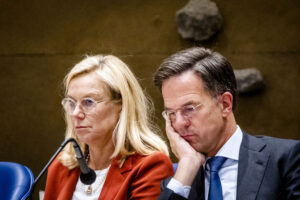
    Finance Minister Sigrid Kaag and Prime Minister Mark Rutte of the Netherlands listen to a debate in parliament in The Hague, September 21, 2022 (ANP/Sem van der Wal)

    Dutch prime minister Mark Rutte announced the dissolution of his fourth cabinet on Friday after two days of negotiations that ran deep into the night on Thursday failed to unite the ruling parties behind a plan to reform asylum law.

    Rutte’s center-right VVD (of which I am a member) and the Christian Democratic Appeal (CDA) had demanded reforms to reduce immigration, which reached a record 400,000 last year. The Christian Union and left-liberal D66 would not support stricter rules for family reunification.

    Rutte tendered his resignation to King Willem-Alexander, who returned from holiday in Greece, on Saturday. He stays on as caretaker prime minister until a new government can be formed. Elections are expected to be held in November.

    Rutte’s VVD is neck and neck in the polls with the right-wing Farmer-Citizen Movement. It won the provincial elections in March. (more…)

  • Three Typical Mistakes About Cultivated Meat

    Cultivated meat
    Cultivated meat in a petri dish (iStock/Svetlana Cherruty)

    Two Californian companies, Good Meat and Upside Foods, have received approval to sell cultivated meat in the United States. They plan to offer it in upscale restaurants first and in grocery stores by 2028.

    It makes America the second country in the world to legalize cultivated meat. Singapore was first in 2020. Israel could become the third: its regulators have received applications by food companies.

    Europe is falling behind. It may take years before the EU allows meat grown from animal cells on its single market. However, the Netherlands — where cultivated meat was invented — is making it possible to taste cultivated meat at its two companies, Meatable and Mosa Meat. RTL News reports that the Dutch Food Safety Authority is expected to issue guideline for tastings in the coming weeks.

    It is exciting news for those of us who like to eat meat, but don’t like to slaughter animals for it. Two in three Americans would try cultivated meat, according to a survey. The Good Food Institute, a think tank that promotes alternative proteins, has found similar interest in Europe.

    A loud minority is vehemently opposed, and they are fed arguments by a livestock industry that considers cultivated meat a threat.

    Let’s tackle the three biggest mistakes they make. (more…)

  • What Sánchez Has Achieved

    Emmanuel Macron Ursula von der Leyen Pedro Sánchez Charles Michel
    Spanish prime minister Pedro Sánchez speaks with European Council president Charles Michel in Versailles, France, March 10, 2022 (European Council)

    When Pedro Sánchez came to power in Spain five years ago, even his allies doubted that his coalition government — the first and most left-wing since the Civil War — could last. Yet with the support of far-left populists, former communists and Basque and Catalan separatists, Sánchez has been able to enact a throng of progressive reforms.

    Sánchez has a knack for defying the odds, as I told Pratik Chougule on the Star Spangled Gamblers podcast. He was ousted by his party after losing the 2015 and 2016 elections, but avenged himself in the 2017 primary. He plotted the first successful vote of no-confidence against a sitting prime minister the following year and has managed to stay in power since despite never winning an outright majority.

    The social democrat’s luck may finally run out. Polls for the general election next month, which Sánchez brought forward from December after his coalition parties lost the municipal and regional elections in May, point to a victory for the conservative People’s Party and far-right Vox (Voice).

    At the risk of writing Sánchez’ political obituary too soon, here is a look back at what he has achieved as prime minister. (more…)

  • EU to Treat Gig Workers as Employees

    Glovo courier Milan Italy
    Glovo courier makes a delivery in Milan, Italy at night, February 17, 2019 (Unsplash/Andrea Ferrario)

    European labor ministers have agreed to bring millions of gig-economy workers into regulation.

    Reforms, which still need to be approved by the European Parliament, would put the onus on platforms like Deliveroo and Uber to prove their workers are not employees.

    Employees are eligible for minimum wage and sick pay, protected against summary dismissal and they qualify for pension and unemployment benefits. (more…)

  • Dutch, German Liberals Split on Climate, Sustainability

    Christian Lindner
    German finance minister and Free Democratic Party leader Christian Lindner boards a government plane to Washington DC, April 22, 2022 (Bundesfinanzministerium)

    Germany’s Free Democrats are turning their backs on climate and sustainability. Across the border in the Netherlands, by contrast, a liberal-led government has accelerated its program to halve greenhouse gas emissions by 2030.

    The Dutch coalition — which includes two Christian democratic and a left-liberal party in addition to the Free Democrats’ ally VVD — is raising taxes on coal use and carbon dioxide (CO₂) emissions in order to pay for subsidies on green hydrogen, solar panels and secondhand electric cars. It is also banning most gas-powered boilers in favor of electric heat pumps by 2027.

    The German liberals resist a similar ban. They nearly torpedoed an EU phaseout of diesel and petrol cars. (more…)

  • Sánchez Gambles by Calling Early Election in Spain

    Pedro Sánchez
    Spanish prime minister Pedro Sánchez visits UN peacekeepers in Lebanon, December 28, 2022 (La Moncloa)

    Spanish prime minister Pedro Sánchez has unexpectedly called an early general election after his Socialist Workers’ Party was defeated in local elections on Sunday.

    General elections weren’t due until December. By bringing them forward to July, Sánchez is taking a gamble — and not for the first time. (more…)

  • Everyone Thinks the Netherlands’ Rental Reforms Are Nuts

    Amsterdam Netherlands
    Muntplein in Amsterdam, the Netherlands, March 27, 2021 (Unsplash/Ruben Hanssen)

    The Netherlands is becoming a case study in how not to regulate rents. An expansion of rent control is driving investors and landlords to despair. Appeals by banks, pension funds, the International Monetary Fund (IMF) and Organization for Economic Cooperation and Development (OECD) are falling on deaf ears in The Hague.

    The European Commission is the latest international body to urge the Dutch government to reconsider. In its annual policy recommendations to member states, it cautions the Netherlands that its “policies regarding the private rental market risk undermining its development.”

    [T]he private rental market is relatively small, which results in a limited supply of affordable and available alternatives to buying a house. The lack of affordable rental housing also undermines labor mobility.

    There are 440,000 job openings. 360,000 Dutch people are still unemployed. A shortage of affordable housing, especially in major cities, is a factor. The average waiting time for a nonprofit social-housing apartment in Amsterdam is thirteen years. Yet the government would make it less lucrative to rent out homes for profit. (more…)

  • Spanish Local Elections Guide

    Pedro Sánchez
    Pedro Sánchez speaks at a conference of the Spanish Socialist Workers’ Party, January 30, 2016 (PSOE)

    Elections are held in over 8,000 Spanish municipalities, 38 provinces and twelve out of seventeen regions on Sunday.

    They are the first test for Prime Minister Pedro Sánchez’ Socialist Party regional elections were held in the Basque Country and Galicia during the pandemic in 2020.

    This guide explains how the elections work, what municipalities, provinces and regions do, and how the political landscape has shifted in Spain in the last few years. (more…)

  • EU Proposals for Nature Restoration Spook Businesses, Farmers

    Veluwe Netherlands deer
    Grey deer in the Veluwe National Park of the Netherlands, November 30, 2020 (Unsplash/Dylan Leagh)

    EU proposals to protect wildlife and reduce the use of pesticides in agriculture have run into opposition from businesses, farmers and their allies in the European Parliament.

    Embarrassingly for European Commission president Ursula von der Leyen, those allies are in her own conservative European People’s Party (EPP). They fear a repetition of the Dutch farm crisis, where strict enforcement of environmental regulations has brought a halt to many construction projects and could drive one in three livestock farmers out of business.

    The far right are also against the Commission’s plans. The liberals, led by French president Emmanuel Macron’s party, are divided. Even the Greens are unhappy. Their commissioner, Virginijus Sinkevičius, is responsible for wildlife protection, but they don’t believe his proposals go far enough. (more…)

  • The Repeal of Title 42 in Context

    Joe Biden
    American president Joe Biden makes a speech in the East Room of the White House in Washington DC, February 15, 2022 (White House/Cameron Smith)

    American president Joe Biden has stopped sending migrants back to Mexico under Title 42. His Republican predecessor, Donald Trump, invoked this public-health statute during COVID-19 to close the southern border for immigration.

    The repeal has triggered an increase in border crossings, prompting Biden to send troops.

    But it isn’t the only reason immigration has increased since Biden took over from Trump in 2021. The Democrat relaxed more policies, and toughened others. (more…)

  • Dutch Drug War Isn’t Working. Politicians Would Escalate It

    Dilan Yeşilgöz
    Dutch justice minister Dilan Yeşilgöz-Zegerius inspects a prison in Vught, June 9, 2022 (LinkedIn)

    The Dutch city of Rotterdam has been rocked by attacks on homes and stores. More explosions were reported in the first four months of this year than during the whole of 2022. The perpetrators, suspected to be drug criminals, have used fireworks, improved explosive devices and hand grenades.

    According to local politician Vincent Karremans, who is in the same liberal party as me, one in four of suspects are under the age of 18.

    Here in Amsterdam, police have also seen in an increase in teenagers selling drugs and taking part in drug-related violence, even assassinations. They are usually boys of Moroccan, Turkish or another immigrant descent.

    The knee-jerk reaction on the right is to escalate the drug war. Give more money to customs and police. Weaken privacy rights, so police can tap phones without a warrant and share information on suspects with non-judicial agencies. Lengthen prison sentences for drug crimes.

    But even Karremans, who is in favor of repression, knows: “that also causes unrest.” When the police get better at their jobs, so do criminals. The recent attacks in Rotterdam — some have been on the homes of family members of suspected drug dealers — follow the arrest and prosecution of prominent drug lords.

    I argue in the Dutch newsletter De Nieuwe Vrije Eeuw that it’s time to rethink our policy. (more…)

  • Italy’s Labor Reforms, Explained

    Venice Italy restaurant
    Restaurant in Venice, Italy, October 5, 2019 (Unsplash/Clay Banks)

    Giorgia Meloni is cutting benefits for out-of-work Italians, reducing taxes for employers and making it easier to hire workers on a short-term contract.

    Many of the reforms were in the prime minister’s election manifesto, but the reintroduction of job vouchers — a way to hire workers without a contract — is a surprise.

    I’ll explain what’s changing, what isn’t — and why Italy’s labor market is such a mess. (more…)

  • Catalan Socialists Learn from Their Mistakes

    Salvador Illa
    Catalan Socialist Party leader Salvador Illa listens to his Basque counterpart, Eneko Andueza, making a speech, January 16 (Socialistas Vascos)

    Catalonia’s Socialists missed an opportunity after the last election to split up the region’s left- and right-wing independence parties. The moderate Republican Left, which supports a Socialist government nationally, had tired of the hardliners in Together for Catalonia (Junts), but local Socialist Party leader Salvador Illa wouldn’t accept anything short of the presidency for himself.

    “Why should I invest a person that I defeated at the polls?” he remarked of the Republican party leader, Pere Aragonès.

    Illa won 50,000 more votes than the Republicans, but both parties got 33 out of 135 seats. Aragonès claimed the presidency too, but he had two paths to a majority, not one. Illa’s intransigence drove the Republicans into the arms of Junts.

    But the coalition proved short-lived and Illa has recently set his ego aside. (more…)

  • Dutch Government Mistakes Reagan’s Warning for Advice

    Ronald Reagan
    American president Ronald Reagan at Rancho Del Cielo in California, August 31, 1985 (Ronald Reagan Presidential Library)

    Ronald Reagan once quipped about government’s view of the economy: If it moves, tax it. If it keeps moving, regulate it. And if it stops moving, subsidize it.
    For the American president, it was a cautionary tale. In the newspaper Trouw, I argue the Dutch government seems to have mistaken it for advice. (more…)

  • Future of Farming Must Be a Mix of High and Low Tech

    Renmark Australia farm
    Farmers prune vines in Renmark, Australia, July 8, 2021 (Unsplash/Zac Edmonds)

    Animal farming causes around 15 percent of global greenhouse gas emissions, more than all airplanes, cars, trains and trucks combined. It is responsible for a third of biodiversity losses around the world.

    Yet consumption of dairy, eggs and meat is rising. Americans and Europeans already eat more than 1,000 animals in their lifetime. There may be two billion more mouths to feed by the middle of this century. If populations in Africa and Asia adopt a “Western” diet — high on animal proteins — we would need to double the crops we grow by 2050.

    How? Jonathan Foley, director of the Institute on the Environment at the University of Minnesota, argues the debate has become polarized:

    Those who favor conventional agriculture talk about how modern mechanization, irrigation, fertilizers and improved genetics can increase yields to help meet demand. And they’re right. Meanwhile proponents of local and organic farms counter that the world’s small farmers could increase yields plenty — and help themselves out of poverty — by adopting techniques that improve fertility without synthetic fertilizers and pesticides. They’re right too.

    High tech is the answer in some places and sectors. Organic and regenerative farming is better in others.

    The one thing we should stop everywhere is factory farming. In addition to the harm it causes to the climate and our natural world, it is cruel to the animals who are reared in it.

    Male baby chicks are ground up alive, because they won’t produce eggs. Cows are forcibly inseminated and kept perpetually pregnant to produce milk. Calves are separated from their mothers after birth. Most bulls are slaughtered after fifteen to eighteen months when their natural life expectancy is 18 to 22 years. Chickens and pigs live their entire lives in cages that are barely largely enough for them to turn around in. Many don’t see daylight until they are transported to slaughter.

    There has to be a better way to feed the world. (more…)