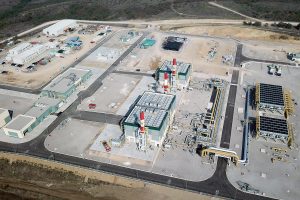
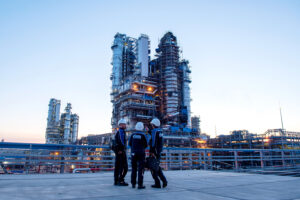
Gazprom workers at the Amur natural gas plant outside Svobodny, Russia, June 9, 2021 (Gazprom)
The price of natural gas is skyrocketing. In the United States, it’s up 100 percent from a year ago. In parts of Europe, 500 percent. Japan and Korea are paying record prices for liquified natural gas imports.
Nick Ottens explained the reasons behind this surge here. I will focus on one: Russia’s role.
Russia has been accused of market manipulation by various countries: forcing the price of gas up in order to accelerate the completion of Nord Stream 2. This accusation is unsurprising, given the history of price and supply disputes between Europe and Russia.
American secretary of state Mike Pompeo meets with President Alexander Lukashenko and other Belarusian officials in Minsk, February 1 (State Department/Ron Przysucha)
Belarus’ Alexander Lukashenko has been in power for 26 years. He is expected to win what will likely be a rigged election on Sunday, but he may not get a landslide this time. The cracks in his regime are widening. (more…)
Presidents Vladimir Putin of Russia and Xi Jinping of China meet in Benaulim, India, October 15, 2016 (Kremlin)
Aside from causing a global humanitarian crisis, COVID-19 has deepened the rift between China and the United States. President Donald Trump has politicized the pandemic, calling it the “Chinese virus” and ordering the federal government’s main pension fund to stop investing in China.
Military conflict remains unlikely. Escalation is more likely to be economic and political — which is still costly, and gives America’s other nuclear-powered adversary, Russia, a chance to strengthen its ties with Beijing. (more…)
Kosovo’s new prime minister, Albin Kurti, is partially lifting his predecessor’s 100 percent import tariff on Serbian goods. He has offered to lift the tariff completely if Serbia suspends its derecognition campaign. If it fails to reciprocate, the tariffs will be restored in June.
Since reciprocation would imply Serbian recognition of Kosovo’s independence, it seems inevitable the trade sanctions will be back soon. (more…)
American secretary of state Mike Pompeo meets with President Alexander Lukashenko and other Belarusian officials in Minsk, February 1 (State Department/Ron Przysucha)
Tensions between Belarus and Russia prompted American secretary of state Mike Pompeo to pay Alexander Lukashenko a visit this weekend. He told the Belarusian leader that the United States could fulfill all of his country’s oil needs if he wants to become “independent” from Russia.
This shouldn’t be taken seriously. Besides the hypocrisy — how “independent” would Belarus be if it traded its dependence on Russia for a dependence on the United States? — it would be logistically and financially almost impossible for America to meet the complete oil needs of Russia’s closest ally.
Pompeo’s remarks do suggest America is willing to help Belarus from being absorbed by Russia. But how much can it really do? (more…)
Mikhail Mishustin was largely unknown both in- and outside Russia until two weeks ago. The head of the Federal Tax Service since 2010, he was unexpectedly promoted to prime minister, replacing Vladimir Putin’s longtime deputy, Dmitri Medvedev.
Yet it was probably because, not in spite of, this political inexperience that Mishustin was chosen. (more…)
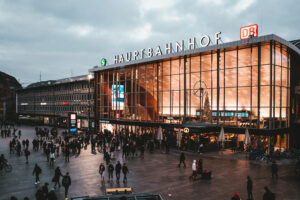
Central train station of Cologne, Germany (Unsplash/Kai Pilger)
Germany is investing €86 billion over the next ten years in its aging rail network. The hope is to shift Germans toward less carbon-intensive forms of travel.

The federal government will cover the bulk of the cost, €62 billion. Deutsche Bahn, the state-owned railway company, will pay the remaining €24 billion. The money will be used to update tracks, stations, signal boxes and energy supply systems.
The government also intends to cut fares by 10 percent for trips of 50 kilometers or more in order to incentivize the use of trains for long-distance travel.
With this package, Germany kills two birds with one stone: it modernizes its infrastructure while reducing carbon emissions.
It also demonstrates Germany’s willingness to spend. (more…)
Skyline of Kiev, Ukraine, January 15, 2015 (Sergey Galyonkin)
Russia and Ukraine have agreed to secure the flow of natural gas into Europe for the next five years. A deal between the two countries satisfies the economic needs of all three parties involved. Russia guarantees the export of its gas, Ukraine continues to benefit financially from transiting the gas, and the EU receives a steady supply of gas for the immediate future.
Gazprom, the Russian gas monopoly, will pipe 65 billion cubic metres of gas into Europe in 2020. The amount will fall to 40 billion over the next four years. The agreement mentions the possibility of extending the contract by another ten years upon maturity.
Ukraine will receive up to $7 billion in transit fees, which would be around 5 percent of its national budget.
An agreement has not (yet) been reached on direct gas supplies to Ukraine. For the time being, it only stands to benefit financially.
Naftogaz, the Ukrainian gas company, will also receive $2.9 billion from Gazprom in overdue transit payments following an arbitration court ruling in Sweden. In return, Ukraine has agreed to drop $12.2 billion in additional legal claims. (more…)
If the German economy does poorly, so will the eurozone’s. A mere .2 percent growth is projected for the first quarter of 2020. This should be a wake-up call to German policymakers.
There are the usual suspects: underdeveloped infrastructure, underinvestment in education, export dependency.
They all stem from Germany’s obsession with surpluses. Revenues generated by exports are not reinjected into the economy. Rather, they sit comfortably in savings accounts. This is the reason for negative interest rates.
Not spending money is one way to get rich. But to grow its economy, or prevent a slowdown, Germany must put its money to work: invest in education, infrastructure and public goods.
Its reluctance to do so affects everyone in the euro area. Germany accounts for nearly 30 percent of the eurozone’s GDP. If Germany spent more at home, it would reduce its current account surplus and increase demand for the products and services of other European nations. (more…)
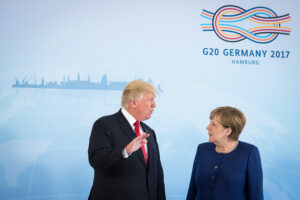
American president Donald Trump speaks with German chancellor Angela Merkel at the G20 summit in Hamburg, July 6, 2017 (Bundesregierung)
Senators in the United States have approved sanctions against companies that are involved in building the Nord Stream 2 pipeline between Russia and Germany.
The sanctions, which President Donald Trump has yet to sign into law, are a last-ditch attempt to halt the pipeline’s construction, which the Americans argue will only increase Europe’s dependence on Russian gas and hurt Ukraine’s position as a transit nation.
They’re not wrong, but placing sanctions on allies is no way to go about it, especially when they have no alternative. (more…)
Compressor station of the Trans-Adriatic Pipeline in Kipoi, Greece, October 2019 (TAP)
After four years of construction, the Trans-Anatolian Natural Gas Pipeline (TANAP) has started pumping gas into Europe.
TANAP is part of Europe’s Southern Gas Corridor, connecting the South Caucasus Pipeline (completed) with the Trans-Adriatic Pipeline (still under construction). It aims to transport natural gas from Azerbaijan all the way through to Italy, where it flows into the European market.
Once the system is fully operational, it should be able to pipe 16 billion cubic meters of natural gas into Europe per year. (more…)
Their EU accession blocked by France, Albania and North Macedonia are opting for a regional, if temporary, solution. Together with Serbia, the Balkan states are looking to create their own version of the EU’s passport-free Schengen Area.
Citizens of the three countries would no longer need a passport to cross the border, but only have to show an ID card.
Labor movement would be liberalized through the mutual recognition of diplomas and qualifications.
Students could go on exchange.
Capital flows would be smoothened.
The other non-EU countries in the region — Bosnia, Montenegro and Kosovo — have been given the green light to join. (more…)
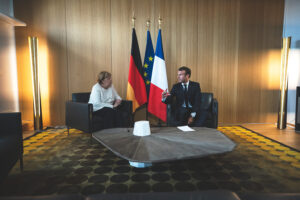
German chancellor Angela Merkel and French president Emmanuel Macron meet on the sidelines of a European Council summit in Brussels, June 20 (Elysée/Soazig de la Moissonniere)
Last week, French president Emmanuel Macron blocked the start of EU accession talks for Albania and North Macedonia, arguing that the Balkan states haven’t made enough progress to qualify and that the EU must reform internally before admitting new members.
His concerns were shared by the leaders of Denmark and the Netherlands.
They are not without merit. It would be naive to assume that decades of institutionalized corruption and crime, particularly in Albania, have been washed away over the course of a few years.
That said, progress has been made. North Macedonia’s name change is far from trivial. It represents a willingness to move on from the past. Albania has reformed its judicial system, encouraged by the prospect of membership.
If the French were so adamant about halting enlargement, they should never have made promises to Albania and North Macedonia in the first place.
Poland’s Andrzej Duda said it best: “Western Balkans states are taking part in a race that does not have a finishing line.” (more…)
Poland will not be able to meet the EU’s 2050 zero-emissions target without additional funds. In an interview with the Financial Times, the country’s chief energy advisor, Piotr Naimski, argues that the European Union needs to take its particular circumstances into account.
Poland’s extreme reliance on coal makes the goal to reduce net emissions to zero a tall order. Coal generates about 80 percent of Poland’s electricity. It also curbs its reliance on Russian energy, which is of geopolitical significance.
There is a political consideration as well. Mining unions are still strong in Poland. The industry has long provided well-paying jobs with a high degree of stability. Miners enjoy special retirement provisions. This makes them a powerful voting bloc. (more…)