
Author: Nick Ottens

  • Democrats Are Losing Touch with Middle America

    Joe Biden
    American president Joe Biden walks away from a news conference in the East Room of the White House in Washington DC, January 19 (White House/Adam Schultz)

    The easiest way to win an election is to appeal to the voter in the center. Fanatics will come up with all sorts of reasons to deny it, and lose. It’s not a perfect rule. In a tight election, turning out your base matters too. But in a two-party system, the party that puts the most distance between itself and the median voter is the one most likely to end up in opposition.

    Take Britain’s Labour Party. It kept Jeremy Corbyn as leader for five years through six defeats. His supporters insisted his policies (raising the minimum wage, a four-day workweek, universal child care) were popular, and many, polled individually, were. But his approval rating was always under water. Middle England didn’t trust the man who opposed the Falklands War in 1982 and the bombing of Yugoslavia in 1999; who called the assassination of Osama bin Laden a “tragedy” and praised Hamas for their commitment to “peace”. Corbyn’s fans mistook his refusal to compromise for principle. It accomplished nothing for Labour voters.

    Democrats in the United States are in the process of making a similar mistake. Many of their policies — the $1.9-trillion coronavirus recovery program, $1 trillion in infrastructure spending, canceling the worst of Donald Trump’s immigration policies, subsidizing child care, rejoining the Paris Climate Agreement — are popular, but the party is not.

    43 percent of Americans have a favorable view of Democrats. 42 percent support Joe Biden and 42 percent plan to vote for a Democrat in the midterm election.

    The only consolation is that Republicans are disliked even more: just one in three have a favorable view of them. Yet 46 percent would vote Republican in November. It seems Republicans don’t need to be loved to win. (more…)

  • Sánchez Can No Longer Ignore Catalonia

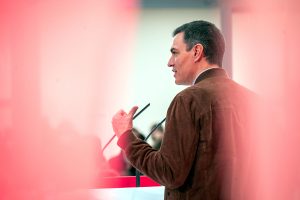
    Pedro Sánchez
    Spanish prime minister Pedro Sánchez speaks at a meeting of his Socialist Workers’ Party in Madrid, April 9 (PSOE/Eva Ercolanese)

    The revelation that dozens of Catalonia’s separatist leaders were hacked should compel Spanish prime minister Pedro Sánchez to finally make good on his promises to the region.

    The Citizen Lab, based in the University of Toronto, Canada, discovered that at least 65 Catalans, ranging from the president of the region to its members of the European Parliament, were targeted or infected with an Israeli spyware that is only sold to governments. Spain’s National Intelligence Center hasn’t confirmed it was behind the hacks, but who else would be interested in spying on Catalan leaders?

    Catalans didn’t have much faith in the Spanish government to begin with. This news threatens to shatter what little hope there was of negotiating a way out of the impasse that has lasted for five years.

    “It is really hard to trust anyone when everything points to the fact that they’ve been spying on you,” Catalan president Pere Aragonès told reporters.

    Imagine if the British government had been listening in on the conversations of Nicola Sturgeon and her cabinet. Would Scots still trust London to negotiate in good faith?

    The difference, of course, is that the United Kingdom recognizes Scotland’s right to self-determination and allowed the country to hold an independence referendum in 2014 whereas Spain sent riot police into Catalonia and suspended the region’s autonomy when it voted to break away in 2017. (more…)

  • Macron Is Lesser of Evils for Mélenchon Voters

    Jean-Luc Mélenchon
    France Unbowed leader Jean-Luc Mélenchon sits in the European Parliament in Brussels, June 6, 2019 (The Left)

    Supporters of Jean-Luc Mélenchon who are thinking of sitting out the second voting round of the French presidential election ought to take a lesson from Bernie Sanders’ supporters in the United States. When they abstained from the 2016 presidential election, or voted for Green party candidate Jill Stein, they made it possible for Donald Trump to win.

    Just 1.5 out of 136 million Americans voted for Stein. Another 100,000 wrote in Sanders’ name (in the fourteen states where that was allowed), even though he wasn’t a candidate and had endorsed Hillary Clinton.

    But those 1.6 million votes made the difference. Clinton lost Michigan, Pennsylvania and Wisconsin, three states Barack Obama had won four years earlier, by a margin of less than 1 percent and a total of 75,000 votes. In all three states, the votes for Stein could have tipped the balance in Clinton’s favor, which would have given her, not Trump, an Electoral College majority. (more…)

  • American Health Care Is Understaffed, Because It Is Overregulated

    New York ambulance
    Ambulance in Manhattan, New York, October 4, 2017 (Unsplash/Benjamin Voros)

    If coronavirus convinces more people our health-care systems need to be overhauled, it may be one of the few good outcomes of the pandemic.

    In the UK, the government-owned National Health Service has long underperformed relative to its rich-country peers. I wrote here in January that the pandemic has underscored the need for reform. If you subscribe to the Financial Times, also read Camilla Cavendish’s story from April about the hundreds of babies who died in English maternity wards between 2000 and 2019 from lack of care. This in the world’s fifth-largest economy!

    The Netherlands’ mixed public-private system is superior, but the country still has a shortage of nurses. It’s something I investigated for Wynia’s Week in December. What I found was that nursing associations, trade unions and researchers have been sounding the alarm for years, yet hospitals continue to underpay nurses and few give their workers the autonomy and flexibility they ask for. Probably because nursing was historically a part-time profession of unmarried women, and doctors and hospital administrators were historically older and male. That hierarchical culture (which I imagine exists in other countries as well) is hard to change, but it is slowly starting to. If you read Dutch, you can glean examples from my second story on the topic.

    In America, excessive licensing requirements and regulations have kept health care understaffed. Pro-market think tanks like the Cato Institute and Niskanen Center have been trying to draw attention to this. Even Vox, hardly a bastion of libertarianism, acknowledges that American health care is, in some ways, overregulated. (more…)

  • Macron Is Wrong to Back Away from Pension Reform

    Boris Johnson Emmanuel Macron
    Prime Ministers Mario Draghi of Italy and Boris Johnson of the United Kingdom speak with President Emmanuel Macron of France and Chancellor Olaf Scholz of Germany during a NATO summit in Brussels, March 24 (10 Downing Street/Andrew Parsons)

    Emmanuel Macron has suggested he could water down French pension reforms in a second term.

    “I am clearly opening the door” to a retirement age of 64, he told BFM TV on Monday, adding that “65 years old was not a dogma.”

    Germany and the Netherlands are raising their retirement ages from 65 to 67.

    Macron also hinted he might call a referendum on the changes. “I don’t want to divide the country.”

    What happened to the brave reformer? (more…)

  • Design and Newsletter Updates

    The Atlantic Sentinel had a facelift. On the home and archive pages, you now see post thumbnails and summaries instead of the full-width image and first paragraphs of the text. I hope this makes it easier to browse. The navigation, which previously moved to the left and right on large screens, has been stuck to the top and bottom. I’ve also tried to give the site an altogether more modern look with some small improvements to buttons and links.

    The only casualty are the comments. I brought back comments a year and a half ago, but in that time just 35 comments were posted on 270 stories. I don’t think that justifies the amount of space the commenting form takes up. Of course, existing comments are preserved, but you no longer have the option to add new ones.

    Please do keep sending me your feedback by email! Some of you frequently write me to share your thoughts on articles. I appreciate that a lot, so don’t hesitate to get in touch. Also if you want to share general feedback on the site. You can reach me at nick.ottens@atlanticsentinel.com. (more…)

  • Macron Places First, But Le Pen Is Stronger Than Ever

    Emmanuel Macron
    French president Emmanuel Macron delivers a televised address from the Elysée Palace in Paris, February 24 (Elysée/Soazig de La Moissonnière)

    This year’s French presidential election will be a rematch of the last. According to exit polls, Emmanuel Macron and Marine Le Pen have won the first voting round and will advance to the second in two weeks.

    Ipsos and Sopra Steria give the incumbent 28 percent support and the far-right Le Pen 23 percent. The far-left Jean-Luc Mélenchon would place third with 22 percent. The other candidates are in single digits.

    Macron defeated Le Pen with 66 to her 34 percent in the 2017 election. Polls suggest this year’s runoff will be tighter.

    Here are my takeaways from the first voting round. (more…)

  • Macron and Le Pen Win First Voting Round in France

    • Emmanuel Macron and Marine Le Pen have won the first voting round in the French presidential election.
    • With 95.5 percent of the votes counted, Macron, the incumbent, is at 28 percent support and Le Pen, the leader of the far right, at 23 percent. Far-left candidate Jean-Luc Mélenchon places third with 22 percent.
    • The April 24 runoff will be a rematch of the 2017 election, when Macron defeated Le Pen with 66 to her 34 percent. Polls predict a narrower margin this year. (more…)
  • French Presidential Election Guide

    Valérie Pécresse
    French Republican party leader Valérie Pécresse reviews an exhibit of French presidents at the Mémorial Charles de Gaulle in Colombey-les-Deux-Églises, October 5, 2018 (Facebook/Valérie Pécresse)

    The first round of the French presidential election will be held on Sunday. Assuming no candidate wins a majority, the top two candidates will advance to a runoff on April 24.

    Polls predict incumbent president Emmanuel Macron will place first in the opening round and win the second round, but the far-right Marine Le Pen and far-left Jean-Luc Mélenchon aren’t far behind.

    Here is everything you need to know. (more…)

  • Five French Election Scenarios

    Elysée Palace Paris France
    Aerial view of the Elysée Palace in Paris, France at night, March 12, 2019 (Elysée/Laurent Blevennec)

    Polls are narrowing in France. Incumbent president Emmanuel Macron is losing support. The far-left Jean-Luc Mélenchon and far-right Marine Le Pen are going up.

    The most likely outcome is still that Macron and Le Pen qualify for the runoff, and Macron wins. But that is less certain than it was three weeks ago.

    There are also legislative elections in June, for which there hasn’t been much polling. Macron’s liberal party, The Republic on the Move (LREM), is expected to lose seats to the Greens and Socialists on the left and the Republicans on the right. What the French call “cohabitation”, and the Americans “divided government” — in which two parties split the presidency and National Assembly — is likely.

    Here are the five possible outcomes in order of probability (as I see it), and what they would mean for French policy. (more…)

  • Programs of the French Presidential Candidates, Compared

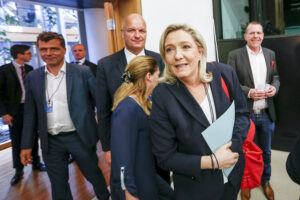
    Marine Le Pen
    French party leader Marine Le Pen makes her way to a news conference in Strasbourg, May 11, 2016 (European Parliament/Fred Marvaux)

    Twelve candidates have qualified to compete in the French presidential election. Only six are polling at more than few percentage points. I will summarize their policies here, plus those of Anne Hidalgo. The mayor of Paris has just 2 percent support in recent surveys, but her Socialist Party could still be a force in the legislative elections in June.

    The comparison reveals strange bedfellows. The centrist Emmanuel Macron and center-right Valérie Pécresse see eye to eye on asylum and pension reform. Macron’s climate policies are closer to the Green party’s candidate, Yannick Jadot. Jadot and the far-right Marine Le Pen emphasize animal welfare. Le Pen and the far-left Jean-Luc Mélenchon agree on renationalizing motorways. Mélenchon and the far-right Éric Zemmour believe NATO is obsolete.

    (more…)
  • Macron’s Successes and Failures

    Emmanuel Macron
    French president Emmanuel Macron answers questions from reporters in Helsinki, Finland, August 30, 2018 (Office of the President of the Republic of Finland/Juhani Kandell)

    Emmanuel Macron is projected to place first in the opening round of the French presidential election in two weeks, which would make him the favorite for the runoff another two weeks later.

    Macron has been in power since 2017 and is only the second of eight presidents who didn’t come from the Gaullist right or the Socialist left. “Liberal” is a dirty word in France, synonymous with Anglo-American capitalism, so Macron calls himself a “centrist” and a “progressive”. But he has governed as a liberal.

    Here is an overview of his successes and failures. (more…)

  • Netherlands’ Kaag Disappoints Liberal Well-Wishers

    Sigrid Kaag
    Peter Maurer, president of the International Committee of the Red Cross, leads then-Dutch trade and international development minister Sigrid Kaag up the stairs of the Royal Tropical Institute in Amsterdam for a conference on mental health in humanitarian crises, October 7, 2019 (MFA/Martijn Beekman)

    When the pro-European Sigrid Kaag became the Dutch finance minister in January, hopes were high that she would take a more relaxed view to debts and deficits in the EU.

    AFP reported that Kaag was “tipped to smooth ties with debt-hit Southern European states that have previously been lectured by the Dutch to cut deficits.”

    EUobserver knew it was “widely expected” Kaag would strike “a more dovish tone” than her Christian democratic predecessor, Wopke Hoekstra.

    The Financial Times predicted that the “polyglot” Kaag — who led her left-liberal party D66 to a “surprise surge” in the polls despite receiving much “opprobrium” from the far right — would be “less hostile on topics such as revamping budgetary rules, joint EU borrowing and fiscal risk-sharing.”

    Her presence around the Eurogroup table should help rebuild trust with southern capitals that often found themselves in Hoekstra’s line of fire.

    It was wishful thinking. (more…)

  • Catalan Support for Independence Down, Autonomy Up

    Barcelona Spain
    Basílica de Santa Maria del Pi in the Gothic Quarter of Barcelona, Spain (Egor Myznik)

    Spanish media widely reported this week that support for Catalan independence is down.

    Most media have learned not to read too much into any one poll, and report averages or trends instead. Spain’s not so much.

    I’m not surprised conservative newspapers like ABC and El Mundo would make hay out of the story. They have been trying to convince their readers Catalan independence is a fringe movement for many years. I am disappointed the center-left El País and Basque El Correo didn’t give their readers more context. (more…)

  • Ukraine War Gives European Defense Union New Urgency

    Emmanuel Macron
    French president Emmanuel Macron arrives in Berlin, Germany, January 25 (Elysée/Soazig de la Moissonniere)

    European leaders agreed in Versailles last week to step up military cooperation in the EU. They asked the European Commission to prepare concrete proposals by May, which would be discussed at another leaders’ summit in June.

    I looked into what closer defense union would mean for the Netherlands’ Wynia’s Week. Dutch readers can click here. What follows is a summary in English. (more…)