Author: Anonymous

  • Macron’s Idealistic Russia Pragmatism

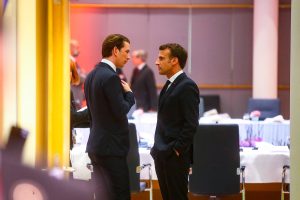
    Sebastian Kurz Emmanuel Macron
    Austrian chancellor Sebastian Kurz and French president Emmanuel Macron speak on the sidelines of a summit in Brussels, April 10, 2019 (BKA/Arno Melicharek)

    The 2020 Munich Security Conference saw French president Emmanuel Macron reaffirm his eagerness to turn Russia into a security partner, suggesting that “we have to restart a strategic dialogue.”

    But Russia hasn’t been a part of Europe for a while and doesn’t belong in a conversation about European autonomy. The only thing that ties it to Europe is geography. (more…)

  • China-Russia Gas Pipeline Should Concentrate Minds in Brussels

    Russia has started piping gas to China through a new pipeline, called Power of Siberia. After five years of construction, it will be able to send up to 38 billion cubic meters of gas to China per year.

    The pipeline marks a reorientation of Russian energy policy away from the European market, which should give European policymakers some concern. (more…)

  • Russian Missile Treaty Violation Is a Wake-up Call for Europe

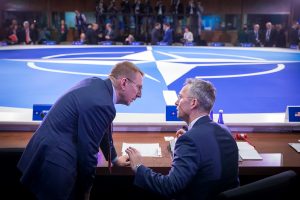
    Edgars Rinkēvičs Jens Stoltenberg
    Latvian foreign minister Edgars Rinkēvičs speaks with NATO secretary general Jens Stoltenberg in Brussels, April 4 (NATO)

    Last month, NATO allies issued a warning to Russia, urging it to destroy a new missile system that could threaten Europe or face a “defensive” response.

    The warning is a final opportunity for Russia to respect the 1987 Intermediate-Range Nuclear Forces (INF) Treaty, which banned land-based cruise and ballistic missiles with a range of 500 to 5,500 kilometers. If it doesn’t — and Russia claims the system in question has a range of only 480 kilometers — it will be another wake-up call for Europe. (more…)

  • Different Player, Same Game

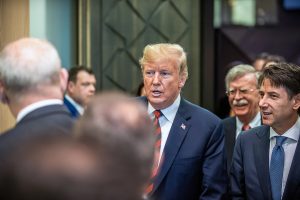
    Donald Trump Giuseppe Conte
    American president Donald Trump and Italian prime minister Giuseppe Conte arrive to a NATO summit in Brussels, July 12, 2018 (NATO)

    Donald Trump has not exactly shied away from advocating for better American relations with Russia. During his presidential campaign, he argued that “Russia and the United States should be able to work well with each other toward defeating terrorism and restoring world peace.” He has repeatedly praised Vladimir Putin and accepted his denials of Russian interference in the 2016 election.

    But even Trump’s Russophilia is no match for geopolitical reality. (more…)

  • Western Sahara: An Unlikely Key to American Strategy in Africa

    Africa, once the forgotten continent in American foreign policy, has rather abruptly become important again. US Africa Command has been front and center as a result of operations in Libya, Somalia and elsewhere. Terrorist groups like Al-Shabaab, Boko Haram and Al Qaeda in the Islamic Maghreb (AQIM) are active and spreading and Chinese economic expansion into the continent makes it strategically interesting almost by default. It is time, now rather than later, for Western policymakers to consider the place of Africa in the world.

    The first and most important way of engaging with an entire continent is developing regional allies. In the case of Africa, these can often be identified by what they oppose. Al-Shabaab may run rampant in Somalia but neighboring Kenya is ready and willing to listen to Western advice and aid. Boko Haram, a key substate actor in Nigeria, is counterbalanced by American diplomatic and economic engagement with the Nigerian government. And AQIM, arguably the most important of Africa’s major terrorist groups, is countered in some areas by a Moroccan constitutional monarchy that has shown great willingness to cooperate with the West on matters of counterterrorism and regional strategy.

    None of these regimes are entirely blameless. But they are convenient allies and a realist approach to international relations requires doing business with imperfect people whose interests nevertheless align with the United States’.

    Credibility, though, has a lot of different sides. The image that the United States want to project in Africa is a simple one: speak softly, carry a big stick in one hand and carry a lot of aid money in the other. That image is somewhat complicated, in the case of American-Moroccan relations, by the issue of Western Sahara. (more…)

  • Escalating Sectarian Divide Threatens Post-American Iraq

    The fragile political power-sharing arrangement imposed by American forces during the Iraqi occupation is at a renewed risk of collapse. Recent moves by Prime Minister Nouri al-Maliki and his Shiite backers have considerably threatened the state’s sensative coalition structure, which couples a Shia prime minister with Sunni and Kurdish deputies, a Sunni parliamentary speaker with Shia and Kurdish deputies, and a Kurdish president with Shia and Sunni vice presidents.

    When American troops left Iraq less than a week ago, the long disgruntled Sunni establishment was on the defensive almost immediately, as deputy prime minister Saleh al-Mutlaq, leader of the Iraqi Front for National Dialogue, was issued a stop work order Monday by Maliki’s office. Citing only “administrative irregularities” and the ambiguous charge of traveling without informing the government, Mutlaq is now effectively barred from entering the cabinet.

    More recently, Vice President Tariq al-Hashimi, a former general secretary of the country’s largest Sunni Islamist bloc, the Iraqi Islamic Party, has fled to the semi-autonomous Kurdish north after being issued an arrest warrant for allegedly running a hit squad targeting government officials. Hashimi has called the allegations “absurd” and describes them as a smear campaign led by Maliki and his Shia backers who control the state’s Interior Ministry.

    While Prime Minister Maliki called Wednesday for Kurdish authorities to hand over Hashimi for trial, the Sunni leader thanked Iraq’s Kurdish president Jalal Talabani on Tuesday for a promise of security as he weighs leaving the country.

    The move puts Talabani in the middle of a renewed sectarian divide that has already seen the powerful Sunni-backed Iraqiya bloc, which controls nine ministerial posts and 82 parliamentary seats, suspend its participation in national unity cabinet meetings. (more…)