One of the most closely watched elections on Tuesday is in Georgia, where Democrat Stacey Abrams and Republican Brian Kemp are competing for the governorship.
Abrams led Democrats in the Georgia House of Representatives from 2011 to 2017 and is the first-ever female African American gubernatorial nominee of a major political party in the United States.
Kemp has been the secretary of state of Georgia since 2010. That puts him in charge of overseeing the very election he is hoping to win. (more…)
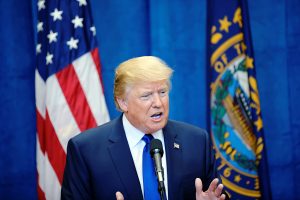
Donald Trump gives a speech in Derry, New Hampshire, August 19, 2015 (Michael Vadon)
What is the essence of Donald Trump? Is he an aspiring strongman? Or is he just a plain old bumbler?
These two schools of thought have been in competition ever since we started to take Trump seriously. Of course he’s narcissistic, duplicitous, misogynistic, bigoted and so forth. But what is at the heart of Donald Trump? Does he intend to emulate Mussolini? Or is he primarily an uncurious incompetent?
The answer: He’s both. And after the firing of FBI director James Comey on Tuesday evening, this has been made astoundingly clear. (more…)
Critics are calling Donald Trump’s missile strike against Syria a flip flop, but it’s really the logical outcome of holding two wildly inconsistent opinions on an issue.
In 2013, Trump said to President Barack Obama, via Twitter (caps his):
AGAIN, TO OUR VERY FOOLISH LEADER, DO NOT ATTACK SYRIA — IF YOU DO MANY VERY BAD THINGS WILL HAPPEN & FROM THAT FIGHT THE U.S. GETS NOTHING!
Indeed, Trump has expressed a consistent willingness to allow Bashar Assad, a Russian puppet, to stay in power so as to focus exclusively on defeating the self-proclaimed Islamic State.
While problematic, it is at least an internally consistent talking point. (more…)
Last week, I wrote about Donald Trump’s soft support among Republicans. Democrats already strongly disapprove of his bigotry, buffoonery and right-wing ideology. In order to dip down to Nixonian or Bush ’43 levels — high 20s, low 30s — he will have to lose support from conservatives and Republican-leaning independents.
This is looking more and more likely. The recent health-care debacle shows why Trump is in trouble — and, unless he makes a fundamental change, doomed to a pointless presidency free of policy accomplishments.
This is the dynamic at play:
Trump is toxic to the vast majority of Americans.
Trump’s involvement in any issue makes that issue toxic and hence more difficult for Republicans to win on.
Trump is easily distracted, has little interest in policy and does not have the energy or political skill to pursue a contentious legislative debate to completion. He (inevitably) withdraws once things become challenging.
The conservative argument is weakened with little to show for it. Republicans are dismayed. Liberals are energized. (more…)
Donald Trump is on the fast track to approval depths last plumbed by George W. Bush, or at least that’s what many Democrats hope. RealClearPolitics has his approval at 41.1 percent — and trending downward.
But without a major change in the political environment, Trump’s ratings won’t sink that much lower. Why? Because he has already burned off the public benefit of the doubt normally afforded to new presidents. In other words, those that could disapprove of him because of his clownish behavior or rank bigotry already do.
Any further decrease in his popularity will have to come from disaffected Republicans and conservative independents.
Until the health-care debacle, this was an unlikely prospect. But now it may be inevitable. (more…)
Donald Trump has always had a difficult relationship with the truth. His sheer volume of daily falsehoods overwhelms an unprepared news media — and buries unsavory stories which the Republican would prefer to keep hidden.
Trump even manages to construct entire narratives via a steady diet of alternative facts delivered to his supporters.
This weekend, we saw something new: For the first time, those falsehoods came together to generate, enact and justify policy.
Here is a brief overview of the alternative facts (previously known as lies) underpinning the travel ban which has thrown international travel into chaos and capriciously interrupted thousands of lives. (more…)
As the Trump transition rolls along, the infamous “Muslim ban” has returned to the forefront.
It all started on December 7, 2015, when then-candidate Donald Trump spoke to supporters after the San Bernardino mass shooting. He advocated a “total and complete shutdown of Muslims entering the United States until our country’s representatives can figure out what is going on.” This proposal is still on his website.
It has been willfully forgotten or explained away since, but the fact remains: Trump’s first instinct was to call for a Muslim ban of indeterminate length.
It doesn’t stop there. Even in July, Trump said his plan had undergone an “expansion” and would bar individuals from places “compromised by terrorism.” This includes NATO allies like France and Germany. They “totally” meet this definition, Trump said, because they “allowed people to come into their territory.” (more…)
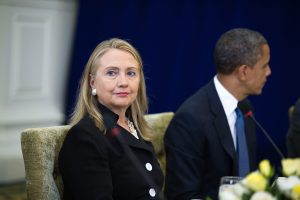
American secretary of state Hillary Clinton and President Barack Obama attend a summit of Pacific nations in Phnom Penh, Cambodia, November 20, 2012 (State Department/William Ng)
The week before election day is always nerve-wracking, this year’s near-apocalyptic feel notwithstanding.
So perhaps it’s fate that in the most contested election in decades, the gap between Hillary Clinton and Donald Trump is narrowing.
According to FiveThirtyEight, the Democrat enjoyed a 6.8-percent lead in the popular vote projection on October 18. As of November 2, it’s a 3.5-percent lead. The race is tightening.
Not that 3.5 percent is an insubstantial margin: FiveThirtyEight — the most Trump-favorable of the election models — projects that Clinton retains a seven-in-ten chance of victory. Those are solid (albeit not certain) betting odds.
Even the “Dewey Defeats Truman” beat-the-polls trope rings hollow. Yes, Harry Truman won reelection by a margin of 4.5 percent despite trailing by 3.5 percent in the polls (an 8-point swing). But as FiveThirtyEight points out, the fact that there are now exponentially more polls in the field — and almost seventy years of methodology improvement since then — we can’t reasonably expect such a monumental error to take place. (more…)
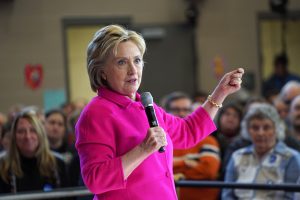
Former American secretary of state Hillary Clinton gives a speech in Iowa, January 23 (Hillary for America/Barbara Kinney)
Voting is an exercise in compromise. Any winner has to get the most votes — i.e., the “first past the post” system. I may believe my old professor, my local police captain, my boss or my well-read uncle would make the best officeholder in any particular election. But writing them in would be useless, since no one gets into office on the strength of one vote.
First past the post means that in the majority of American elections, only two candidates stand a plausible chance of winning: the Democrat and the Republican.
Does this limit our options? Of course. But a better system doesn’t (yet) exist, which means that when you vote for a third party, you abdicate your right to affect the outcome.
Third parties will tell you that viability isn’t the point. Voting for them sends an unfiltered, uncompromised message that your views are not represented by Democrats or Republicans. Instinctively, that makes sense. Who’s to tell you to vote against your conscience? And if both candidates are equally objectionable, is there harm done if withholding your support from one helps elect the other? (more…)
Whatever else can be said about the relative virtues of the two Democratic candidates running in the presidential primary election, the party should consider itself fortunate that the Republicans are about to nominate Donald Trump.
Clinton’s rival, Bernie Sanders, by comparison, enjoys a net favorability of +11.1, alone among all candidates but John Kasich in being in positive territory.
According to CBS, both Clinton and Trump are viewed more unfavorably than any major-party frontrunner in polling history. (more…)
The outcome of the Michigan Democratic presidential primary suggests Bernie Sanders might have a chance after all.
Although the Vermont senator did not win Michigan by a large margin, overcoming media expectations as he did on Tuesday night stands to give him the same “buzz” that a landslide would have.
Democratic senator John Kerry of Massachusetts speaks with President Barack Obama in the Oval Office of the White House in Washington DC, October 21, 2009 (White House/Pete Souza)
John Kerry’s ascension to the position of secretary of state isn’t just the culmination of one’s man career in public service. The successful nomination to this post of the man who went down to defeat against President George W. Bush in 2004, who many expected could lose his reelection at the time, is a reversal of fortune few could have anticipated eight years ago.
Kerry’s fast confirmation to the position he now holds, with the near universal support of Republicans who have not been in the business of supporting President Barack Obama, is not only a reflection of his own qualifications and expertise. It’s indicative of a sea change in American politics since the 2004 election and an admission from the right that the Kerry worldview was right all along.
Yet the anti-war crowd wasn’t always so ascendant. (more…)
Skyline of Las Vegas, Nevada (Shutterstock/Andrey Bayda)
Often forgotten amid the larger, classic swing states like Florida, Pennsylvania and Ohio, the American West is finding itself in a new position of prominence in the 2012 election and will likely retain that prominence as the country’s demographics shift in the Democrats’ favor over the coming years.
With the Midwest probably in President Barack Obama’s column and the entirety of the South probably in Republican candidate Mitt Romney’s (with the possible exception of Virginia), Tuesday’s election may come down to three states in the Rocky Mountains that all went for Obama in 2008, George W. Bush in 2004 and split between Bush and Al Gore in 2000.
The region was uncompetitive for Democrats in 2000, with the exception of New Mexico which Al Gore won by a mere five hundred votes that year. In 2004, the region was one of John Kerry’s many “backup” paths to victory (besides Florida and Ohio) that didn’t pan out. In 2008’s election between Obama and John McCain, it didn’t make the difference — preelection polls weren’t close and the election was effectively decided well before results came in from the West.
What will happen this time around? Recent history might offer a clue as to what we can expect — history as recent as the 2010 congressional elections. (more…)