Author: Ryan Bohl

  • Bashar Assad’s Big Push to Recover His Eastern Border

    Bashar al-Assad hadn’t had control of his Iraqi frontier for years. It’s a major headache; it’s allowed Sunni rebels to supply themselves from Anbar, a favorable route for Gulf states hoping to keep the war going.

    It’s also allowed the Islamic State to slide supplies from its shrinking Iraqi domains to its shrunken Syrian ones.

    The Islamic State famously demolished the literal border wall between the two countries. That was right after they blitzed across it to capture Mosul in June 2014.

    Now Assad’s Iranian and Iraqi allies are hoping to rebuild the border and thereby secure the regime they’ve fought so hard to preserve.

    From Reuters:

    Syrian rebels say the United States and its allies are sending them more arms to try to fend off a new push into the southeast by Iran-backed militias aiming to open an overland supply route between Iraq and Syria.

    The stakes are high as Iran seeks to secure its influence from Tehran to Beirut in a “Shiite crescent” of Iranian influence through Iraq, Syria and Lebanon, where Sunni Arab states have lost out in power struggles with Iran.

    The Iraqi-Syrian border already has a checkered history of security. It’s a long, sparse landscape full of Bedouin and smugglers used to crossing it at will. The Americans, for all their efforts, could not secure it during the occupation of Iraq from 2003-11. When the civil war began in Syria in 2011, it made sense that these wildlands would be some of the first to slip from government control. (more…)

  • Duterte’s Play for a Dictatorship

    When you yearn for a caesar, you more often than not get it. Such now is the price being paid by the people of the Philippines, who swept to power a man whose harsh authoritarianism was clear as day. As the southern island of Mindanao slips into chaos, Rodrigo Duterte’s not-so-subtle desire for absolute power has become all too obvious.

    From Reuters:

    “Anyone now holding a gun, confronting government with violence, my orders are spare no one, let us solve the problems of Mindanao once and for all,” said Duterte, who is from the island, after cutting short a visit to Russia and returning to Manila.

    “If I think you should die, you will die. If you fight us, you will die. If there’s an open defiance, you will die and if it means many people dying, so be it. That’s how it is.” (more…)

  • Saudi Arabia’s Culture Wars Strain the Kingdom

    The Saudi stereotype is bleak. Environmental desolation is mirrored by a cultural desert. Religious police meander between buildings, looking for victims. Women hurry between shadows behind their male guardians. The strict interpretation of Najdi Islam dominates nearly every aspect of life. It is a quiet, bleak place, with the only civic engagement at the mosque, whose loudspeakers are the only music the kingdom ever hears.

    It’s stark and it sticks in the mind. It is, of course, not totally true.

    Saudi Arabia’s approximately twenty million citizens may be dominated by those who wish the kingdom to look like that; they’ve done a bang-up job controlling the kingdom’s image. Yet beneath the surface, discontent stirs. (more…)

  • What the Hell Just Happened to Turkey?

    And “to” seems the right word, because this was done to Turkey by Recep Tayyip Erdoğan and his political machine. International electoral monitors cite fraud; so too does the powerful Republican People’s Party. That hardly matters, it seems. Turkish election officials will not allow a recount.

    And so even if cheated, it is a victory for Erdoğan. It has been a long road for a critical Middle Eastern nation. The geopolitical trajectory of Turkey is now set. (more…)

  • Why Russian Resets Keep Failing

    Vladimir Putin
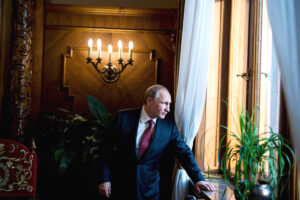
    Russian president Vladimir Putin looks out a window in Budapest, Hungary, February 17, 2015 (Facebook/Viktor Orbán)

    In short, if it wasn’t one thing, it would have been another.

    It didn’t have to have to be a gas attack. It could have been a stray Russian shell in some Ukrainian city, a dead exiled opposition leader on the streets of a Western capital city, a major hacking attack against a critical American target, a crucial NATO ally “flipped” by a Russian disinformation campaign or a released set of Trump e-mails.

    It could have been Donald Trump waking up one day to realize the Russians aren’t interested in destroying the Islamic State so long as IS distracts the Americans and grinds down anti-Assad rebels.

    It could have been when Trump tried to rally Moscow to support a new round of sanctions or military threats against North Korea.

    Perhaps Trump’s bromance might have ended with a shooting incident over Finnish skies or maybe he’d have changed his mind if Russian troops showed up in Libya to prop up Moscow’s increasingly favorited local strongman, Khalifa Haftar.

    The fact is, on a long enough timeline, he would have changed his mind or faced an all-out revolt from his cabinet, his generals and his party.

    The furor surrounding Ivanka Trump and Jared Kushner’s alleged influence over the airstrikes last week is therefore overblown. Presume then that they did not exist and that Steve Bannon continued to whisper pro-Russian lullabies in the president’s ear, even as critical NATO allies like the United States, France, Canada and Germany clamored for action.

    How long until the next incident? How long could Trump have kept ignoring his spy and military chiefs because Steve Bannon and his alt-right supporters said to? (more…)

  • Donald Trump Is Now a Real American President

    “Real” is not the same as “good”. “Real” means he is finally coming to understand America as a geopolitical entity.

    America is not a sports team; it is not a business. It is not a hero or a villain in some movie. It is a nation state.

    Its state is vast, made up of millions of individuals who gather to accomplish titanic, slow-moving goals.

    Its nation is even bigger: hundreds of millions who only see the narrow incentives of their daily lives, piling up into the interests of a superpower. (more…)

  • The Weird Worries of Sheikh Mohammed bin Zayed

    There he is again, the crown prince of Abu Dhabi, stirring up all sorts of trouble on the global stage.

    Sheikh Mohammed bin Zayed Al Nahyan, the de facto ruler of the United Arab Emirates, has been putting his fingers into too many pies lately. From mercenaries in Yemen to bombing runs in Libya to cozying up to Israelis, the UAE’s supreme commander defies just about every Middle Eastern geopolitical stereotype. He is no flag-burning theocrat, nor a chest-thumping Arab nationalist: he’ll kill jihadists, Muslim Brothers and Ba’athists equally, given the chance. (And torture Emirati liberals for good measure.)

    Now he’s been caught up in the middle of the Russia-Trump spy affair.

    According to The Washington Post:

    The United Arab Emirates arranged a secret meeting in January between Blackwater founder Erik Prince and a Russian close to President Vladi­mir Putin as part of an apparent effort to establish a back-channel line of communication between Moscow and President-elect Donald Trump, according to US, European and Arab officials.

    So far, it’s not proven that the Trump transition team had any knowledge of this meeting: Erik Prince apparently did it on his own volition. (Prince is also the brother of Betsy DeVos, Trump’s secretary of education.)

    Regardless, the fact that the UAE is even trying to set up back channels between the Russians and the White House goes to show the odd way the country is approaching the world.

    Unlike many states, all of this can be attributed to one man: Sheikh Mohammed bin Zayed Al Nahyan. Not to be confused with Mohammed bin Rashed, the ruler of Dubai, Mohammed bin Zayed has a very specific take on the UAE’s future.

    And he has a tale worth telling. (more…)

  • Donald Trump is Going to Love Egypt’s Dictator

    Call a spade a spade: Abdul Fatah al-Sisi is as much a president, with its democratic connotations, as Syria’s Bashar al-Assad. Egypt now rates a dismal 26 from 100 on Freedom House’s Freedom Index, just behind Qatar and barely above dysfunctional Iraq.

    Some may quibble that Sisi is more a “strongman” than a dictator; in terms of political outcomes, that’s the difference between holding rigged elections and having no elections at all.

    And now al-Sisi is coming to kiss the Trump ring. (more…)

  • How Climate Change Will Be the Biggest Geopolitical Crisis of the Century

    Russian Arctic tanker
    A United States Coast Guard icebreaker escorts a Russian tanker through the Bering Strait, January 6, 2012 (Coast Guard)

    America is out of the environmental protection businesses; so says the haughty God-Emperor Donald Trump, whose word is apparently law.

    Too bad even god-emperors cannot change facts. Too bad, especially, for the billions who are almost certain to be disrupted, displaced and decimated by the looming geopolitical effects of climate change.

    That basic truth is denied heartily by many who have incentive to play games for short-term gain. These are old-school industrial concerns, for whom environmental regulation hammers a bottom line; alt-right, alt-truthers, for whom simple science is a threat to their incoherent worldview; and shattered working classes, seeking a simple scapegoat for the complicated story of their economic dissolution and disenfranchisement.

    As written in Salon:

    The executive order is another example of the Trump Administration’s ignoring basic facts in service of a right-wing ideology rooted mostly in a blind, irrational hatred of Obama.

    Unfortunately for Trump, undoing Obama’s climate legacy will require more than the stroke of a pen.

    The science of climate change is so basic, however, that it is shaping geopolitical forces on a global scale. Whether those forces will overcome the denialists remains to be seen.

    Climate change will be the human event of the twenty-first century. It will be a shaping of our species unlike anything since the end of the last Ice Age. To presume that nation states, or their successors, will somehow carry on blithely in spite of it is naive in the extreme. (more…)

  • The Forces Shaping the French Election: Populism, Pride and Prejudice

    Paris France
    View of Paris, France from Montmartre, October 2, 2016 (Unsplash/Colin Maynard)

    And why is it so critical? Nothing less than the European Union is at stake — and with it, the geopolitical contract that has bound Germany and France together since World War II.

    After the defeat of anti-Islam populist Geert Wilders early this month in the Netherlands, it is reasonable to ask if populism as shaped by the alt-right has hit its limit. Europeans have watched the confusion in Britain over Brexit and the rise of Donald Trump. Now they are revisiting both their Euroskepticism and their willingness to gamble on ideologies not yet fully tested.

    Yet France is subject to powerful forces quite different than the Netherlands, which has only a fraction of its population and international obligations. A large, unassimilated Muslim and African population simmers; an aging, conservative voter base roils; a discredited, weakened left wavers; and nobody knows what to do with the neoliberal threads that hold together the European Union yet impoverish just about anyone not in the upper classes.

    All these factors make France a combustible mix of alt-right populism, weakened mainstream parties, terror cells, angry youth and dithering establishment elites. If we were shocked by Brexit, we should be less shocked by whatever happens next month as the French go to vote. France is as upended as everyone else. 2017 compares to the turmoil of the collapse of the Fourth Republic in 1958. (more…)

  • The Global History of the Alt-Right

    Matteo Salvini Marine Le Pen Harald Vilimsky Michał Marusik
    Far-right party leaders Matteo Salvini of Italy, Marine Le Pen of France, Harald Vilimsky of Austria and Michał Marusik of Poland give a news conference in Strasbourg, May 11, 2016 (European Parliament/Fred Marvaux)

    When I was a teenager, I had to drive my older brother to downtown Phoenix. He couldn’t drive himself; he’d made a series of poor life choices, so it fell to me, the relatively responsible one, to ferry him about.

    As we drove, he ranted to me about blacks, Mexicans and Jews, using all the tried and true tropes of the traditional white-supremacist right — tossing in, for my “education,” that the Bible had given blacks over to whites as slave-animals. When we pulled up to our destination, a Mexican guy was hanging out on the Phoenix equivalent of a stoop; my brother would have to pass by the guy. I asked him, in that teenaged point-blank manner, what he thought of the man.

    “Oh no,” my brother replied. “He’s one of the good ones.” Switching off from racist extraordinaire, he proceeded to carry out his errand and have a light, polite chat with the very man whose race he’d spent much of our journey together trashing.

    It was my first encounter with the doublethink that would swirl to become the alt-right. (more…)

  • America Has No Deep State. Egypt Helps Prove It

    Washington DC
    Skyline of Washington DC with the United States Capitol in the distance, September 28, 2017 (Ted Eytan)

    It’s become the phrase of the week: the deep state, a cabal of anti-Trump ideologues seeking a coup against a democratically-elected president hiding within the warrens of the CIA, State Department and any other agency that can be labeled as “shadowy”.

    The reputed deep state is the boogeyman of the Trumpistas frustrated that their president is unable to enact his agenda instantly and without opposition. (more…)

  • South Sudan is Starving Itself, But We Shouldn’t Rush to Judge

    There are no famines anymore, unless people want them.

    South Sudan is starving. As reported by Foreign Policy, the world’s newest country is also one of the world’s hungriest:

    On February 20, the United Nations declared a famine in parts of the country, saying that some have already died from hunger and another 100,000 people are on the brink of starvation. One million more are headed toward the same fate. “Our worst fears have been realized,” Serge Tissot, the UN Food and Agriculture Organization’s representative in South Sudan, said in a news release.

    In an age where Hobbsian scarcity has been nearly conquered, it is discomforting in the extreme to see starving children on HD video. Humans produce some 17 percent more food per person than thirty years ago, yet that means little to the South Sudanese.

    In the cruelties of its civil war, there are key geopolitical understandings to be had in South Sudan. Why do some countries starve? How can one African country peacefully reject a dictator while another pits two democratically elected leaders into armed conflict? How much blame does the rest of the world deserve and what does this say about the future of our species? (more…)

  • The Future of the Middle East is Turkey, Iran and Islamic Socialism

    Tehran Iran
    View of Tehran, Iran from the Milad Tower at night (Shutterstock)

    It may not seem it, what with the Islamic State’s suicide bombers lashing out, Israeli soldiers shooting wounded Palestinians and the war in Yemen grinding on, but the Middle East’s broad new outlines are starting to show.

    They appear in front of the Turkish tanks on their way to Raqqa; in the brightly-lit press conferences of the White House; in the ballot printing factories of Tehran and in the banks of Dubai.

    They are both a return to history and step further into it. Nation states founded on the borders of great empires are reasserting themselves and the assault on neoliberal economics will give way to Islamist socialism. (more…)

  • Syria’s Endgame

    It has taken at least 400,000 dead and over ten million internally and externally displaced Syrians, but we are finally coming to the end game of the Syrian Civil War.

    Last week, Turkey’s Recep Erdoğan blithely announced in a news conference that Raqqa, the capital of the Islamic State, would be the final target of the Turkish invasion.

    Today, Pentagon sources leaked that the United States might send large combat forces into Syria.

    This comes on the heels of talks between Iran, Turkey and Russia aimed at ending the conflict.

    At long last, a confluence of interest is emerging that is the beginning of the end of the Syrian Civil War. (more…)