Author: Christian FitzHugh

  • Venezuela Is Starving and Still Maduro Clings to Power

    Nicolás Maduro is still president of Venezuela. That may not sound like news, but in the six years he has been in power, he has so poorly managed the economy, with increasingly authoritarian measures, that GDP has shrunk 60 percent, inflation has reached an astronomical 10 million percent, once forgotten diseases have returned, 4.5 million Venezuelans have fled the country and 90 percent of the remaining population lives in poverty. It’s the worst economic collapse outside of a civil war.

    Little wonder mass protests have been a recurrent aspect of Maduro’s administration, but so far all attempts to remove him have failed.

    Maduro only won reelection in 2018 after arresting opposition presidential candidates, sidelining the opposition-controlled legislature and most likely rigging the vote.

    In January, Juan Guaidó, a social democrat and president of the National Assembly, took the extraordinary step of invoking Article 233 of the Constitution to declare himself interim president and call for early elections. (more…)

  • Macri’s Failure Returns Peronists to Power in Argentina

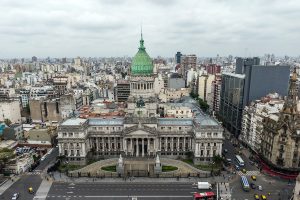
    Argentinian Congress Buenos Aires
    Palace of the Argentine National Congress in Buenos Aires (Unsplash/Nestor Barbitta)

    Mauricio Macri will vacate the presidency of Argentina next month after a disappointing term in office and a first-round defeat to Peronist candidate Alberto Fernández.

    Fernández won by bringing the controversial former president Cristina Fernández de Kirchner into the fold as vice president to help unite the moderate and leftist strands in his party. That unity will be tested by a severe economic crisis. (more…)

  • Millions Flee Venezuela, But Maduro Is Going Nowhere

    Twenty years have passed since Hugo Chavez’ Bolivarian Revolution began in Venezuela. Although the first decade halved unemployment and brought poverty levels down to 27 percent, under President Nicolás Maduro there has been a dramatic economic, political and social decline.

    Inflation has skyrocketed and is expected to reach 1,000,000 percent this year. Shortages of basic goods have resulted in widespread malnutrition. The outbreak of previously forgotten diseases and violence has reached unprecedented levels. 73 lives are lost per day.

    This, combined with a political system that has barred and arrested opposition presidential candidates, sidelined an opposition-dominated legislature and last year carried out an election marred by an opposition boycott and claims of vote-rigging, has led to an exodus of almost 10 percent of Venezuela’s 30 million population. 90 percent of those who remain live in poverty.

    With such a parlous state of affairs, how has Maduro kept the show on the road?

    And why haven’t Venezuela’s neighbors, who are sheltering most of its refugees, acted to end the misery? (more…)

  • AMLO and Trump: Useful Scapegoats or Unlikely Allies?

    Mexico’s new president, Andrés Manuel López Obrador (AMLO), looks like the perfect adversary for Donald Trump. The American represents the financial elites and inequality AMLO has railed against his entire career whereas he himself embodies the hopes of Mexico’s poorest, many of whom have sought a better life in the United States — and who have been disparaged by Trump as criminals and rapists.

    But the two leaders also share traits: a populist style, policy light on detail and nostalgia for a bygone era.

    The two have avoided a confrontation on trade. Immigration and security provide more opportunities for compromise — but could just as easily cause the relationship to come unstuck. (more…)

  • Is Brazil’s Bolsonaro the Trump of the Tropics?

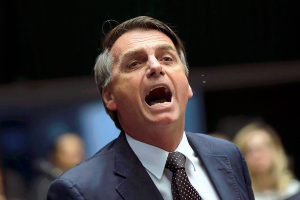
    Jair Bolsonaro
    Jair Bolsonaro makes a speech in the Chamber of Deputies of Brazil, September 14, 2016 (Agência Brasil/Marcelo Camargo)

    Brazil is the latest country to lurch toward right-wing nationalism. When Jair Bolsonaro resoundingly defeated his left-wing opponent, Fernando Haddad, in the country’s presidential election last month, news whirled around the world reporting this was Brazil’s Donald Trump.

    Bolsonaro is certainly keen to be Trump’s partner in Latin America. But is the comparison apt? And is it helpful to view each new iteration of right-wing nationalism through the Trump prism? (more…)

  • Stakes High for Colombia’s Presidential Novice

    Last month, 41 year-old Iván Duque was elected as Colombia’s youngest president ever with the largest vote in the country’s history.

    Turnout, at 53 percent, was the highest since 1998. The elections came on the heels of an historic peace deal with the far-left Revolutionary Armed Forces of Colombia (FARC), ending half a century of conflict. (more…)

  • Brazil’s Presidential Election Is Up in the Air

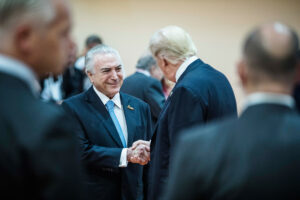
    Michel Temer Donald Trump
    Presidents Michel Temer of Brazil and Donald Trump of the United States meet at the G20 in Hamburg, Germany, July 8, 2017 (Bundesregierung)

    Brazil’s presidential election is less than four months away, yet it’s still far from clear what will happen. (more…)

  • With the Castros Gone, Is Change Afoot in Cuba?

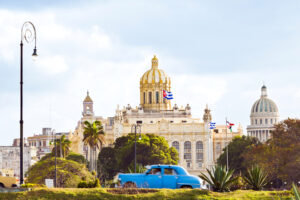
    Havana Cuba
    Skyline of Havana, Cuba (iStock/Spooh)

    The appointment of a new president in Cuba, Miguel Díaz-Canel, sixty years after the island’s socialist revolution, feels like a turning point.

    Once anointed by the 605-strong National Assembly as Cuba’s first non-Castro president in decades, Díaz-Canel vowed to modernize the economy and make government more responsive to its people.

    What does the change mean in practice?

    Not having a Castro, neither Fidel (1976-08) nor Raúl (2008-18), as leader carries with it great symbolism for sure. For the first time in many years, the powerful roles of president and head of the Communist Party are no longer combined. (Raúl remains party leader for three years.) But the Castro years weren’t quite as monolithic as they are sometimes portrayed and the next few years are unlikely to see a turnaround. (more…)

  • What You Need to Know About the Election in Mexico

    Mexico’s general election on July 1 will involve roughly 3,400 new elected officials taking office and $2 billion in campaign finance. It has been dubbed the biggest election in Mexican history.

    It is important not only in terms of scale, but in terms of its new rules. For the first time, the ban on reelection does not apply and independent candidates can run.

    This heightened capacity for change coincides with an electorate moving from apathy toward anger. Last year, only 18 percent of Mexicans told pollsters they were satisfied with their democracy, down from 41 percent in 2016. Institutional confidence is at a nadir.

    Concerns about violence and insecurity related to drug cartels and organized crime are now coupled with deep frustrations about corruption and impunity as well as lopsided relations with the United States. (more…)

  • Piñera Back, But Chileans Need Convincing

    Sebastián Piñera unsurprisingly won back Chile’s presidency last week, defeating the governing party’s Alejandro Guillier in a runoff.

    Piñera last ruled the country from 2010 to 2014 but was constitutionally barred from serving a consecutive second term.

    What was surprising was the scale of his victory following a weak performance in the first voting round, where left-wing candidates got a combined 55 percent of the votes. (more…)

  • No Shock Therapy: Macri Takes Gradual Approach to Reform

    Mauricio Macri Michel Temer
    Presidents Mauricio Macri of Argentina and Michel Temer of Brazil answer questions from reporters in Brasília, February 7 (Palácio do Planalto/Carolina Antunes)

    Argentina’s Mauricio Macri and his coalition have reasserted their position as the party of government following last month’s midterm elections. The first conservative to win the presidency since democracy was restored in 1983, his supporters won majorities in thirteen out of 23 provinces. They have also taken charge of five of the most populous districts in the capital Buenos Aires.

    Yet Macri’s party, Cambiemos (Let’s Change), still doesn’t have a majority in Congress, which helps explain his step-by-step approach to reforming the economy. (more…)

  • Chile Shows Better Way to Neighbors in Crisis

    Whether change comes swiftly or slowly, a deafness to cries for change can discredit not just politicians or political parties but whole systems of government.

    This has already happened in Venezuela. It’s in the process of happening in Brazil. Chile, however slowly, is showing a better way. (more…)

  • Venezuela Lurches Toward Authoritarianism

    Venezuela has plummeted to new depths. In an act of blatant disregard of the separation of powers, the Supreme Court has stripped the opposition-controlled National Assembly of its lawmaking power and revoked immunity from all assembly members after accusing parliamentarians of “contempt”.

    This latest step toward authoritarianism was denounced as a “coup” and “a final blow to democracy” — not just by opposition parties, but by the international community and even some within the government (the state attorney general).

    It was this broad consensus that brought about a hasty volte face within a matters of days. President Nicolás Maduro reversed the judiciary’s decision in order to “maintain institutional stability”. (more…)

  • Trump Could Bring Enemies in South America Closer Together

    The alliance between Cuba and Venezuela has lost prominence in recent years as the former normalized its diplomatic relations with the United States while the latter doubled down on a self-described anti-imperialist policy.

    Now Donald Trump’s presidency threatens to bring the two countries closer together again.

    Trump, who assumed power last week, has pledged to reverse the Cuba policy of his predecessor “unless the Castro regime meets our demands”.

    Rex Tillerson, Trump’s secretary of state and the former boss of ExxonMobil, has an acrimonious history when it comes to Venezuela.

    Nicolás Maduro, the Venezuelan president, has said Trump — a fellow illiberal strongman — can be no worse than Barack Obama. But that’s probably not how the Cubans see it. (more…)

  • Political Victory for Temer During Anxious Times for Brazil

    Brazil’s president, Michel Temer, scored a major political victory last week when Congress passed a constitutional amendment that limits public spending for the next twenty years.

    This was no small feat, given that 63 percent of Brazilians, according to one recent poll, want Temer out.

    At the same time, right-wing parties, which support his austerity program, prevailed in municipal elections in October at the expense of the long-ruling Workers’ Party. (more…)