
Author: Abhijit Iyer-Mitra

  • Structural Impediments to Closer Indo-American Relations

    Barack Obama Naredra Modi
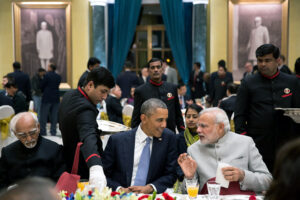
    American president Barack Obama speaks with Prime Minister Modi of India during a state dinner at the presidential palace in New Delhi, January 25 (White House/Pete Souza)

    American president Barack Obama’s recent visit to India supposedly saw the conclusion of some far-reaching agreements, including on defense cooperation, specifically missile defense, technology transfer and the operationalization of the dormant nuclear agreement Obama’s predecessor, George W. Bush, negotiated with India in 2005.

    All of this cements the image of India’s new prime minister, Narendra Modi, of being both a strategic thinker and a doer.

    But this is at the political level. At the operational level, things are controlled by a bureaucracy that remains deeply anti-American and is ingrained in leftist nonaligned thought. It may well fail to implement or even block the implementation of the latest agreements.

    The clearest sign of the Indian bureaucracy’s ingrained anti-Americanism came from the visible euphoria of officials who were part of the negotiations. This in spite of the fact that no public announcements were made. (more…)

  • After Month of Unrest, Pakistan Back to Square One

    For the last month or so, most of South Asia has been transfixed on the situation in Pakistan. Except for minor diversionary hiccups involving the Islamic State and its victories in Iraq, the subcontinent’s media has been focusing on the shenanigans of Imran Khan and Muhammad Tahir-ul-Qadri — before predictably losing interest and moving onto other things.

    In Pakistan, the press found mundane stories to report, such as the forced deplaning of former interior minister Rehman Malik by the irate passengers of a Pakistan International Airlines flight that was delayed because of him. In India, prime ministerial visits to Japan and Chinese presidential visits to India grabbed the headlines while in Sri Lanka, a dispute with trespassing Indian fishermen quickly took over.

    The waning interest, even in Pakistan, is symptomatic of the merry go round that is Pakistani politics. What we see is not any real movement to change the status quo but rather the usual shadowboxing of civil-military relations that is now in its umpteenth rerun. (more…)

  • Kayani’s Succession Follows Familiar Pakistani Pattern

    Pakistani general Ashfaq Parvez Kayani achieved rather little during his six years as army chief while his replacement this week brings back painful memories of past mistakes and missteps.

    Kayani was General Pervez Musharraf’s successor as chief of Army Staff. When he took over in 2007, he was hailed, as is usual in the Pakistani press, as a reformer, a realist, apolitical and whatnot. By Pakistani standards he certainly was, given that the country had its first peaceful democratic transition of power under his watch. He is also credited with unverified reports of midnight diplomacy between politicians and judges to stave off a constitutional crisis.

    But militarily he was no reformer. Pakistan’s green book, believed to be the core doctrine of army thought, retains its focus on India. This showed in Kayani’s conduct of counterterrorist operations. Pakistani troops remained just as deliberately ineffective in fighting the Taliban and other radical groups. (more…)

  • India’s Conservative Leader Modi Outmaneuvers Rival

    After a disastrous election defeat and a stint as absentee leader of the opposition, Lal Krishna Advani finally resigned from India’s opposition conservative party on Monday at the culmination of its national conference held in Goa. That conference was meant to sew up the final minutiae of the Bharatiya Janata Party’s electoral strategy for next year’s general election. The Indian press labeled the resignation as some kind of major churning being set in motion.

    Ostensibly this churn is a result of the meteoric rise of Narendra Modi, the supposedly divisive chief minister of Gujarat state. Advani, as the story goes, believed Modi’s divisiveness to be detrimental to the party’s electoral prospects. The reality is that Advani, like most Indian politicians, used identity politics to further his own career. This had little to do with inclusiveness and everything to do with an internal power struggle. (more…)

  • Cabinet Reshuffle Changes Little in India’s Political Outlook

    Sunday saw one of the biggest midterm cabinet shakeups in India since the United Progressive Alliance formed the government in 2004. The reason it is considered “big” is largely due to the fact that it heralds a generational change and lowers the average age of the cabinet.

    The specifics of the cabinet reshuffle are less important than the power structure of the ruling Congress party and the electoral and structural dynamics of the country.

    The National Congress has in its second term lost significant sympathy as a result of a nigh total policy paralysis and almost daily stories of monumental corruption, causing a string of electoral reverses in state elections.

    True power in the party rests with its president, Sonia Gandhi, who is not a member of the government. The split between executive and political power seldom works since in most cases, Gandhi can veto any decision that is made by Prime Minister Manmohan Singh. No change was made in this party structure on Sunday so the fundamental political outlook of the Congress cannot have changed either. (more…)

  • India Sends Message to Washington from Tehran

    The Nonaligned Movement has historically been seen as something of a talk fest — high on statements, missing in action and lacking in cohesion.

    This week’s summit in Tehran, while mostly living up to the stereotype, was nevertheless important because of what was not said.

    Of the 120 member states, only 29 sent their heads of government to Iran. President Mahmoud Ahmadinejad chose a reasonably befuddled topic as the theme of the summit — “Lasting peace through joint global governance” — as if either of those will ever materialize. But in spite of one expensive exercise in whispering sweet nothings, one message was being conveyed loud and clear — and that was to the United States by India. (more…)

  • The Great Farce of Pakistani Politics

    Recent developments in Pakistan have been variously characterized as a “judicial coup,” a “prelude to a coup” (or not, depending on the commentator), an anti-corruption crusade, a personality clash, a vendetta, an intelligence agency conspiracy and a military-judicial collusion. This plethora of views is best encapsulated by the conclusion to the poem The Six Blind Men of Hindoostan.

    So six blind men of Hindoostan
    disputed loud and long,
    Each in his own opinion
    exceedingly stiff and strong;
    Though each was partly in the right,
    they all were in the wrong!

    It is far too easy and a crude oversimplification to blame the “military” for Pakistan’s ills. The problem with Pakistan has always been systemic which is why history repeats itself time and again, usually as a farce, which is what this latest “crisis” is. (more…)

  • China Plays Energy Security Card in India Relations

    The Chinese and Indian state hydrocarbon monopolies signed a far-reaching agreement last week envisaging cooperation across the gamut of activities from exploration to the point of sales. This brings into play several business synergies but geopolitically, it throws up many conundrums and opportunities.

    Two possibly related developments have to be kept in mind here. India last month withdrew from its allotted exploration blocks in the South China Sea, widely seen as capitulating to Chinese pressure. Almost simultaneously, India’s defense minister Arackaparambil Kurien Antony delivered one of India’s harshest condemnations of China at the Shangri La summit in Singapore, in effect joining the ring of naval containment emerging around China.

    Both China and India are heavily dependent on sea lanes for their energy security. (more…)

  • India Stops Hedging, Backs American Naval Strategy

    Most dull speeches are ignored but a few mask statements of such enormity that their importance is lost.

    In that context, Indian defense minister Arackaparambil Kurien Antony’s words at the Shangri La 2012 summit were borderline genius.

    Unlike in previous centuries, maritime freedoms cannot be the exclusive prerogative of a few. Large parts of the common seas cannot be declared exclusive to any one country or group. We must find the balance between the rights of nations and the freedoms of the world community in the maritime domain. Like individual freedoms, the fullness of maritime freedoms can be realized only when all states, big and small, are willing to abide by universally agreed laws and principles.

    The sheer innocuousness of these statements mask their potency in the Indian context. The basic summary was that India stopped hedging and threw in its lot with America. (more…)

  • Eurofighter: The Great German Backstab

    As David Cameron’s now infamous veto of a treaty for greater fiscal integration in the European Union, the leaders of France and Germany bonded closer, overcoming to a large extent their difficult personal chemistry.

    Thousands of kilometers away in India, this realignment coincided with the victory of the French-made Dassault Rafale in India’s Multi Role Medium Combat Aircraft (MMRCA) contest. The emerging schism which the tantrum was symptomatic of, had already begun to play out in India.

    The MMRCA contest has been India’s biggest fighter contest of this century, worth about $20 billion or $60 billion if spread out over the next thirty years. It coincided with a similar quest for a new fighter jet in Japan.

    The Eurofighter also participated in both contests. Italy and Spain, junior partners in the joint fighter project, took a backseat while Germany took the lead in India (unusually, given that the British are much more familiar with it) while the British were given charge of the Japanese campaign (again, unusual, since the Germans consider themselves to have penetrated the Japanese psyche more). (more…)

  • Eyeing China, India Strains Relations with Sri Lanka

    India’s support for an American-sponsored resolution at the United Nations Human Rights Council that condemned the government of Sri Lanka signifies a complete reversal of a decades-old policy.

    As irrelevant as Sri Lanka may seem strategically and in terms of resources, geopolitical stakes are playing out on what what would seem to be but a mild rebuke of Sri Lanka with little by way of actual consequence for the perpetrators of war crimes.

    China’s calculus is straight. Hemmed in by overwhelming American naval superiority and the fleets of Japan and Korea, its efforts at acquiring power projection capabilities have set off the same kind of opposing dynamic that German and Russian admirals Alfred von Tirpitz and Sergei Gorshkov triggered, reinforcing the offshore balancer.

    The Malacca Straits are a vital energy jugular of China’s economy and hence its rise. India’s emerging naval strategy seems, gauged both from procurement plans as well as the strengthening of Andaman’s joint air-naval command, directed at choking this jugular. China’s trump card, Pakistan, is now in the throes of disintegration moreover, its strategic utility seems lost, while Burma, due to a significant overdose of Chinese “soft power,” has run into India’s arms.

    Thus Sri Lanka emerges as China’s new strategic pawn more out of necessity than choice. Analogically, it is India’s Cuba, a mere irritant without nuclear weapons. Insufficient in national power and having no nuclear ambitions, its usefulness as an ally — at least the “crazy” independent kind which the Chinese seem to prefer — is limited. It does not posses a disproportionate ability to wreak havoc or tie down regional powers.

    What is more, the Sri Lankan economy is too dependent on Indian goodwill and supply routes to deal with a American style trade embargo. At best, it can be China’s “Albania” to draw in another analogy; strategically inutile and of dubious rhetorical value but requiring China to expend vast diplomatic resources.

    India’s Sri Lanka policies have largely been driven by paranoia surrounding the rise of China, stoked in no small degree by the budget hungry but intellectually deficient armed forces.

    This phenomenon has been exploited successfully in the past by Sri Lankan politicians to either extract concessions from or to relieve pressure applied on them by India.

    Some Indian commentators have exaggerated this development to suggest that Sri Lanka has somehow “successfully balanced” against India. As a result, New Delhi’s options to help Lankan Tamils have been completely paralyzed by dubious grand strategy analyses — overcompensating for every Chinese move and appeasing the Sinhala majority.

    This overcompensation has now produced a furious centripetal reaction from India’s Tamil Nadu state. Here, the state ruling party and opposition have joined hands to blackmail a severely weakened central government into executing a policy U-turn. This reversal is a stark departure from uncritical support of the Sri Lankan government last week to supporting a harsh condemnation of it the following

    In the final analysis, all three parties have overplayed their hands.

    China overplayed the Sri Lanka card and did so too soon to the point that it now faces being cornered, supporting a country that can provide it no tangible benefits in the foreseeable future.

    Sri Lanka in its attempt to thwart Indian support for Tamil rights overplayed the China card and demanded too much from India.

    India overplayed the China threat and has now been forced into a humiliating retreat by small regional parties within India’s polity.

    Some good may yet come of this forced construct of a China-Sri Lanka axis. As the former prime minster of Nepal Surya Bahadur Thapa used to say, “Nepal is surrounded by dogs, the one to the south barks but does not bite, the one to the north does not bark but bites viciously.”

    Sri Lanka is going to learn the Nepal lesson the hard way opting for an ally that can only realistically support it at diplomatic fora. As the lessons of Pakistan and North Korea show, China never pays the bills at the end of the day.

    China is now faced with the bloated cost of maintaining an ally that is incapable of realistically bringing synergies to the grouping. India on the other hand learns a good lesson; that China’s abilities must be viewed realistically and analyzed without hysteria.

    Sri Lanka has two options. One is to make good on its China threat with all the attendant liabilities. The other is to capitulate to India.

    The problem lies with India, which in spite of its delirious view of itself as a benign power was and is an insufferable regional bully. Like a man eating tiger that can never turn back once it has tasted human blood, the taste of victory in Sri Lanka will in all probability lead to triumphalism and the inevitable clumsily overplayed hand — the hallmark of Indian diplomacy, which will in turn set in motion a new round of regional balancing in the subcontinent.

    Correction: An earlier version of this story erroneously referenced the United Nations refugee agency instead of the United Nations Human Rights Council.

  • India’s Iran Policy Starting to Mirror Its Israel Policy

    A slow but sure shift can be observed in India’s Iran policy. What is curious about this is that in many ways, India’s Israel policy seems to be the blueprint.

    The Indian government still emphasizes the significance of Iranian oil and gas buys. This position is bolstered by Saudi Arabia’s refusal to boost output last week in anticipation of an expected drop in Iranian exports. Following a beggars can’t be choosers logic, New Delhi has refrained from joining an embargo of Iranian crude despite heavy Western pressure to do so.

    Reports have surfaced of sanctions being threatened against India for its obstructionism in this regard. The nature and substance of these sanctions remains unknown. The United States State Department though, in an unusual step, rather than squelching the rumors, added fuel to the flames, stating merely that reports to this effect were “highly speculative.”

    There are two implication of such a threat being held over India. (more…)

  • What India’s State Elections Mean for the West

    India’s ruling Congress party was trounced in recent state elections especially in the all-important province of Uttar Pradesh. The trends reinforced by the results portent trouble for both India and the West.

    First, chances of India joining the Iran embargo have ended — the dynamics explained earlier at the Atlantic Sentinel.

    Almost on cue as news of the Congress defeat started filtering in, the Indian embassy in Washington went on an unusually aggressive defense of its Iranian oil imports. It claimed a “distorted picture of New Delhi’s foreign policy objectives and energy security needs” was being projected.”

    India’s relationship with Iran is neither inconsistent with nonproliferation objectives, nor do we seek to contradict the relationships we have with our friends in West Asia or with the United States and Europe.

    But the sting was in the tail. “Given the imperative of meeting the energy needs of millions of Indians, an automatic replacement of all Iranian oil imports, is not a simple matter of selection, or a realistic option.”

    There was some number juggling there to show India’s consumption of Iranian oil had decreased of late. The reality is that the decline was due to the inability to pay Iran electronically (as is the norm) because of international sanctions.

    Now that a rupee trade agreement with Iran has come into force, expect the graph to skyrocket again. No amount of innovative statistical interpretations is going to be able to explain it away. In fact, given the consolidation of Muslim votes (long seen as a captive Congress vote bank) away from the Congress in Uttar Pradesh, any Indian moves against Iran are a nonstarter.

    If this were not bad enough, the policy paralysis that has gripped Delhi since 2009 will continue since the Congress’ bargaining position with its own left-wing allies has reduced dramatically.

    The return of India to the notorious 6 percent “Hindu rate of growth” coincided with a London School of Economics study on “Why India Will Not Become a Superpower.” In short, if the Western alliance was hoping for a demographic, democratic and economic bulwark against China, India will not be it.

    With prolonged policy paralysis and a looming water and food crisis on the horizon, expect the “rise of India” to turn into something of a nightmare.

    Forget also the American-Indian nuclear accord hailed by President George W. Bush as “India’s passport to the world,” which is now not expected to move forward due to opposition to the liability clause.

    Forget also the implementation of the Walmart direct purchase model, that was set to break the baneful influence of middlemen (a prime cause of inflation) and provide a much needed stimulus to agriculture as the Congress is expected to want to keep these middlemen in its good grace. They can, after all, engineer a “strategic” preelection price spike to wreck what little hope the Congress has left. Basically India is in soup and the West bet on the wrong horse.

    To be fair, all these trends existed well before these elections. The problem is that the behavior that produced these trends are expected to be reinforced now rather than producing the predicted corrective reforms a Congress victory was to have heralded.

    Two more important states go to the polls of which Gujarat may be the key. By all predictions Gujarat will stay with the conservative Bharatiya Janata Party under the leadership of Narendra Modi, a no nonsense development man who has maintained the state’s growth rate even under trying circumstances at a stellar 11.6 percent.

    Should the conservatives elect Modi as their leader for the 2014 elections, he will be pitted against the severely underperforming Rahul Gandhi, the Congress’ crown prince.

    The problem is that Modi is weighed down by allegations (nothing yet proven) of his complicity in the 2002 Gujarat riots. Modi, chief minister of Gujarat, the West could snub and name call publicly. But as the possible claimant to the largest democratic mandate on Earth, the West will face a very different problem if he is elected. India will never be Austria and Narendra Modi will never be Kurt Waldheim. Any criticism of him has thus far been painted by his campaign as an insult to all Gujarat and the focus of this demagoguery will presumably shift as he moved to the national stage to focus on external enemies.

    In many ways, if India is repainting itself into geostrategic and economic irrelevance, the wWst has blundered badly. Continuing to pressure India on Iran will only lead to further political paralysis in Delhi with significant long-term strategic consequences.

    At any rate, come 2014, the West will either have created a passively noncooperative left-wing India or a passively hostile right-wing one.

  • Libya: French Soft Power in Retrospect

    If a state possesses sufficient “soft power,” it has acquired the ability to frame and shame events and actors in international relations. The ability to frame enables the protagonist to package a debate in terms that are conducive to its own interests. The power to shame refers to the possibility of trapping other countries rhetorically and changing their behaviour.

    The French role in last year’s intervention in Libya was a perfect example. (more…)

  • Internal Politics Prohibit India from Joining Iran Embargo

    India, despite its growing closeness to the West, will not support further sanctions on Iran or abide by the Western oil embargo. This was made abundantly clear to visiting dignitaries through the last two weeks. Many reasons exists that have been discussed elsewhere including the economics of having a captive supplier with little propensity to negotiate and the realpolitik angle of encircling Pakistan and its Taliban proxies.

    There is also the much more calculated but never stated in public rationale of neutralizing Sunni influence (which Indian policymakers in private see as deeply malignant) with a Shia bomb.

    The overwhelming reason however — as all things are in India (something the West tends to forget) — is domestic electoral politics, both sectarian and economic.

    Given that 2012 marks the start of a string of provincial elections in India’s most important swing states leading up to the general elections of 2014, the stakes are too high to allow flimsy considerations like foreign policy or alliance dynamics to overtake all-important power equations on the home turf.

    As is the case throughout South Asia, the Sunni-Shia spilt in India stands at a 7:3 ratio. But unlike the repressed and economically depressed Shia in other Sunni majority states, in India, Shiites are way ahead economically socially and politically.

    This dominance is very discreet given that the various Shia groupings in India tend to maintain a low profile and avoid issuing a slew of regressive fatwas concerning anything and everything under the sun. Politically however, precisely because they are so progressive, herd voting behavior is virtually nonexistent amongst the Shia.

    In recent years, India’s Shia have started showing a tendency to vote for the opposition conservatives, especially in Kashmir Province. This forms an invaluable vote bank for the Bharatiya Janata Party, desperate to cultivate the minority vote — ergo for the opposition any alienation of Iran would be electoral suicide given that Islamic pan-national concept of ummah encourages Indian Shia to cherish their kinship with their Iranian coreligionists.

    The Indian Sunnis on the other hand are among the most economically and socially depressed sections of Indian society and their voting patterns are controlled by key religious leaders with significant evidence of “loyalty transferability” on demand. These leaders form the key support blocks of the ruling Congress party as well as large segments of the left. The problem comes in because the Shia not having a block voting pattern also constitute a large support base for the Congress and alienating Iran can only be carried thus far and no further.

    Economically, given the dire straits Iran is in, it will be hard for another supplier to match the prices or payment terms that Iran provides. The more disadvantaged Iran’s international position, the more India’s leverage grows.

    The rupee trade agreement with Iran under which Iran will accept barter and/or rupee payment for upto 45 percent of its petroleum exports to India (and provide added economic stimulus in India) stands as the prime candidate for renegotiation as Iran’s bargaining position worsens.

    Moreover, Iranian isolation helps India’s case in urging Iran to decouple oil and gas prices which would then see the now dead submarine Iran-India pipeline return to economic and security viability.

    All this feeds into the fact that in India’s electoral math, the rural voter is king. Much of India’s rampant food inflation has to do with skyrocketing oil prices and consequently the high cost of transport — and the Indian rural voter does tend to vote on bread and butter issues. The loss of Iranian oil and the favorable pricing it offers translates into a price spike that however temporary, no political party would want to have to deal with on election eve.

    In effect therefore while American and European sanctions seem rational and logical to the West, in Delhi, the call to follow suit is simply an invitation to electoral harakiri. Change in India’s Iran policy if at all it comes will have to wait until after the 2014 elections.