
Author: Christopher Whyte

  • American Bomber Overflights Challenge Chinese Air Control

    American Japanese fighter jets
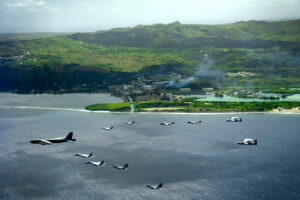
    An American B-52 Stratofortress bomber leads a formation of American and Japanese fighter jets over Guam, February 21, 2011 (USAF/Angelita M. Lawrence)

    America sent a strong signal on Tuesday of its position in a territorial dispute between China and Japan when it conducted bomber overflights of the Senkaku Islands. The island chain has been at the center of tensions in the Sino-Japanese relationship for some years and lies at the heart of an Air Defense Identification Zone that China declared just days ago.

    Chinese authorities’ announcement of the ADIZ unilaterally requires all aircraft wishing to operate within a broad zone of the East China Sea to register their flight plans and other identifying information ahead of time. Failure to comply would, according to the government in Beijing, lead to proportionate responses from its armed forces. The implication being that this applies to the military and merchant aircraft that regularly service and patrol the Senkaku Islands which are administered by Japan and known in China as the Diaoyu Islands. (more…)

  • America’s Cool New Destroyer, Coming Soon

    The United States Navy’s coolest and most controversial new surface combatant is just months away from leaving drydock at the General Dynamics Bath Iron Works in Maine, according to Navy officials, despite delays caused by the recent government shutdown.

    The USS Zumwalt, the first of the new DDG-1000 class of destroyer, is expected to put to sea for tests and shakedown in the first few months of 2014, moved back from the original October 19 launch date.

    At a little more than 15,000 tons at full displacement, the Zumwalt will be one of the biggest non-aircraft carrying surface combat ships to be produced by the United States since the Second World War. The class features a new “tumblehome” design, which will improve upon ship stability by allowing new destroyers to pierce and pass through waves rather than cresting them, as well as extremely advanced electronic warfare systems that might be adapted to carry new types of weaponry developed in the future. (more…)

  • What Iran’s New Drone Aircraft Mean for Israel

    During televised press briefings on the 33rd anniversary of the Iran-Iraq War and with demonstration videos on hand, the Islamic Republic of Iran last week announced the production of three lines of unmanned aerial vehicles (UAV) that could see deployment within the year. The drones, dubbed the Yaseer, the Ra’ad-85 and the Shahed-129, have apparently been designed to perform in both reconnaissance and combat roles and will allow Iran greater capacity to monitor and enforce activities at home and, potentially, across the region.

    UAV technology has not, until now seemingly, been effectively deployed by Iran. Patrolling sovereign airspace and undertaking aerial strike missions, like those prosecuted during the Iran-Iraq War, has for years been the responsibility of Iran’s missile corps and, with aging planes like the F-14 Tomcat and the MiG-29, the air force’s manned fighter fleet.

    New unmanned systems would, if feasible in their deployability, allow for a significant expansion of the country’s capacity to both gather intelligence and surgically project power at home and in its near abroad. After all, from the lightly built Yaseer to the heavy Shahed, each of Iran’s new drone systems will have advanced reconnaissance suites, including high resolution cameras and communications equipment, as well as the capacity to launch precision strike munitions. (more…)

  • New Choppers, New Capabilities on the Horizon for US Army

    After more than fifty years of remarkable service from helicopter combat and airlift platforms like the Apache and the Black Hawk, the United States Army has taken the first crucial step toward obtaining replacements for decades to come. The Army’s Aviation and Missile Research, Development and Engineering Center recently issued four contracts to major development firms to begin work on designs for a family of future helicopters that would be phased into service sometime after 2030.

    Development of the “next generation” family of helicopters will begin immediately and testable prototypes are expected by 2017. The new choppers will eventually replace all current medium-lift platforms and the vast majority of those combat models presently in use. (more…)

  • Navy’s Drone Carrier Test Points to Robotic Warfare Future

    A milestone in the development of unmanned aerial technologies was passed recently when the United States Navy’s sea based drone strike platform, the experimental X-47B, was successfully launched from and recovered aboard an aircraft carrier.

    Testing of the Navy’s prototype drone took place aboard the USS George H.W. Bush and mirrored earlier tests undertaken at the Naval Air Station Patuxent River in Maryland. As was the case in previous trials, this most recent undertaking examined the plane’s ability to take off and land using the assistive catapults and wires needed to fly from seaborne runways. Unlike earlier trials, however, this test was without simulated variables — the drone was actively tasked to consider and calculate the movement of a ship at sea.

    The success of the test is significant for a number of reasons. Perhaps foremost among these is the way in which the Navy test — in essentially proving that launching drones from aircraft carrying ships is viable — highlighted America’s relatively near term ability to field the advancing capabilities of unmanned planes like the X-47B and those future variants likely to be designed around it.

    Unlike the fleet of drones utilized by the United States in recent wars in both global surveillance and surgical strike roles, this new generation of drones exhibits characteristics of more traditional combat fighter platforms and will benefit from the greater power and mission flexibility afforded by an air frame built for combat. (more…)

  • Taiwan’s Defense Review Consciously Vague

    Earlier this month, Taiwan’s Ministry of National Defense released its second Quadrennial Defense Review. The document, in addition to discussing the state of defense policies in the present political environment, examines the challenges facing the island and reports on the condition of national military preparedness.

    Beyond minor changes in the language describing the local threat environment, there is very little new content over what was in the 2009 version. Indeed, the only substantial changes come in the form of a renewed focus on mainland China’s strategic transformation from a focus on near shore power projection to far sea perimeter defense.

    This, of course, will guide Taiwanese defense planning and preparedness calculations in the future. But details on how that will translate into what new capabilities are to be pursued are thin on the ground and commentators have been quick to suggest that proposed spending levels and a lack of decisive developments could leave the island vulnerable to Chinese attack. (more…)

  • North Korea Cancels Peace Pacts, Threatens Nuclear Strike

    Days of escalatory remarks and posturing on the Korean Peninsula culminated on Friday with the North announcing that all peace pacts with the South will be called off and threatening a nuclear strike against the United States. The move follows the unanimous approval of new sanctions by the United Nations Security Council as a punitive measure for Pyongyang’s nuclear weapons test last month.

    A spokesman for President Barack Obama stated in response that the United States can defend against any North Korean attack and that Pyongyang’s rhetoric is not unusual. However, the threat of nuclear assault is a serious problem for regional and international security. Could the rogue regime actually deliver a nuclear device to American soil? If not, could it hit treaty partners like Japan and South Korea? (more…)

  • Drawn Out Confirmation Could Inhibit Hagel’s Effectiveness

    Top Republicans in the United States Senate urged President Barack Obama on Thursday to withdraw his nomination of former Republican senator Chuck Hagel for the position of secretary of defense.

    Tension between the parties has been high for several weeks as concerns about Hagel’s record of comments and actions on a number of issues failed to abate. Opposition legislators have questioned his position on the entrenched American-Israeli relationship, the United States’ military force posture around the world and his commitment to resolving the Iranian nuclear question.

    Republicans in the Senate have previously resolved to stand aside and allow the Democratic majority to approve Obama’s nominations but it is clear that unease yet permeates discussions in Washington about Hagel’s future in the administration. (more…)

  • Chinese Military Might Look Inward With New Drone

    Recently, at the ninth biennial China International Aviation and Aerospace Exhibition in Zhuhai, the China Aviation Industry Corporation (AVIC) showed off a full-scale version of its new unmanned aerial vehicle. The Yi Long, which AVIC officials labeled a proof of concept model that will see further development before it is deployed, can carry two missiles and has the distinctive bulbous outline of a plane designed to contain a veritable arsenal of electronic warfare and surveillance systems.

    While the Yi Long will likely not be as immediately effective as the relatively veteran Predator, Avenger and other American military platforms that it clearly resembles, the move toward the capacity to deploy drone forces says a lot about the mentality surrounding China’s future airpower calculations.

    Most prominently, it suggests that the military leadership in China has seen America’s extensive use of unmanned aerial technologies in Afghanistan and Iraq as an indication of where war fighting capabilities will be in the future. (more…)

  • Iraqi-Russian Arms Deal Suggests Reduced American Role

    Russian news agencies report that Moscow has signed arms trade agreements with Iraq worth more than $4.2 billion.

    The move returns Russia to the role of principal arms provider to Iraq, second only to the United States in the volume of goods to be shipped, for the first time since Saddam Hussein was in power and could hint at a number of dynamic trends for the broader Middle East, including the nature of America’s withdrawal from the region.

    The new arms agreement, reportedly signed shortly after talks between the two countries’ prime ministers concluded on Tuesday, is apparently the first in what is supposed to be a litany of procurements for the new Iraqi state. It is said to include orders for as many as thirty Mil Mi-28 attack helicopters, nearly four dozen Pantsir-S1 mobile surface to air missile systems and numerous types of weapons designed to augment the capabilities of the country’s infant ground forces. (more…)

  • Chinese Military Progress Can Worsen Sea Disputes

    This past week has seen developments for the military of the People’s Republic of China that could eventually alter the balance of power between states that are engaged with it in disputes in the South and East China Seas.

    On Wednesday, new pictures were released of a Chinese stealth fighter prototype taxiing near a testing and development site.

    The press leak that revealed the existence of the plane, an aircraft thought to be the Shenyang J-21/J-31 outcome of the country’s domestic stealth fighter jet competition, corresponded with the visit of American defense secretary Leon Panetta and clearly showed a design different from last year’s J-20. According to experts familiar with fifth-generation fighter design, the plane shares airframe characteristics with fighters like the American F-22 Raptor, even down to the twin engine design of the platform’s rear. (more…)

  • Libya Consulate Attack Could Force Deeper US Engagement

    On Wednesday morning, the Reuters news agency reported that four Americans, including the country’s ambassador to Libya, J. Christopher Stevens, had been killed in an attack on the American consulate in Benghazi, the cradle of last year’s revolt against the regime of Muammar al-Gaddafi.

    The ambassador and members of his staff were killed when unidentified men stormed the grounds of the diplomatic site, armed with small weapons and homemade explosives. Though no official details have emerged on how Stevens and the three members of his staff died, Libyan sources have indicated that a volley of rocket fire may have been responsible. It is thought by most commentators that protests against an American film said to insult the Prophet Muhammad served as the primary motivator for the assailants.

    The tragic development is the latest in a series of attacks against international and government personnel across the Middle East and North Africa. From an assault on a Red Cross convoy carrying British diplomats across Libya to recent violent protests at American and other embassies in Cairo, Egypt, disturbances clearly indicate that the political and social fallout of last year’s upheaval in the region has yet to dissipate.

    Indeed, given the severity of today’s criminal act and the grave impact that diplomatic deaths can have on a country’s policy actions, it is likely that the near term future may see an American refocusing of efforts on dealing with unrest and other ongoing issues in the new and established countries of the Middle East.

    More violent than the protest movements in Tunisia and even Egypt, the 2011 international campaign in the skies above Libya was seen by many as having been relatively successful for the United States and its coalition partners in terms of remaining relatively withdrawn from invasive operations in support of democratic regime change.

    Unlike the campaign on the ground for rebel forces, the conclusion of Libya’s “Arab Spring” movement turned out to be a discreet coup for the Obama Administration’s foreign policy. Although expensive, both the support of various Arab League and NATO partners and the clear mandate to avoid ground missions allowed the United States to act in a limited fashion, intervening without the need to stall ongoing operational rebalancing to priorities in Asia and the Pacific.

    This kind of intervention capacity, one that includes a level of reliance on the support of responsible international partners, may be increasingly valuable as America restructures its commitments in the wake of a political decision to focus on East Asia and the ongoing focus on budgetary austerity across the Western world.

    However, in the context of the embassy attack, it seems likely that the challenge for American administrations will lie not only in deploying such intervention capacity but also having to affect involvement in a region whose priority status was envisioned to be diminishing. After all, with unrest and uncertainty presently peaking in events like those that killed Ambassador Stevens, it is undoubtedly the case that the United States will need to devote significant and visible efforts to encouraging and supporting the construction of institutional stability in countries in both Africa and the Middle East.

    One point to consider is that, given that most recent dissident acts of violence have come from the general citizenry, as opposed to official government or third party groups, the United States will be incentivized to lend significant support to local governments in the form of security advising and engaging with stakeholders to crack down on factions that are contributing to instability across the region. Those factors include and are exacerbated by the fact that large segments of Arab population remain in possession of arms that were used during protests and rebel actions last year.

    The basic fact is that the attacks on American diplomatic sites in Egypt and Libya communicate a continued need for American engagement in the Middle East. It seems likely that policymakers, particularly given upcoming elections in the United States and obvious corollaries to the situation in Syria, will quickly address the previously waning topic of how security aid can be directly rendered to those states that emerged from the Arab Spring.

    Indeed, popular dissension and dangerous circumstances for international actors imply that the United States might even have to throw stabilizing efforts into high gear in the short term to assure both regional partners and new acquaintances alike.

    The question will inevitably be whether or not America can adapt to such a diffusion of national security priorities. Can Washington act to adopt appropriate granular approaches to affecting policies in the Middle East that can, at the same time, both guide broad confidence building initiatives and keep resource commitments, and thus the viability of achieving other global goals, in check?

    Given the escalation of localized unrest these past few days and the sudden impact it has had on international diplomacy, we will surely find out in the weeks and months to come.

  • Canada Closes Embassy, Joins Isolation of Iran

    Canada announced on Friday that it will be closing its embassy in Iran. All Iranian diplomatic staff in Canada will be expelled soon due to ongoing concerns about international security and the safety of embassy personnel currently in Tehran.

    The government’s move to affect a political disconnect with Iran came by means of a statement made by the foreign minister, John Baird. It effectively puts Canada on the same level as the United States when it comes to dealings with the Islamic republic — no diplomatic engagement alongside an official position of disapproval.

    In the text, Baird lambasted Iranian leaders’ “racist antisemitic rhetoric and incitement of genocide,” a clear allusion to comments directed by religious leaders against the state of Israel. He also cited ongoing support for Syria’s president Bashar al-Assad, who is battling an uprising against his regime, and resurgent concerns about restrictions placed on International Atomic Energy Agency inspectors as the primary catalysts of the Canadian decision.

    Perhaps most dramatically, Ottawa officially listed Tehran as a state sponsor of terrorism and placed warning based travel restrictions on Canadian nationals seeking to visit the country.

    Though it takes away some flexibility of discourse when it comes to Canadian concerns over regional issues concerning Iran, the decision is clearly one that reflects understanding of a broader trend of distancing that is underway in international affairs.

    With Iran allegedly closing in on achieving the necessary conditions to build an explosive nuclear device, many countries fear that the security situation in the Middle East may degenerate toward one of instability and crisis. When viewing this potential trend with historical instances of upheaval and anti-foreign assertiveness by Iran, including the storming of American and British embassies at various points in the last three decades, it is easy to see why a country may be inclined to adopt, at minimum, a cautious standoff position.

    The wording of Baird’s statement was powerful and indicated strong support of the positions held by Israel and the United States. Most significant, though, is that the move shields Canadian personnel and institutions from political and diplomatic harm in a future crisis to a greater degree than had been possible before.

    Canada’s position indicates where the holding point of international actors’ relationships with Iran seem destined to rest.

    In recent months, countries across the globe have joined the United States in sanctioning the Islamic regime for its alleged pursuit of a nuclear weapons capability. Neighboring states like Saudi Arabia have indicated a willingness to support Western economic and political action against Tehran, while Asian and European countries have taken the flexible position of counseling for restraint on all fronts.

    However, the main question to come out of Ottawa’s decision has to be whether or not protecting the personal security of diplomatic staff is a good enough reason to shut down the lines of communication. Canada’s last ambassador to Iran, John Mundy, asked that very question Monday in a The Globe and Mail piece that challenged the efficacy of the government’s decision.

    Mundy argues that Canada has removed itself as a stakeholder in the country, even if it was only able to act in a limited fashion. Following events on the ground in Tehran will become more difficult without dedicated representation there.

    Moreover, Ottawa will no longer be able to liaise with new leadership following upcoming elections, something that precludes Canada from being able to offer assessment of issues and candidates to the international community.

    Perhaps most importantly, severing diplomatic ties and removing personnel security from the list of concerns that Canada has about Iran merely serves to exacerbate another issue. Officials can no longer lobby for or take action on behalf of Canadian citizens in Iran, including those in prison. And though the country has issued a cautionary statement to its nationals, travel to Iran is still possible and there are a number of dual citizens present in the Islamic republic.

    Canada was one of the few remaining Western nations to maintain diplomatic relations with Iran. The choice to isolate it not only removes potential paths for dialogue; it illustrates the international community’s polarization on the issue of Iran’s uranium enrichment program.

    After all, since states have historically been reluctant to sever ties with those partners seen as adversarial, Canada’s actions do little to indicate anything other than what many around the world have feared for some time — that the writing, with regard to taking action to stop Iran’s nuclear program, is on the wall.

  • The Navy’s Drone Fighter Almost Ready for Testing

    After years of design work, virtual simulations and basic field testing, DefenseNews reports that Northrop Grumman’s X-47B is almost set for scheduled active at sea trials this coming year.

    The plane, actually an unmanned drone, is the Navy’s attempt to design a combat platform suitable for takeoff and landing operations aboard an aircraft carrier and is likely just the first of what will end up being the next generation of air combat capabilities for the United States Navy.

    Sea trials will take place aboard the Nimitz class supercarrier Harry S. Truman sometime next year and will test a variety of mechanisms and features common to carrier-based jet fighters, including the ability to use launching catapults and arrestor wires. Most of these features, unseen in prior unmanned aircraft designs, have represented an added layer of complexity for the designers of the X-47B, as the intricacies and nuanced interactions of the plane with shipboard systems must be performed with a much higher degree of precision and coordination than is typically seen in land based aerial operations.

    That being said, while it may seem that unmanned platforms are only just catching up to the performance capabilities assumed to be normal for manned planes, nothing could be farther from the truth. (more…)

  • A New Air Force Procurement Strategy for Taiwan

    It is reported that Taiwan has more than halved the number of F-16 fighter planes it requests from the United States government, from 66 down to 24.

    The China Times based in Taipei quotes a supposedly authoritative military source on the matter. That source, in citing budgetary concerns as the primary reason for the reduced order, indicates that the combined cost of indigenous defense programs and other international purchases would not leave sufficient funds over the course of near term fiscal periods to accommodate a large purchase.

    While the Taiwanese government has denied the report, other news outlets, citing multiple sources, have picked up on the news. In many ways, a reduction in F-16 purchases does make sense. (more…)