
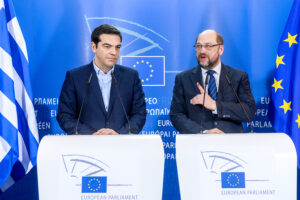
Belying the official line of Greek prime minister Alexis Tsipras that a “no” vote in Sunday’s referendum about the latest bailout offer from the nation’s creditors was not a vote on whether or not to stay in the euro, political and economic realities now point inexorably toward a “Grexit”.
Although a conciliatory tone was struck by the eurozone’s laggards Italy and Spain, the main anchors of the currency bloc are losing patience.
In Germany, the rhetoric of Chancellor Angela Merkel’s Christian Democrat grassroots has hardened substantially. One leading member of the Christian Social Union in Bavaria openly stated that Athens “chose a path of isolation” by rejecting what Merkel effectively presented as the final offer on the table. Even her Social Democratic partners admit they cannot see a path forward from here and that Greece must show greater flexibility than it has up to this point.
Dutch prime minister Mark Rutte echoed the language of Berlin’s hardliners after the referendum results were announced, saying if Tsipras arrived at an emergency summit with proposals not closely resembling those its creditors put forward a week ago, the eurozone would be at an impasse. “There is no other choice,” he maintained. Greece “must be ready to accept deep reforms.”
Finally, French president François Hollande, terrified of strengthening Marine Le Pen’s Euroskeptic forces but simultaneously concerned about giving a resurgent Nicolas Sarkozy too much political ammunition, abandoned his media-constructed role as a sympathetic go-between and issued a joint statement with Merkel demanding that Greece put out its own proposals to stay in the euro within two days. (more…)
