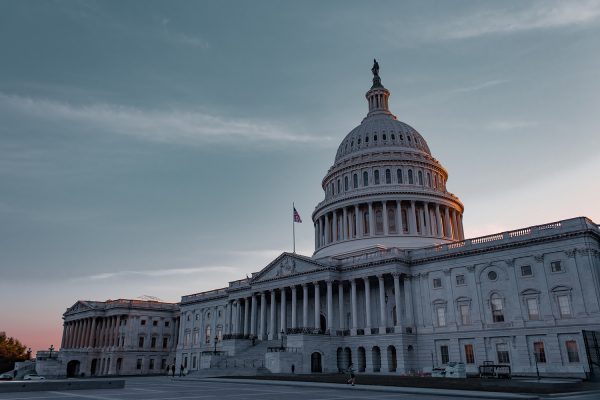
United States Capitol in Washington DC (Shutterstock/Orhan Cam)
Americans vote in midterm elections on Tuesday. All 435 seats in the House of Representatives and 35 of the 100 seats in the Senate are contested. President Joe Biden’s Democratic Party is projected to lose its majority in at least one and possibly both chambers of Congress.
This guide explains how the elections work, why Republicans are up in the polls, why Democrats may yet defend their majority in the Senate, and which states will decide the outcome. (more…)
French president Emmanuel Macron walks through the Elysée Palace in Paris with American vice president Kamala Harris, November 10, 2021 (White House/Lawrence Jackson)
American-French relations have taken a turn for the better. President Joe Biden has invited Emmanuel Macron to a state visit, his first. At a joint news conference with Foreign Minister Catherine Colonna, Secretary of State Antony Blinken said the United States “couldn’t ask for a better partner” than France. Blinken praised the “united and unwavering” allied response to Russia’s war in Ukraine.
Compare the kind words to two decades ago, when American lawmakers were so appalled by French opposition to the Iraq War that they changed the name of French fries in their cafeteria to “freedom fries”.
In part, the restored friendship is a consequence of time having passed and two Atlantic powers remembering their shared interests. But the rapprochement was helped by Russia. Some American and French politicians saw Russia as a useful hedge against the other. They were discredited by Russian aggression against its neighbors and Russian meddling in Western politics. (more…)
The United States Capitol in Washington DC, December 10, 2019 (Unsplash/Julien Gaud)
Two years ago, Republicans avoided a debate about their party’s principles by copy-pasting their 2016 manifesto and slapping Donald Trump’s name on it.
I had hoped Trump’s defeat might repudiate what he stood for, and bring Republicans back to the center-right, but that hasn’t happened.
Worse, the Trump wing is the only one with a plan to move forward. Senate leader Mitch McConnell has resisted outlining a governing agenda for a Republican Congress. House leader Kevin McCarthy’s “Commitment to America” — modeled on Newt Gingrich’s “Contract with America” that returned Republicans to a majority in 1994 — is a summary of ambitions few could disagree with: create good-paying jobs, curb wasteful government spending, fund border security, lower the price of gasoline, strengthen Medicare and Social Security. But none of McCarthy’s “plans” answer the obvious question: how? Which means they aren’t plans, but slogans.
Only the Republican Study Committee, formerly a fringe faction in the House of Representatives that has come to encompass three in four members, has made concrete proposals in the form of a counterbudget.
I read all its 122 pages, so you don’t have to. But first: why Republicans need a plan. (more…)
Wind turbines in the dunes of Holland (Vattenfall)
Should we sacrifice wildlife to fight climate change? Whether it’s toads being uprooted by geothermal plants or birds being killed by wind turbines, the question vexes politicians in America and the Netherlands.
So far, the Americans have been more likely to answer “no”.
West Virginia senator Joe Manchin has angered many in his Democratic Party with a plan to speed up energy permits. He would set a two-year target for environmental reviews and a 150-day statute of limitations on court challenges. (The average review takes four-and-a-half years, costs $4.2 million and is 600 pages long. I’ve argued the reforms don’t go far enough, and the two-year “target” should be made into a deadline.)
In the Netherlands, the left-liberal climate and energy minister, Rob Jetten, has licensed the construction of 1,700 wind turbines in the North Sea, which would increase Dutch offshore energy generation by a factor of eight. Environmentalists warn the impact of this expansion on birds and marine life is understudied. (more…)
Impossible burgers made from plants (Impossible Foods)
Reducing dairy and meat consumption is the easiest thing Westerners can do to slow down climate change and improve the lives of animals.
Livestock farming causes 15 percent of greenhouse gas emissions. We could quit fossil fuels tomorrow, and animal agriculture would still push us past 1.5˚C of global warming.
Environmentalists feel guilty about flying, but eating meat and yoghurt every day causes more pollution. And no animals are harmed in building airplanes.
We should eat more seafood and vegetables anyway. Europeans eat twice as much meat as the rest of the world. Spaniards top the list with 100 kilograms per year, which is about the same as Americans. Nutritionists recommend between a quarter and a third of that.
Meat is a source of iron, protein and nutrients, like vitamin B12 and zinc. But most can be found in fish and vegetables as well. Eating too much — especially red — meat can cause bowel cancer and raise cholesterol levels, which increases the risk of heart disease and stroke. Even carnivores who care little about animals or the environment should give that vegaburger a try for the sake of their own heart.
Wind turbines outside Wasco, Oregon, July 1, 2019 (Unsplash/Dan Meyers)
West Virginia Democrat Joe Manchin, the most conservative in the Senate, has proposed to make it easier to build energy plants and infrastructure.
Manchin was promised permitting reforms for supporting the Inflation Reduction Act; really a health-care and green-energy spending plan.
But other Democrats are skeptical, arguing Manchin’s Energy Independence and Security Act would benefit fossil fuels and nuclear power in addition to renewables. Republicans don’t think the reforms go far enough.
Which would normally suggest to me Manchin had found the right balance, but in this case the right has the better of the argument. (If you agree America must massively expand clean energy, which unfortunately few Republicans do.) (more…)
Dutch self-propelled Panzerhaubitze 2000 takes part in a military exercise in Sweden, October 2018 (Ministerie van Defensie)
For the first time since the Russian invasion in February, European countries did not pledge additional weapons to Ukraine in July.
The German Kiel Institute, which keeps track of countries’ humanitarian as well as military assistance to Ukraine, reports that the United States is providing €25 billion in weapons, in addition to €20 billion in humanitarian and financial support. European countries, including the UK, are giving less than €10 billion in arms.
Christoph Trebesch, who leads the team in Kiel that compiles the data, calls it “surprisingly little considering what is at stake.” He compares the €10 billion for Ukraine to the €750 billion Europe, excluding the UK, spent to recover from the coronavirus pandemic.
I have a story in the Netherlands’ Wynia’s Week about Europe’s waning support for Ukraine. I’ll translate the highlights. (more…)
View of Washington DC with the United States Capitol in the distance, February 17, 2015 (Matt Popovich)
Child-care workers without a college education will have to give up their profession in Washington DC.
Regulations that were meant to go into effect in 2020, applying to all daycare centers and some home-based child-care businesses, were challenged by two child-care workers and a parent, but a federal court ruled for the district this week. Reason has the story.
The two workers, Altagracia Sanchez and Dale Sorcher, have 49 years of child-care experience between them. Both have Bachelor’s degrees — but not in early-childhood education, making them ineligible under DC’s new rules. (more…)
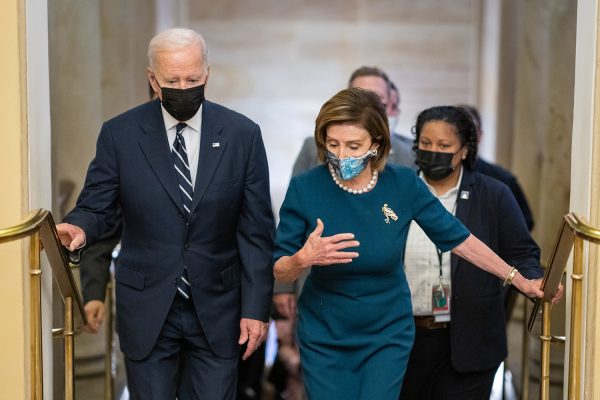
American president Joe Biden and Democratic House speaker Nancy Pelosi in the Capitol in Washington DC, October 28, 2021 (White House/Adam Schultz)
Ronald Reagan summarized government’s view of the economy: “If it moves, tax it. If it keeps moving, regulate it. If it stops moving, subsidize it.”
Economists now call this cost-disease socialism: first restrict supply, then subsidize the costs. The United States does this with everything from health care (examples here) to housing (although Joe Biden’s reforms go in the right direction).
Democrats are making the same mistake with their technology and climate laws.
There is plenty to like about the CHIPS and Science Act and the (albeit misleadingly-named) Inflation Reduction Act. The first doubles government funding of research into 6G communications, advanced manufacturing, artificial intelligence and other breakthrough technologies; the latter creates a 15-percent minimum tax on the largest corporations, lowers annual out-of-pocket drug payments for Medicare patients from $7,050 to $2,000 beginning in 2025 and will allow Medicare to negotiate some drug prices starting in 2026.
But both laws also spend billions of dollars in subsidies and tax credits to prop up technologies and industries that could have been deregulated instead. (more…)
There’s good news and bad news from the drugs front in Amsterdam.
The good news is that a new coalition government of Labor, liberal Democrats and Greens want to pilot the legal sale of MDMA, also known as ecstasy. The three parties won the municipal elections in March.
The national government, in which the liberal Democrats rule with three center-right parties (including my own), has agreed to study the decriminalization of MDMA, although for medicinal use. A majority in the Amsterdam city council want to regulate recreational use as well.
The bad news is that Mayor Femke Halsema is still trying to convince the council to ban the sale of cannabis to tourists. I wrote an op-ed against her proposal in the NRC newspaper in April and have another story about it in Het Parool, the newspaper of Amsterdam.
The arguments used by both sides in Amsterdam will sound familiar to Americans. Proponents of decriminalization want to reduce harm. Opponents fear it would lead to more drug use. (more…)
Aerial view of Boston, Massachusetts, October 22, 2010 (Thomas Hawk)
Joe Biden has unveiled five new policies to alleviate America’s housing shortage.
Two are related to financing, which I’m not qualified to assess. The goal is to make it easier for low-income Americans to build and buy homes. I just hope that doesn’t lead to a repeat of the subprime mortgage crisis, which was at least partly caused by the federal government underwriting mortgage loans homeowners could not afford.
A third seeks to make it more difficult for investors to buy family homes. I don’t know if that’s worth the tradeoff, but there is one. The left-wing city government of Amsterdam has done the same, arguing all investors do is buy properties, renovate them and raise rents. But that renovation part is important! Maintaining buildings that are centuries old is expensive. Investors raise rents to recuperate the costs, but at least they can spread out those costs over multiple renters and multiple years. Banning property investment could cause monumental buildings to either become unaffordable to all but the wealthy or fall into disrepair, which happened in Amsterdam during the 1930s and 40s, and is why entire neighborhoods, like the Jewish Quarter, were demolished after the Second World War.
Biden’s last two policies are the most interesting to me: ending discrimination against prefabricated and modular homes and encouraging local zoning reform. (more…)
Port of Seattle, Washington, June 15, 2021 (iStock/Mark Hatfield)
There’s not much elected politicians can do about high inflation. They might have inadvertently caused it with massive COVID-19 rescue and recovery programs, which saved businesses and jobs but also put money in the hands of consumers at a time when supply chains were strained. When producers can’t meet demand, prices rise.
Central banks have the strongest tools to fight inflation, but there is something governments can do: cut tariffs and regulatory barriers to trade. More and cheaper imports would reduce costs for consumers. (more…)
Walt Disney World Resort in Bay Lake, Florida, January 25, 2020 (Unsplash/Christian Lambert)
What happened to the party of free enterprise?
In Florida, Republicans are revoking Disney World’s self-government and not even pretending it’s anything but retaliation for the company’s opposition to their education policy.
“I will not allow a woke corporation based in California to run our state,” Governor Ron DeSantis said. “Disney has gotten away with special deals from the state of Florida for way too long.”
Disney World is Florida’s largest employer and manages its own utilities, including firefighting, garbage collection and water reclamation, in the so-called Reedy Creek Improvement District. It can also build homes and attractions without permission from the state or local government.
The arrangement dates from the 1960s, when Disney committed to develop the former swampland into a theme park and town.
The entertainment giant drew DeSantis’ ire when it came out against his Parental Rights in Education law. It prohibits teaching gender identity and sexual orientation to children under the age of 10 in ways that are not “age-appropriate” — without specifying what age-appropriate means. Critics have dubbed it the “Don’t Say Gay” law.
Whatever the merits (for the record, I think schools should teach what they think is best, parents should be able to send their kids to whichever school they think is best, and the Florida law is at a minimum poorly written), punishing a company, or indeed anyone, for their beliefs is an overreach. It is neither conservative nor liberal, and the sort of thing we’d expect in China, not the United States.
It is also rushed. DeSantis does not appear to have thought through what will happen to the Reedy Creek Improvement District’s $1 billion in debts. Taxpayers could be on the hook.
The Louvre in Paris, France, February 9, 2020 (Unsplash/Louis Paulin)
I once hailed the French voting model as an alternative to America’s. Unlike the first-past-the-post system, which encourages voters to sort into two major parties lest their vote go wasted, France’s two-round voting system encourages temporary, not permanent polarization. Multiple parties thrive in the first round. Voters choose between two finalists in the second.
Until 2017, third parties seldom made the runoffs. But they played an important role by conditioning their support for one of the two major parties on policies or cabinet posts.
Under François Hollande, several members of the Radical Left and Greens served in a Socialist-led government. Nicolas Sarkozy had ministers from small centrist and center-right parties who backed him in the presidential election.
But what if the major parties don’t qualify for the runoffs at all? That has now happened in two presidential elections in a row, and it calls the stabilizing effect of the two-round voting system into question. (more…)
Skyline of Washington DC with the United States Capitol in the distance, September 28, 2017 (Ted Eytan)
A year ago, I wrote that the child benefits Joe Biden snuck into his $1.9 trillion coronavirus recovery program might outlive the pandemic. Once American parents had accustomed to receiving monthly cheques of $250 or $300 per child, I figured it would be hard for Congress to let the program lapse.