Tag: United States

  • Democrats Are Losing Touch with Middle America

    Joe Biden
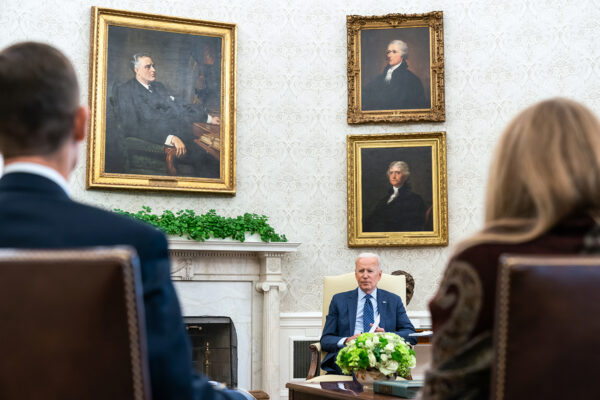
    American president Joe Biden walks away from a news conference in the East Room of the White House in Washington DC, January 19 (White House/Adam Schultz)

    The easiest way to win an election is to appeal to the voter in the center. Fanatics will come up with all sorts of reasons to deny it, and lose. It’s not a perfect rule. In a tight election, turning out your base matters too. But in a two-party system, the party that puts the most distance between itself and the median voter is the one most likely to end up in opposition.

    Take Britain’s Labour Party. It kept Jeremy Corbyn as leader for five years through six defeats. His supporters insisted his policies (raising the minimum wage, a four-day workweek, universal child care) were popular, and many, polled individually, were. But his approval rating was always under water. Middle England didn’t trust the man who opposed the Falklands War in 1982 and the bombing of Yugoslavia in 1999; who called the assassination of Osama bin Laden a “tragedy” and praised Hamas for their commitment to “peace”. Corbyn’s fans mistook his refusal to compromise for principle. It accomplished nothing for Labour voters.

    Democrats in the United States are in the process of making a similar mistake. Many of their policies — the $1.9-trillion coronavirus recovery program, $1 trillion in infrastructure spending, canceling the worst of Donald Trump’s immigration policies, subsidizing child care, rejoining the Paris Climate Agreement — are popular, but the party is not.

    43 percent of Americans have a favorable view of Democrats. 42 percent support Joe Biden and 42 percent plan to vote for a Democrat in the midterm election.

    The only consolation is that Republicans are disliked even more: just one in three have a favorable view of them. Yet 46 percent would vote Republican in November. It seems Republicans don’t need to be loved to win. (more…)

  • American Health Care Is Understaffed, Because It Is Overregulated

    New York ambulance
    Ambulance in Manhattan, New York, October 4, 2017 (Unsplash/Benjamin Voros)

    If coronavirus convinces more people our health-care systems need to be overhauled, it may be one of the few good outcomes of the pandemic.

    In the UK, the government-owned National Health Service has long underperformed relative to its rich-country peers. I wrote here in January that the pandemic has underscored the need for reform. If you subscribe to the Financial Times, also read Camilla Cavendish’s story from April about the hundreds of babies who died in English maternity wards between 2000 and 2019 from lack of care. This in the world’s fifth-largest economy!

    The Netherlands’ mixed public-private system is superior, but the country still has a shortage of nurses. It’s something I investigated for Wynia’s Week in December. What I found was that nursing associations, trade unions and researchers have been sounding the alarm for years, yet hospitals continue to underpay nurses and few give their workers the autonomy and flexibility they ask for. Probably because nursing was historically a part-time profession of unmarried women, and doctors and hospital administrators were historically older and male. That hierarchical culture (which I imagine exists in other countries as well) is hard to change, but it is slowly starting to. If you read Dutch, you can glean examples from my second story on the topic.

    In America, excessive licensing requirements and regulations have kept health care understaffed. Pro-market think tanks like the Cato Institute and Niskanen Center have been trying to draw attention to this. Even Vox, hardly a bastion of libertarianism, acknowledges that American health care is, in some ways, overregulated. (more…)

  • How Can Biden Be Successful and Unpopular At the Same Time?

    Joe Biden
    American president Joe Biden disembarks Marine One on the South Lawn of the White House in Washington DC, October 15 (White House/Erin Scott)

    Earlier this week, I argued the media consensus about Joe Biden is too negative; that the first year of his presidency has been more successful than the headlines suggest.

    But Biden is also unpopular. Just 42 percent of Americans believe he’s doing a good job, down from 53 percent when he started. His party is projected to lose the midterm elections in November.

    Two things can be true:

    1. Biden had been moderately successful.
    2. He has focused too little on the issues Americans care about. (more…)
  • Give Joe Biden a Break

    Joe Biden
    American president Joe Biden boards a helicopter at Joint Base Andrews, Maryland, October 7, 2021 (White House)

    One year into Joe Biden’s presidency, the media consensus is that he is failing.

    The Financial Times reports that the Democrat is trying to “reboot” his “faltering” presidency. The Washington Post believes he is “stumbling”. The Wall Street Journal calls it “flailing”.

    Foreign journalists agree. Britain’s The Guardian newspaper writes that Biden is historically unpopular and “much of his domestic agenda is stalled on Capitol Hill.” Here in the Netherlands, EW Magazine wonders if anyone is still happy with the president while RTL reports that he has “blundered” abroad and “broken” his election promises. (more…)

  • Biden Did Not End Trump’s Trade War with Europe

    Kamala Harris Joe Biden
    Vice President Kamala Harris and President Joe Biden of the United States deliver a news conference outside the White House in Washington DC, May 13 (White House/Adam Schultz)

    During last year’s presidential election, Joe Biden promised to end America’s “artificial trade war” with Europe. His predecessor, Donald Trump, had imposed $7.5 billion worth of tariffs on European aluminum and steel.

    Biden has relaxed the tariffs, but not abolished them. The EU has completely pulled down its retaliatory tariffs on bourbon whisky and Harley-Davidson motorcycles.

    If anyone deserves credit for ending the trade war, it’s the EU. (more…)

  • Democrats Would Make American Child Care More Expensive

    Joe Biden
    American president Joe Biden walks down the colonnade of the White House in Washington DC, August 20 (White House/Erin Scott)

    Over the summer, I wrote here that President Joe Biden’s child benefits — $300 per month for children under the age of 6 and $250 for kids up to the age of 17 — help American parents pay for child care, but don’t make child care less expensive.

    Now Democrats propose to make it more expensive. (more…)

  • American Health Care Is Worst in Rich World

    Empire State Building New York
    The Empire State Building in Manhattan, New York behind the light of an emergency vehicle, June 9, 2016 (Unsplash/Dapo Oni)

    America has the worst health-care system of eleven rich nations.

    The Commonwealth Fund, a century-old foundation dedicated to improving health care, places the United States behind Australia, Canada, France, Germany, the Netherlands, New Zealand, Norway, Sweden, Switzerland and the United Kingdom in its latest report. The Netherlands and Norway share first place.

    America is the world’s top innovator of new medications and treatments. The best medical schools are in the United States. The country spends relatively more on preventative care than most. But this doesn’t outweigh its poor scores on the Commonwealth Fund’s other criteria: access to care, administrative efficiency, equity and outcomes.

    In practical terms, this means especially low-income Americans don’t get the health care they need, either because it’s too expensive, too complex or both. Preventable deaths, including infant and maternal mortality, are higher in the United States than in other wealthy countries. Life expectancy is lower.

    The Commonwealth Fund’s findings match those of the Euro Health Consumer Index, OECD, Peterson Center on Healthcare and Kaiser Family Foundation. All rank the United States below Australia, Canada and most countries in Europe. (more…)

  • America’s $1 Trillion Infrastructure Bill, Explained

    Arthur Ravenel Jr Bridge South Carolina
    Arthur Ravenel Jr Bridge outside Charleston, South Carolina, December 2, 2017 (Unsplash/David Martin)

    The United States Senate is expected to pass a $1 trillion infrastructure bill this week with funding for everything from broadband Internet to road safety.

    The bill, which is believed to have the support of enough Republicans to overcome a forty-senator filibuster, falls short of the $2 trillion President Joe Biden had proposed to spend on (green) infrastructure over four years.

    The compromise bill has $550 billion in new spending. The rest consists of existing infrastructure funds which are either being diverted or renewed.

    Unlike Biden’s $2 trillion proposal, which would have been funded by corporate tax increases, the compromise version draws money from various sources, including around $200 billion left over from COVID-19 relief programs. (more…)

  • Biden’s Child Benefits Don’t Make Child Care Cheaper

    Joe Biden
    American president Joe Biden meets with staff in the Oval Office of the White House in Washington DC, June 2 (White House/Adam Schultz)

    Last week, American parents received their first monthly child benefits worth $300 for children under the age of 6 and $250 for kids up to the age of 17.

    Couples making under $250,000 per year, or single parents earning less than $112,500, qualify.

    President Joe Biden described the cheques, worth $15 billion, as “the largest ever one-year decrease in child poverty in the history of the United States of America.”

    That’s probably true, and the hope is that the benefits, introduced as part a COVID-19 rescue plan, will become permanent.

    But they don’t lower the price of child care. (more…)

  • Judges Need to Know Their Place

    Supreme Court The Hague Netherlands
    Supreme Court of the Netherlands in The Hague, February 3, 2016 (Rijksvastgoedbedrijf/Bas Kijzers)

    European judges have discovered they can compel politicians to take action against climate change.

    France’s Council of State has given the government of Emmanuel Macron an April 2022 deadline (one month before the election) to ensure the country will meet its target of reducing greenhouse gas emissions 40 percent by 2030 compared to 1990.

    Germany’s Constitutional Court issued a similar ruling in April and gave the government an end-of-year deadline to update its policy.

    A Dutch court has gone further, ordering Shell, the Anglo-Dutch oil giant, to reduce not just its own carbon dioxide emissions by 45 percent but those of its customers and suppliers as well.

    It’s like we’re living in a kritocracy. (more…)

  • Europe Doesn’t Need a Biden

    Joe Biden
    American president Joe Biden boards Air Force One at Joint Base Andrews, Maryland, February 5 (White House/Adam Schultz)

    European leaders are “weak”, the American president is “bold”. It’s a trope so old, at this point it tells us more about the people who perpetuate it than about elected officials on either side of the Atlantic.

    Romano Prodi was “weak“. José María Aznar was “weak“. François Mitterrand was “weak“. His successor, Jacques Chirac, lacked “gravitas“.

    A year before the election of Donald Trump, Robert Kaplan disparaged the “grey, insipid ciphers” who wandered Europe’s halls of power. An article in Foreign Affairs accused the continent’s “cowardly” leadership of rendering the EU “irrelevant”. A 2005 op-ed in The New York Times lamented the “weakness” of European leaders at the very time President George W. Bush called for a “renewal” in transatlantic relations. (The same George W. Bush who two years earlier had created the deepest crisis in transatlantic relations since the end of the Cold War by invading Iraq.)

    Here we go again. Jef Poortmans, a commentator for Belgium’s Knack magazine, compares Joe Biden’s “zeal” with Europe’s “washed out” leadership. Timothy Garton Ash, whose expectations the EU has never met, argues the bloc faces “one of the biggest challenges of its life” (again). Philip Stephens contrasts Biden’s “ambition”, “audacity”, “energy” and “resolve” with the “defensive incrementalism” of his European counterparts, in particular Angela Merkel.

    The “real significance” of Biden’s agenda, writes Stephens in the Financial Times — a $1.9 trillion coronavirus rescue program and a $3 trillion education and infrastructure bill — “lies in a bold reassertion of the responsibilities of government.”

    His mistake is to assume America and Europe are starting from the same point. (more…)

  • Child Benefits Could Outlive Biden’s COVID-19 Stimulus

    Joe Biden
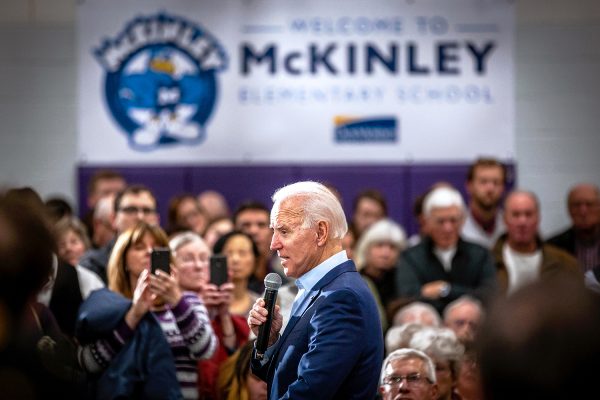
    Former American vice president Joe Biden campaigns in Des Moines, Iowa, August 8, 2019 (Gage Skidmore)

    The United States Senate has approved President Joe Biden’s $1.9 trillion coronavirus recovery plan, more than twice the size of Barack Obama’s 2009 stimulus.

    With the exception of a $15 hourly minimum wage, the soon-to-be-law includes nearly all the provisions Biden had called for, including additional spending on health care, extended unemployment insurance (if cut by $100 per week from the original version) and rental assistance. For detail, check out my post about the bill from January.

    The part I want to focus on here is a child allowance that ranges from $250 to $300 per month per child. (more…)

  • Biden’s Foreign Policy Begins at Home

    Joe Biden
    Former American vice president Joe Biden gives a speech in Des Moines, Iowa, January 4, 2020 (Phil Roeder)

    The appointment of Jake Sullivan as Joe Biden’s national security advisor is a strong hint that the new president’s focus on domestic issues — COVID-19, the economy, racial equity — will influence American foreign policy in the next four years.

    While at the Carnegie Endowment for International Peace during the Trump Administration, Sullivan co-authored a report that argued American foreign policy had failed the American middle class. As Biden’s closest foreign-policy advisor, he can push for the return to Obama-style multilateralism, but this time with a laser focus on the interests of middle America.

    Here’s what that could mean for the top items on Biden’s foreign-policy agenda: Afghanistan, China and Europe. (more…)

  • America Needs a de Gaulle

    Charles de Gaulle Lyndon Johnson
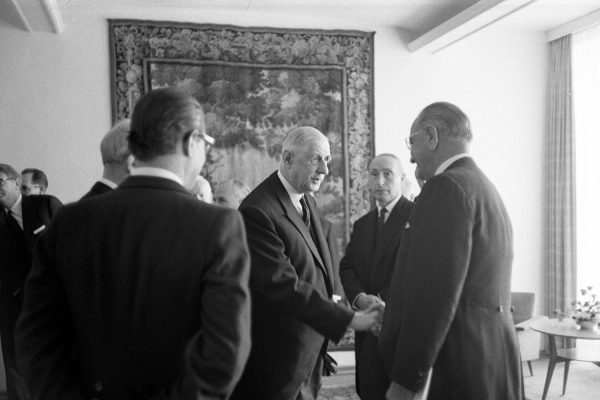
    Presidents Charles de Gaulle of France and Lyndon B. Johnson of the United States meet at the memorial service for Konrad Adenauer, the former chancellor of West Germany, April 25, 1967 (LBJ Library)

    Charles de Gaulle’s great accomplishment, to paraphrase his British biographer, Julian Jackson, was that he reconciled the French left to patriotism and the French right to democracy.

    The history of France since 1789 has been a consistent struggle between a universalist left and the conservative right; between republic and monarchy; the Enlightenment and Catholicism; labor and capital; Paris and La France profonde.

    History hasn’t ended. Emmanuel Macron and Marine Le Pen embody opposite visions of France today. But de Gaulle narrowed the divide and helped Frenchmen and -women think of each other as opponents rather than enemies.

    That America could use a whiff of Gaullism isn’t my idea. Ross Douthat, the conservative columnist of The New York Times, called for an American de Gaulle two years ago.

    I suspect he envisaged an authority figure on the right. Instead we have Joe Biden. Can he play the same role? (more…)

  • Death, Debt, Tax Cuts and Lies: Trump’s Legacy

    Donald Trump
    American president Donald Trump enters a limousine at Joint Base Andrews, Maryland, September 17, 2020 (White House/Shealah Craighead)

    Donald Trump’s presidency ends on Wednesday. He leaves behind an America that is more in debt, more isolated in the world, less generous and less safe. (more…)