Tag: Latin America

  • Trump Could Bring Enemies in South America Closer Together

    The alliance between Cuba and Venezuela has lost prominence in recent years as the former normalized its diplomatic relations with the United States while the latter doubled down on a self-described anti-imperialist policy.

    Now Donald Trump’s presidency threatens to bring the two countries closer together again.

    Trump, who assumed power last week, has pledged to reverse the Cuba policy of his predecessor “unless the Castro regime meets our demands”.

    Rex Tillerson, Trump’s secretary of state and the former boss of ExxonMobil, has an acrimonious history when it comes to Venezuela.

    Nicolás Maduro, the Venezuelan president, has said Trump — a fellow illiberal strongman — can be no worse than Barack Obama. But that’s probably not how the Cubans see it. (more…)
  • Political Victory for Temer During Anxious Times for Brazil

    Brazil’s president, Michel Temer, scored a major political victory last week when Congress passed a constitutional amendment that limits public spending for the next twenty years.

    This was no small feat, given that 63 percent of Brazilians, according to one recent poll, want Temer out.

    At the same time, right-wing parties, which support his austerity program, prevailed in municipal elections in October at the expense of the long-ruling Workers’ Party. (more…)

  • The Rational Person’s Guide to Fidel Castro

    There are few leaders who inspire the kind of irrational passion that surrounds the recently-deceased Fidel Castro. He is a hero and a villain and to have an opinion on him so often forces you to choose between the two.

    But there is another way to judge leadership. To understand Castro’s true historical legacy, we should think of him geopolitically.

    That means setting aside moral judgements, which rely on evidence that’s so readily cherrypicked, and pushing past propaganda to look not on Castro’s intentions or his personality but his geopolitical outcomes.

    All leaders who are judged in such a manner must therefore pass a basic question: How much did they secure their nations and/or states and for how long can their methods work?

    Security, of course, should break down as both physical security from invasion and rebellion as well as economic and social security from recessions, poverty and unrest. We are asking, in essence, about how well a leader used their ever-limited power to strengthen their nation state.

    Such strengthening goes beyond mere morality, because murder is murder and always wrong in the eyes of the ethicist. But to murder someone who might corrupt or weaken a nation state is wise geopolitical policy. After all, it’s hard to argue that murdering Adolf Hitler in 1931 would have weakened Germany. (more…)

  • Colombia’s Santos Seeks Revised Peace Deal with FARC

    There was little hope left in October of bringing Colombia’s 52 year-old conflict with the Revolutionary Armed Forces of Colombia (FARC) to an end, when voters narrowly rejected a proposed peace plan in a referendum. Fears swelled that violence would break out again.

    President Juan Manuel Santos, however, was undeterred and set about piecing together a revised peace deal.

    Six weeks on, gloom and uncertainty have made way for cautious optimism. (more…)

  • When People Don’t Give Peace a Chance: Colombia Rejects Peace with FARC

    Who do you blame when bad things happen to good people? Who is your private scapegoat that helps you understand when barrel bombs kill children in Aleppo or when drones blow up weddings in Afghanistan? Who is to blame for war?

    On many a Facebook comment, the answer is simplistic: “terrorists”, “the West”, “greedy corporations” — so rarely blamed are everyday people, who are, after all, war’s primary victims.

    Such quick labels are good for our psychology: they make the problem seem surmountable, the worst parts of humanity something we can banish over the next hill.

    That these scapegoats can also be accurate makes the situation all the more difficult; terrorists, the West, corporations and just about every other favorite boogeyman all have a hand in starting and sustaining wars. The Americans can surely blame the Russians for the Ukraine war; the Russians can surely blame the Americans for the Islamic State. Cherrypicked experience can justify anyone.

    But no one geopolitical scapegoat can start and sustain a war. And Colombia’s voters just proved it. (more…)

  • Colombia’s Referendum: Has the Best Chance for Peace Gone?

    On Sunday, the people of Colombia unexpectedly rejected what had been dubbed an historic peace deal between their government and the Revolutionary Armed Forces of Colombia (FARC). 50.2 percent voted down the proposed accord in a referendum. The peace deal is off.

    The 297-page agreement, signed last week after four years of negotiation, was meant to end a conflict that spans back to 1964 and has claimed an estimated 260,000 lives.

    In speech after speech, President Juan Manuel Santos has extolled the peace accord’s historic nature. Confident of the referendum’s outcome, he staked his presidency on it. His future is now in doubt as well. (more…)

  • Rousseff Leaves But Brazil’s Problems Remain

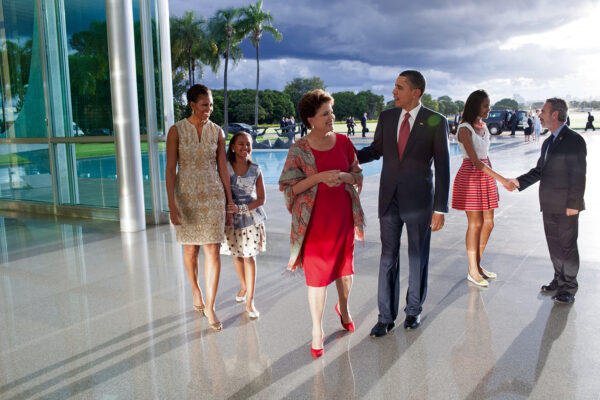
    Dilma Rousseff Barack Obama
    Brazilian president Dilma Rousseff welcomes her American counterpart, Barack Obama, and his family in Brasília, March 19, 2011 (White House/Pete Souza)

    By the end of this month, not only will the 2016 Olympic Games in Rio have come and gone; it is also likely that the left-wing Dilma Rousseff will have finally been removed from the presidency.

    Neither will occur without incident. Nor will they solve Brazil’s increasingly confused, complex and confrontational state of affairs, from a messy entanglement of impeachment proceedings to the possibility of fresh elections to the worst economic recession in Brazilian history. (more…)

  • Maduro Defiant as Venezuela Teeters on the Brink

    When Venezuela’s opposition Democratic Unity Roundtable (MUD) won a two-thirds supermajority in the National Assembly last year, it represented an unquestionable shift after sixteen years of socialist rule. There was desire for change. Not just from the traditional array of opponents to the ruling party government, but also from those who still call themselves Chavistas.

    Those clamors, in part mobilized by the MUD, have become noticeably louder in recent weeks and months and protests have been firmly met by riot police and tear gas.

    The country, home to the world’s largest oil reserves and previously one of the most developed in Latin America, is now suffering from the world’s highest inflation rate, varying between 180 and 700 percent. In the boom times, oil (which accounts for 95 percent of exports) helped pay for a million homes for the poor. Now, after three years of decline, with the sovereign wealth fund depleted and the economy expected to shrink by 8 percent, default is a distinct possibility.

    Everyday Venezuelans are feeling the bite through shortages in electricity, food, water and medicine. The bare essentials of society have been stripped away and replaced by blackouts, endless queues for basic household goods, violence and looting. The country has the second highest murder rate in the world.

    Desperation is in the air and its manifestations can no longer be passed off by the government as “revolts of the rich,” as was the case following similar protests in 2014. (more…)

  • Peru Votes for Continuity Amid Growing Discontent

    Peru’s fourth consecutive democratic election has been marred somewhat by a series of events that have placed the Peruvian Electoral Commission at center stage.

    Last week’s presidential election followed a familiar path, once again going to a second round which is set to take place in the first week of June.

    But prior to the electorate’s trip to the ballot box, two candidates vying to make it to the presidential runoff were barred from participation.

    Long-time poll leader Keiko Fujimori, the daughter of former president Alberto, comfortably made her way to the second round with 40 percent of the votes.

    The battle for second place was much tighter but won by 77 year-old Pedro Pablo Kuczynski, known as “PPK”, with 21 percent support. (more…)

  • Peruvian Voters May Not Get Change They Want

    Peru’s presidential election in April will come at a time when voters across Latin America are expressing a desire for change.

    In November, for the first time since democracy was reintroduced there, a right-wing candidate, Mauricio Macri, was elected president in Argentina. December saw the Venezuelan Socialist Party lose its majority in the National Assembly after sixteen years in power. Dilma Roussef, Brazil’s president and leader of the left-wing Workers’ Party, is under threat of impeachment with approval ratings at an all-time low.

    Voters in Peru are no less keen on a break even though their president, Ollanta Humala, has turned out to be far less radical in his populism than his 2011 campaign rhetoric and media coverage may have led them to believe.

    Instead, his presidency has been characterized by vacillation, both in terms of policy and personnel — but with no great departure from the liberal economic path trodden by Humala’s predecessors. (more…)

  • Venezuela Swears In Opposition Majority

    After sixteen years of Chavismo, a symbolic new phase in Venezuelan politics began this week: members of the opposition Democratic Unity Roundtable (MUD) took their seats in the National Assembly as part of a new two-thirds supermajority.

    Prior to last month’s surprisingly peaceful parliamentary election, the governing United Socialist Party of Venezuela (PSUV) had a majority of 96 out of 167 seats.

    Because of the dire straits the country finds itself in, and in spite of considerable obstacles, the MUD has managed to increase their 63 seats to an overwhelming 112. Although an opposition victory was no surprise, the scale of the triumph has sent an unequivocal message of dissatisfaction with the “Bolivarian Revolution” in its current form. (more…)

  • Colombia’s Peace Talks with FARC Running Out of Time

    A smattering of outbursts by the leader of the Revolutionary Armed Forces of Colombia (FARC), Rodrigo Londoño, also known as “Timochenko,” have suddenly cast doubt on the peace talks between the Colombian government and the still 8,000-strong rebel group.

    The current negotiations, initiated in Cuba three years ago, are the fourth such talks since the conflict began in 1964. An agreement reached in September, on the controversial issue of transitional justice, was seen as a significant breakthrough.

    The conflict has, at different stages, been characterized as a war on communism, a war on drugs and a war on terror. It has claimed an estimated 220,000 lives; a further five million people have been displaced.

    There is no manifest clarity to this struggle, with involved parties ranging from the smaller National Liberation Army — yet to enter any kind of peace negotiations — to the right-wing paramilitary United Self-Defense Forces of Colombia (AUC), supposedly disbanded in 2003 and adjudged to be responsible for up to 80 percent of civilian casualties. The waters have been further muddied by a thriving drugs trade infiltrating all parties. (more…)

  • Scandals Could Derail Chile’s Constitutional Rewrite

    Last month, Chile’s president, Michelle Bachelet, announced the beginning of the long-awaited process of rewriting the Latin American country’s constitution.

    Before her election in 2014, Bachelet campaigned on three issues: tax reform, education reform and, last but certainly not least, the introduction of a new constitution.

    Chile made the transition to democracy in 1990 after seventeen long years of military dictatorship under Augusto Pinochet. Yet the constitution drafted by Pinochet and his junta in 1980 remained in place.

    The legacy of the Pinochet dictatorship was one of extensive executive powers, unforgiving neoliberal reform and the loss of thousands of lives. Although his regime brought significant economic growth, through the privatization of state-owned companies and a liberalization of the overall economy, it came at the expense of wages, benefits and working conditions. Over 40 percent of Chile’s population was living below the poverty line by 1990.

    Bachelet’s return to the presidency last year arrived on a wave of optimism with over 50 percent of the votes and a feeling that she would bring long-anticipated changes to address the fact that among developed countries Chile remains the most unequal in the world. (more…)

  • The Beginning of the End of Chavismo?

    Sixteen years after Chavismo took hold in the country, the United Socialist Party of Venezuela (PSUV) could — for the first time — lose its parliamentary majority. Elections in December will test the party’s ability to withstand growing discontent and support for a united opposition.

    The majority of opinion polls place support for the opposition between 50 and 60 percent with government backing at roughly half that number.

    The PSUV currently has 96 out of 167 seats in the National Assembly against 63 held by their opponents who would need 84 for a majority.

    Ever since the PSUV’s president, Nicolás Maduro, took office following the death of his predecessor, Hugo Chávez, in April 2013, he has faced an uphill struggle. (more…)

  • Argentina’s Right Gets Close to Unseating Peronists

    Last weekend, Argentina experienced something of a shock as presidential candidate Daniel Scioli of the governing Peronist party was forced into an historic second voting round by the conservative mayor of Buenos Aires, Mauricio Macri.

    Following twelve years of Kirchnerismo — the most radical form of the Peronist umbrella movement to govern to date — Argentina is set for a change in political direction. The extent and speed to which the country’s political course shall be altered, though, depends on the outcome of the presidential runoff next month. (more…)