In 1974, Turkish forces invaded Cyprus, splitting the island into a Turkish north and a Greek Cypriot south. Now, for the first time in decades, unification seems at hand. Once the sorest point for the NATO alliance, the Cyprus dispute may soon be consigned to the dustbin of history.
What’s happened here? Why has everyone suddenly started acting so reasonable?
The short answer: the geopolitical conditions that caused the 1974 war are dead and buried. (more…)
Polls suggest no party will win an outright majority in Spain’s election this weekend. For the first time since democracy was restored, the country may need a coalition government.
Provided it’s one between Mariano Rajoy’s conservatives and the liberal Ciudadanos (Citizens), we think Spain should welcome the prospect.
A political duopoly is unhealthy. For more than thirty years, Rajoy’s People’s Party and the Socialists have alternated in power. Corruption and nepotism, while not at Greek or Latin American levels, are too common. When it comes to economic and social policy, the two main parties, for all their campaign rhetoric, really aren’t that far apart. (more…)
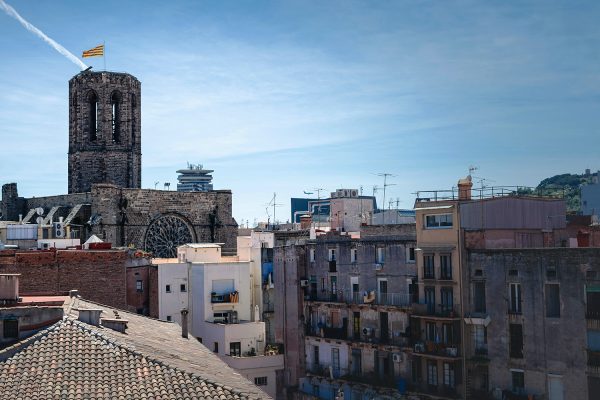
Basílica de Santa Maria del Pi in the Gothic Quarter of Barcelona, Spain (Egor Myznik)
First it was Great Britain, now it’s Spain: the devolution of once all-powerful nation states continues. On Monday, Spain’s Catalonia region’s autonomous parliament voted to secede from Spain by 2017, having won elections in September promising to do just that.
Why is Europe breaking up? And what does this mean for Spain? Let’s get super. (more…)
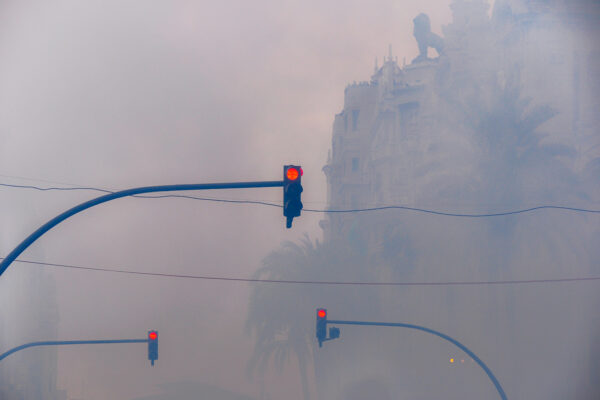
Traffic lights in Valencia, Spain, March 3, 2013 (Keith Ellwood)
The Spanish economy is in the “champions league” in terms of GDP growth but has failed the deficit, unemployment and debt exams. The autumn forecasts from the European Commission are devastating: it has raised the deficit noncompliance to 4.7 percent of GDP for this year and 3.6 percent for 2016, well off the levels of 4.2 percent and 2.8 percent, respectively, previously agreed with Brussels. Unemployment will not fall below 20 percent until 2017 while the public debt will increase even further in the coming months to reach 101.3 percent in 2016.
The Spanish government’s immediate response has been to attribute the worsening deficit to the “hole” discovered a few weeks ago in the Catalonian government and Zaragoza city council’s finances. And quite apart from this technical explanation, economy minister Luis de Guindos has again reiterated that the public deficit targets will be met both this year and next.
The experts are not so convinced. The government has included a .6 percent social security deficit in its budget when this is most likely to reach 1 percent. And much the same is happening with the autonomous regions. The official prediction is for 1 percent of GDP by year-end for this subsector but Afi analysts maintain that the target could be missed by 4-6 percentage points of GDP.
Spain has the highest deficit in the EU after Croatia (-4.9 percent) and even worse than Greece (-4.6 percent). In order to comply with Brussels forecasts, the government to emerge after the December 20 general elections will have to update the Spanish budget and trim an additional €8 billion off the deficit. (more…)
While the world was looking at the Russian military campaign in Syria, Russia may have scored a victory in Europe: the government of Valeriu Streleț in Moldova was toppled by a vote of no confidence initiated by pro-Russian parties in the Chișinău parliament. Meanwhile, opposition protesters clashed with police in Montenegro’s capital and the Serbian Prime Minister, Aleksandar Vučić, visited Moscow. It seemed as if Russia had been on a winning streak. But in reality, Vladimir Putin has too many battles to fight and his own strategy — if there is one — put him under pressure. In fact, Russia is winning only where it does not have to have a strategy.
On 29 October, the government of Moldova had to resign after a successful vote of no-confidence in the parliament. It did not come as a surprise. The country had been in a turmoil since May, when a report by the Kroll company about the “heist of the century,” a scheme that resulted in the theft of $1 billion, one-eighth of Moldova’s GDP was made public. The report accused Ilan Shor, a 28 year-old banker, of orchestrating the theft.
But clearly, it needed more than that: it needed connivance by Moldova’s political elite and institutions. (more…)
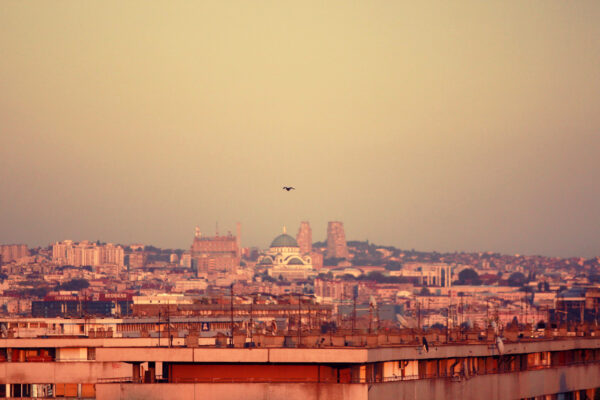
Skyline of Belgrade, Serbia, August 22, 2011 (Serzhile)
Much of the world’s attention is fixed on the refugee crisis emanating from the warzones in Afghanistan, Iraq and Syria. It’s a simple enough narrative for journalists: fleeing the bombs and bullets of the Islamic State or the Taliban, refugees swarm peaceful Europe, hoping for humanitarian salvation.
But that narrative overlooks a key failure of European migration policy. This wave of migration is hardly new. On the continent itself are states that have long propelled their citizens to jump the borders for greener pastures in Western Europe.
Three of Germany’s top five asylum-seeking countries of origin are not in the wartorn Middle East but rather the overlooked Balkans: Albania, Kosovo and Serbia. Macedonia, another Balkan state, ranks seventh.
What’s happening here? Why are fellow Europeans from peaceful states fleeing to Germany? (more…)
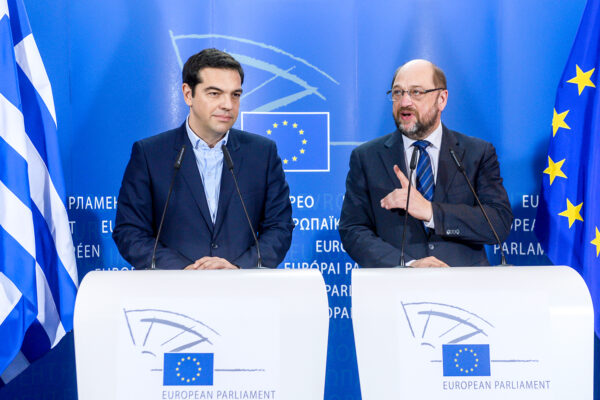
Greek prime minister Alexis Tsipras and European Parliament president Martin Schulz answer questions from reporters in Brussels, February 4 (European Parliament)
Belying the official line of Greek prime minister Alexis Tsipras that a “no” vote in Sunday’s referendum about the latest bailout offer from the nation’s creditors was not a vote on whether or not to stay in the euro, political and economic realities now point inexorably toward a “Grexit”.
Although a conciliatory tone was struck by the eurozone’s laggards Italy and Spain, the main anchors of the currency bloc are losing patience.
In Germany, the rhetoric of Chancellor Angela Merkel’s Christian Democrat grassroots has hardened substantially. One leading member of the Christian Social Union in Bavaria openly stated that Athens “chose a path of isolation” by rejecting what Merkel effectively presented as the final offer on the table. Even her Social Democratic partners admit they cannot see a path forward from here and that Greece must show greater flexibility than it has up to this point.
Dutch prime minister Mark Rutte echoed the language of Berlin’s hardliners after the referendum results were announced, saying if Tsipras arrived at an emergency summit with proposals not closely resembling those its creditors put forward a week ago, the eurozone would be at an impasse. “There is no other choice,” he maintained. Greece “must be ready to accept deep reforms.”
Finally, French president François Hollande, terrified of strengthening Marine Le Pen’s Euroskeptic forces but simultaneously concerned about giving a resurgent Nicolas Sarkozy too much political ammunition, abandoned his media-constructed role as a sympathetic go-between and issued a joint statement with Merkel demanding that Greece put out its own proposals to stay in the euro within two days. (more…)
If American foreign policy lacks anything, it is imagination. When 2016 presidential contenders speak about the rest of the world, their rhetoric is often superficial and predictable. It seems the country’s strategic thinking is succumbing to a creeping “Russification” — an obsession with neo-imperial greatness and jingoistic patriotism.
Irrespective of party label, America’s political elites and resident media experts have framed the country’s position in the world as a straightforward choice between strength and weakness: Unless America retains a permanent and dominating presence in every significant region of the world, a dystopian “war of all against all” will reign. Into this inevitable vacuum will leap “bad actors,” such as China, Iran and Russia. The delicate stability that supports the global economy will be upended and the American homeland will be under relentless threat. The assumption is that America’s role in the world is fateful and irreversible rather than a matter of choice or an accident of history — what America’s often globally unaware public thinks of this is beside the point.
America’s political values, and founding principles have become intertwined by consensus with its supposed role as the guardian of international peace and security. Those who pose the counterfactual, question the assumption of America’s inevitable internationalism or propose an alternative path for the nation’s foreign policy have been diagnosed as malicious, anti-American retrogrades whose weakness would see the country prostrate before vacuous evil forces that must be fought “there” to avoid having to confront them “here at home.”
In this way, American liberty has been exchanged for the authoritarian tribalism of, among others, Vladimir Putin’s Russia. (more…)
Greek prime minister Alexis Tsipras has unwisely accused Spain and Portugal of intentionally trying to block a solution for his country’s troublesome discussions with the Eurogroup at a Syriza party meeting. The reaction has gone beyond any reasonable limit. The two targeted nations filed formal claims to the European Commission asking it to take action against Greece. One wonders why their Foreign Ministries did not warn of the utter ridicule such a step would precipitate. Worse still, the row between European Union partners might leave longstanding scars.
The Greek government is all too conscious of having failed to deliver on its election manifesto promises. That is scarcely surprising, given the attempt to restructure outstanding debt and doing away with the rescue plan was doomed from the outset. Convincing the German Bundestag on the long-term merits of such a scenario was out of question. Even Nobel Prize laureates would be at pains to achieve such a feat. Germany stood as the real blocking hurdle all through the tough negotiations.
Greece secured an agreement on favorable political terms. After all, reviewing the current rescue package represents a formidable victory for a country bound to require extra money to cover its immediate needs. It will implement a humanitarian plan for those suffering from sheer poverty and freeze privatization processes. Other promises such as offering employment for redundant civil servants, reducing the retirement age or steeply increasing the minimum wage, will have to wait. Yet the Greek government has achieved widespread support among the population for its stubborn defence of national interests.
Was it prudent to engage in a tug-of-war with its Iberian partners? Certainly not, as such conduct only helps to underline its purported failures. (more…)
Late Monday night, Italy’s new prime minister, Matteo Renzi, cleared his first parliamentary hurdle by winning a confidence vote in the Senate.
The outgoing mayor of Florenco succeeds Enrico Letta, who resigned earlier this month under pressure from Renzi and his supporters in the Democratic Party.
The handover came with a partial cabinet reshuffle. Half the ministers are now women while Angelino Alfano, the leader of the junior center-right party, is no longer deputy prime minister. (more…)
Italian prime minister Enrico Letta’s irrevocable resignation on Friday has opened the door for Matteo Renzi, the mayor of Florence and leader of the ruling Democratic Party, to form a new government.
The shuffle had not been expected. After he was elected party leader in December, Renzi repeatedly insisted that he would not compromise the stability of Letta’s government. But the overwhelming support he had received in a party leadership contest resulted in a complicated cohabitation with the prime minister. Outside the government, Renzi could take strong initiatives on his own, such as striking a deal with former prime minister Silvio Berlusconi, who leads the opposition Forza Italia party, to reform Italy’s electoral system. (more…)
Italy’s politics may soon be reshaped fundamentally if Silvio Berlusconi and Matteo Renzi, the leaders of the country’s two biggest parties, get their way.
The two have agreed to reform Italy’s electoral system, which left neither the left nor the right with a governing majority last year, resulting in months of bickering before a “grand coalition” was formed that has since been unable to pass major reforms.
The deal also aims to change the balance of power between the two legislative branches that has often led to weak majorities in the Senate. (more…)
Silvio Berlusconi’s ejection from the Italian Senate and the withdrawal of his loyalists from the ruling coalition leaves Prime Minister Enrico Letta is a stronger position, at least in the short term. But his septuagenarian predecessor isn’t giving up.
Four months after Berlusconi was convicted of tax fraud at his media empire, a majority of lawmakers in the upper chamber on Wednesday rejected all of his party’s appeals against the application of an anti-corruption law and voted to expel the man who has dominated Italian politics for two decades. Without any legal or political tool left to challenge the decision, the disgraced politician and media tycoon may opt for community service to avoid house arrest and, most importantly, is barred from standing for public office for six years.
The impact on the conservatives’ parliamentary activity is marginal, as Berlusconi had a staggering 99.94 percent absence rate. He only showed up during a confidence vote in October when he reluctantly supported Letta’s government after having threatened to withdraw his party from the coalition — which prompted Deputy Prime Minister Angelino Alfano to lead a rebellion against Berlusconi’s loyalists and split from the party. (more…)
Disagreement within former prime minister Silvio Berlusconi’s party looks certain to divide the Italian right into a new conservative party and a more liberal group, both derived from the media tycoon’s Il Popolo della Libertà.
Berlusconi long maintained a solid grip over his party but faced overt opposition when he proposed to quit the government of Enrico Letta last month. Many conservatives were unwilling to link his judicial struggles — Berlusconi was convicted for tax fraud in his media empire — with the stability of the ruling coalition. His deputy, Angelino Alfano, and four other conservative ministers initially resigned from Letta’s cabinet but later turned against their leader with the support of more than twenty senators, forcing Berlusconi into a humiliating retreat.
The episode was the first interruption in Berlusconi’s twenty year-long domination of Italy’s right-wing politics and paved the way for a definitive split between the “government doves” and “loyalist hawks.” (more…)
To avoid new elections after former Italian premier Silvio Berlusconi’s supporters withdrew from the cabinet on Saturday, President Giorgio Napolitano will push Prime Minister Enrico Letta to build a new majority with dissidents from the conservative party as well as the anti-establishment Five Star Movement.
Berlusconi’s decision came after months of infighting between the two ruling parties. He admitted on Saturday that he had urged the “Il Popolo della Libertà delegation to consider the possibility of resigning” from the government. Deputy Prime Minister Angelino Alfano and four of his colleagues followed the septuagenarian leader’s advice immediately.
The move came as no surprise given the precarious balance that existed in the coalition since it was formed after an inconclusive election in February gave neither the left nor the right a mandate to govern with its traditional allies. (more…)