Skyline of Paris, France, May 27, 2020 (Unsplash/Nicolas Jehly)
Two videos, two visions of France.
The first kicks off Éric Zemmour’s presidential campaign. (Version with English subtitles here.) It’s a France where gangs of dark-skinned men rob elderly women and liberal elites call true patriots racists and xenophobes.
The second comes from the Elysée Palace and celebrates the “pantheonization” of American-born singer and French Resistance fighter Josephine Baker. It appeals to the best of France: brave, cultured, multiethnic, republican. It’s a vision Emmanuel Macron will want to make his own. (more…)
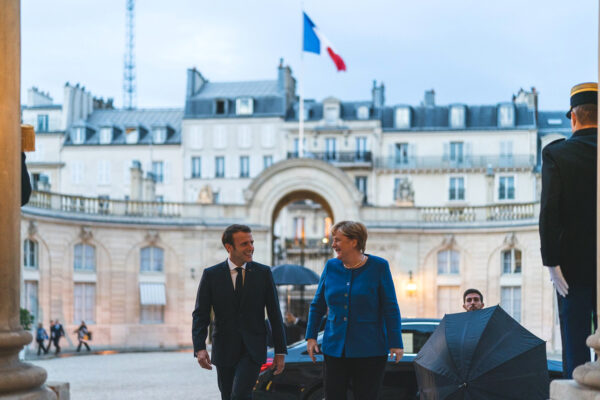
French president Emmanuel Macron and German chancellor Angela Merkel enter the Elysée Palace in Paris, November 12, 2019 (Elysée)
French Republicans have thrown away their two best chances of denying Emmanuel Macron a second term.
Party members eliminated Michel Barnier and Xavier Bertrand from the center-right’s presidential primary on Thursday, giving the men 24 and 22 percent support, respectively.
The more right-wing Éric Ciotti and Valérie Pécresse qualified for the runoff on Saturday with 25 percent support each.
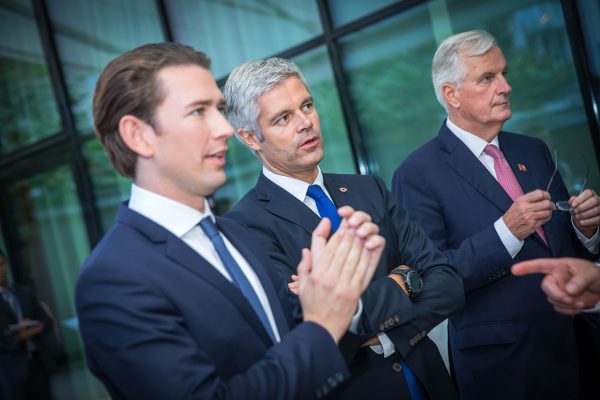
Austrian chancellor Sebastian Kurz meets with French Republican party leaders Laurent Wauquiez and Michel Barnier in Salzburg, September 19, 2018 (EPP)
French Republicans choose their presidential candidate this week, who will challenge Emmanuel Macron in the spring.
Like all French elections, the primary is held in two rounds. Five candidates have qualified.
French president Emmanuel Macron and his wife, Brigitte, leave the Elysée Palace in Paris, July 5 (Elysée/Ghislain Mariette)
France’s presidential election is six months away, and it’s Emmanuel Macron’s to lose.
One in four voters support him wholeheartedly. That’s the support he got in the first voting round of the 2017 election, and it’s the share polls give him now.
Another 25 to 35 percent would prefer Macron over the far-right Marine Le Pen or Éric Zemmour, who are polling in second and third place.
Only a center-right candidate could make the second voting round competitive, with Xavier Bertrand holding the best cards. (more…)
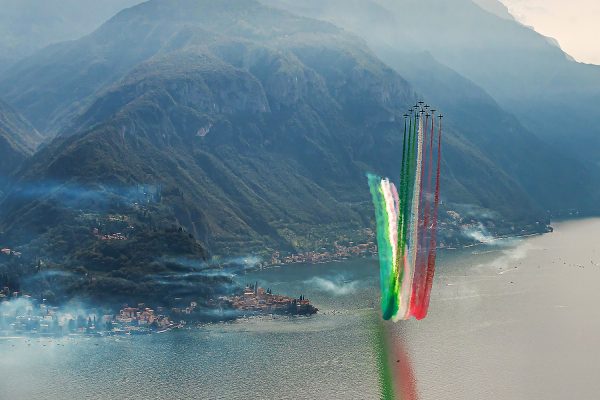
Italian Air Force jets create the country’s tricolor with green, white and red smoke trails over Varenna, September 29, 2019 (Wikimedia Commons/Achille Ballerini)
Pre-Trump America is not coming back. If last week’s announcement of a trilateral defense pact between Australia, the United Kingdom and the United States (“AUKUS”) doesn’t convince the last Atlanticists that Europe needs to take matters into its own hands, I don’t know what will.
The new alliance excludes Europe. It snatches a deal to build nuclear submarines from France, the EU’s top military power. And it was negotiated in secret. The three English-speaking leaders didn’t even bother to give their European allies a head’s up!
The French, who would lose a €56 billion contract to build submarines for Australia, have called the snub “a breach of trust” and “a stab in the back.” French ambassadors have been recalled from Canberra and Washington DC for the first time ever.
Other Europeans are frustrated too, with officials calling the Australian about-face “unacceptable.”
Inevitably, it has been dubbed a “wake-up call” by everyone from Josep Borrell, the EU’s foreign-policy coordinator, to Michael Roth, Germany’s European affairs ministers. But canceling an Australia-EU trade deal, which the European Commission had hoped to finalize this year, or postponing transatlantic talks about technology cooperation, which are scheduled for next week, won’t make Europe safer. What Europe needs to do is take its own defense seriously. (more…)
High-speed train in France (Adobe Stock/Chlorophylle)
French lawmakers adopted a far-reaching climate law this week that puts the country on track to meet its Paris commitment of reducing greenhouse gas emissions 40 percent by 2030 compared to 1990 levels.
That is short of the 55-percent cut the European Commission has proposed in its “Green Deal”, which has yet to be approved by member states.
The French measures do align with the EU’s new Common Agricultural Policy, which sets aside 20 to 25 percent of funding for “eco-schemes”, which can range from organic farms to forests and wetlands being retained for carbon sequestration.
Some of the policies flow from the citizen consultations President Emmanuel Macron held across France in the wake of the 2018 Yellow Vests protests, which were sparked by a rise in gasoline tax.
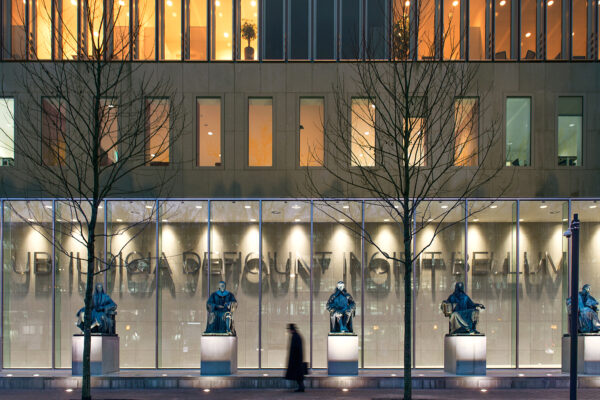
Supreme Court of the Netherlands in The Hague, February 3, 2016 (Rijksvastgoedbedrijf/Bas Kijzers)
European judges have discovered they can compel politicians to take action against climate change.
France’s Council of State has given the government of Emmanuel Macron an April 2022 deadline (one month before the election) to ensure the country will meet its target of reducing greenhouse gas emissions 40 percent by 2030 compared to 1990.
Germany’s Constitutional Court issued a similar ruling in April and gave the government an end-of-year deadline to update its policy.
A Dutch court has gone further, ordering Shell, the Anglo-Dutch oil giant, to reduce not just its own carbon dioxide emissions by 45 percent but those of its customers and suppliers as well.
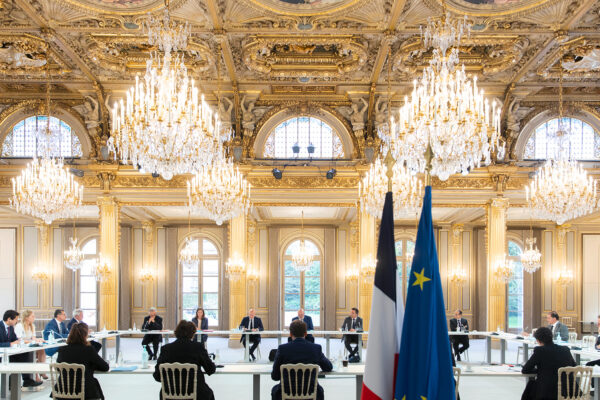
French president Emmanuel Macron chairs a meeting in the Elysée Palace in Paris, August 27, 2020 (Elysée/Philippe Servent)
Emmanuel Macron is reportedly mulling pension reforms that were put on hold during the COVID-19 pandemic.
There are risks: reforms will almost certainly spark protests, including from trade unions, which oppose raising the retirement age. Macron can ill afford social unrest a year away from the election.
But it could also burnish the French president’s reformist credentials after the COVID-19 crisis forced him into a more managerial role.
Macron is expected to unveil his plans when he addresses the nation ahead of Bastille Day on July 14. The fact that it has leaked he may bring back reforms suggests he is testing the waters. So let me add my arguments to the discussion.
I’ll take the political first before covering the — more important — substantive arguments. (more…)
Le Mabilay in Rennes, France, February 21, 2019 (Unsplash/Howard Bouchevereau)
France’s traditional major parties are projected to defend their control of the country’s thirteen regions in Europe in the second voting round on Sunday.
Last week, the center-left Socialists and center-right Republicans placed first in all regions, pushing Marine Le Pen’s far-right National Rally and President Emmanuel Macron’s liberal En Marche! into third and fourth place.
The runoffs this weekend confirmed the results with exit polls giving the Republicans 38 percent support nationally, followed by the Socialists and Greens (who allied in the second round) at 35 percent and National Rally on 20 percent.
Elections were also held in France’s five overseas regions. (more…)
French president Emmanuel Macron confers with his staff in the Elysée Palace in Paris, February 5, 2020 (Elysée/Soazig de la Moissonniere)
The unexpectedly strong performance of the center-right in France’s regional elections calls Emmanuel Macron’s reelection strategy into question.
The liberal incumbent has been leaning to the right expecting he would need their support to defeat the far right’s Marine Le Pen in a presidential runoff.
But if the center-right Republicans regroup, Macron risks not even qualifying for the runoff. (more…)
Harbor of La Rochelle, France, June 23, 2020 (Unsplash/Simon Pallard)
France’s traditional left- and right-wing parties won the first round of regional elections on Sunday.
They were eclipsed in the 2017 national and 2019 European elections by Emmanuel Macron’s En Marche! and Marine Le Pen’s National Rally.
Neither Macron nor Le Pen is likely to win one of France’s eighteen regional presidencies, but they are still polling in first and second place for the 2022 presidential election.
The second round of the regional elections will be held next week. (more…)
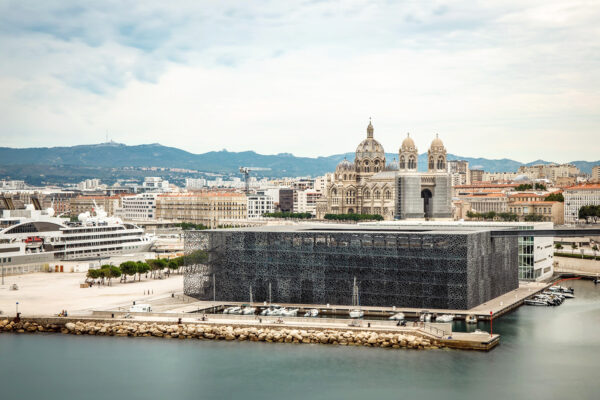
Skyline of Marseille, France, June 13 (Région Sud Provence-Alpes-Côte d’Azur)
All eighteen regions of France — thirteen in Europe and five overseas, counting Mayotte — hold assembly elections this Sunday and next. The assemblies in turn elect regional presidents, whose powers are more limited than those of American and German state governors.
More than 4,000 council seats across 96 departments — the administrative level between regions and municipalities — are also contested.
These are the last major elections in France before the presidential and National Assembly elections in April of next year. They are less a test of President Emmanuel Macron’s reelection prospects than a preview of whether he will be challenged by the center-right or far right.
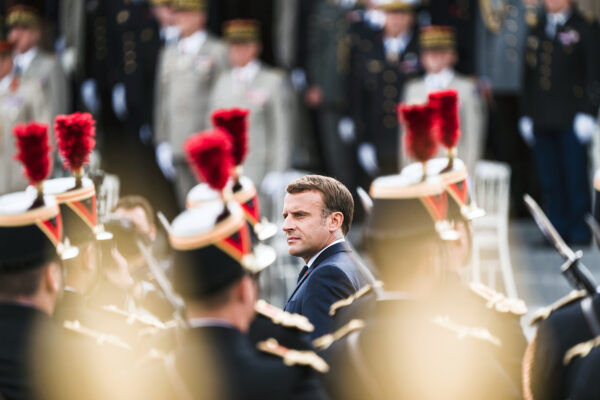
Presidents Donald Trump of the United States and Emmanuel Macron of France inspect an honor guard in Paris, July 13, 2017 (Elysée/Soazig de la Moissonniere)
French president Emmanuel Macron has proposed to hire an additional 10,000 cops before his term expires in a year, tighten laws against online hate speech and revise laws on criminal responsibility that allowed the killer of an elderly Jewish woman to go free.
In an interview with the conservative newspaper Le Figaro, the liberal head of state warns that “everyday violence” is on the rise and vows to “push back delinquency everywhere.”
The law-and-order offensive has inevitablybeenframedabroad as Macron’s attempt to take the wind out of Marine Le Pen’s sails. This isn’t wrong per se; he is likely to face the far-right leader in next year’s presidential election. But it substitutes for an analysis of whether the measures are justified. (more…)
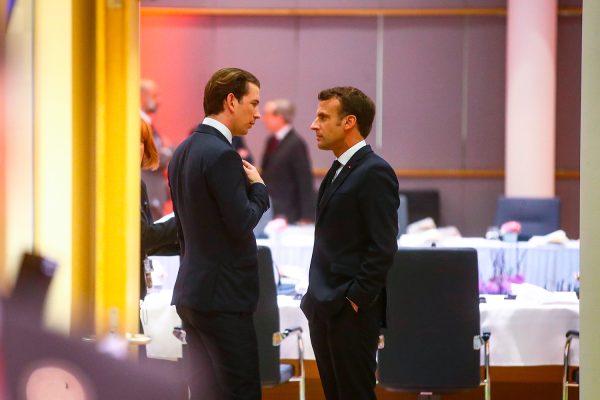
Austrian chancellor Sebastian Kurz and French president Emmanuel Macron speak on the sidelines of a summit in Brussels, April 10, 2019 (BKA/Arno Melicharek)
One constant of Emmanuel Macron’s presidency has been Anglo-American handwringing about his popularity.
This started almost immediately after he defeated Marine Le Pen in 2017, when Macron’s support fell from 66 percent in the election to just over 50 percent in the opinion polls.
The Guardian called it a “precipitous decline in approval ratings.”
French president Emmanuel Macron reviews a Bastille Day parade in Paris, July 14, 2020 (Elysée/Philippe Servent)
What has gotten into Persuasion?
First they published a ridiculous hit piece arguing Spain’s center-left prime minister, Pedro Sánchez, is the greatest threat to democracy since Francisco Franco. Now it’s Emmanuel Macron’s turn.
Robert Zaretsky, a history professor at the University of Houston, writes the French president has become “authoritarian”.
To be fair, Zaretsky recognizes that a measure of autocracy is built into France’s presidential-centric Fifth Republic. On paper, the French president is the most powerful leader in democratic Europe; both ceremonial head of state and chief executive. Every president, from Charles de Gaulle to François Mitterrand, has been accused of dominating French politics in their time.
Macron is no different. Zaretsky marshals little evidence to prove this president (ab)uses the powers of his office more than his predecessors. (more…)