Tag: Europe’s Far Right

  • Poland’s Law and Justice Party Finally Went Too Far

    Poland’s ruling Law and Justice party backed away from controversial press reforms on Tuesday after several nights of street demonstrations in the capital Warsaw.

    The concession is a rare victory for the liberal-minded opposition, which has otherwise been unable to stop Law and Justice from reversing the last twenty years of Poland’s democratization and liberalization.

    Last week, the nationalist-conservative party proposed a law that would ban all recordings of parliamentary sessions except by a select few broadcasters. It also called for a limit on the number of journalists who are allowed in the building at all.

    The bill became a focal point of protest against Law and Justice’s illiberal agenda, prompting even Lech Wałęsa to speak out. (more…)

  • The French Far Right’s Family Feud Explained

    Marine Le Pen
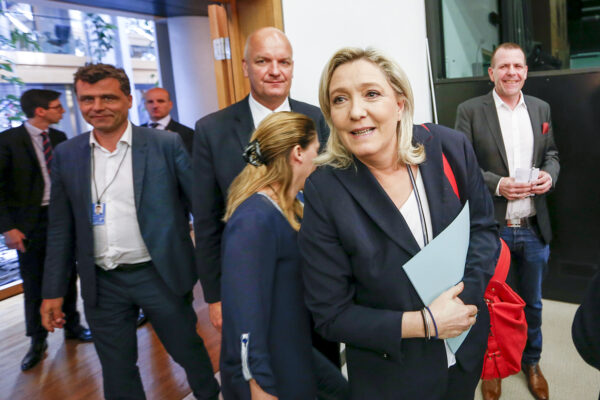
    French party leader Marine Le Pen makes her way to a news conference in Strasbourg, May 11 (European Parliament/Fred Marvaux)

    Politico reports that a long-simmering dispute between the two most prominent women of the French far right is getting out of hand.

    There is even a risk of a split in the Front national, the website argues: between the faction of leader Marine Le Pen and the socially conservative wing that has rallied around her 26 year-old niece, Marion Maréchal-Le Pen.

    The fact that it’s a family feud, in which the Le Pen patriarch and Vichy apologist Jean-Marie inevitably resurfaces, makes this a headline-grabbing story.

    But there are deeper, geographical and political divides at play that have less to do with personality. (more…)

  • Netherlands’ Wilders Attacks Court After Discrimination Verdict

    Dutch nationalist party leader Geert Wilders has attacked the judges who found him guilty of inciting discrimination on Friday and vowed to appeal the verdict.

    The controversial right-wing politician dismissed the panel of judges as “Freedom Party haters” who convicted “half the Netherlands” along with him.

    He previously called the proceedings a show trial and said he would not tone down his rhetoric whatever the outcome.

    “People who want to stop me will have to kill me,” he said.

    Wilders has lived under constant protection for twelve years. (more…)

  • Trump’s European Admirers Are Deluding Themselves

    Donald Trump’s unexpected presidential election in the United States has delighted his ideological counterparts in Europe. Brexiteers in the United Kingdom think he will give them a better deal than Hillary Clinton. Populists in France and the Netherlands have responded to Trump’s victory with glee. So have ultraconservatives in Central Europe.

    They should think again. Trump may be a kindred spirit. His triumph is a setback for the liberal consensus that nationalists in Europe and North America are trying to tear down. But he is no friend of European nations. (more…)

  • Echoes of Clinton-Trump Contest in the Netherlands

    Mark Rutte
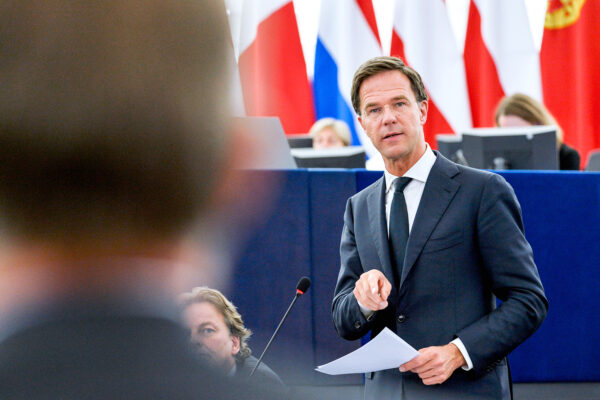
    Dutch prime minister Mark Rutte answers questions from members of the European Parliament in Strasbourg, July 5 (European Parliament)

    Tom-Jan Meeus has a good piece in Politico about the state of Dutch politics five months out from the next election.

    Meeus, who is a political columnist and former United States correspondent for NRC Handelsblad, argues that there is a American influence on this election: Should Donald Trump win in November, Meeus expects his Dutch counterpart, Geert Wilders, will shift further to the right. Mark Rutte, the incumbent center-right prime minister, could benefit if Hillary Clinton prevails.

    This probably oversells the effect of America’s elections on the Netherlands’, but Meeuw is onto something. (more…)

  • Austria’s Presidential Election Was About the Next Election

    Hohenwerfen Castle Austria
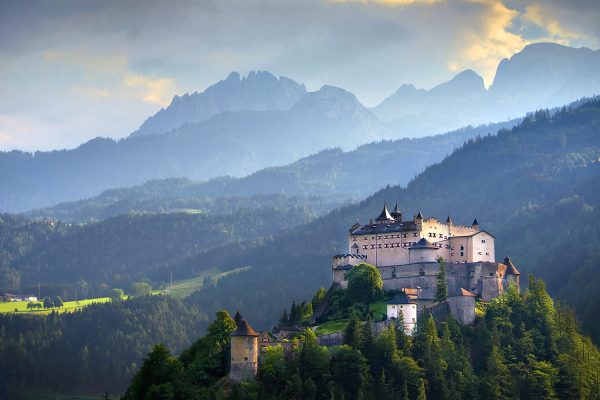
    Hohenwerfen Castle in the Salzach valley of Austria, August 14, 2015 (Daniel Parks)

    The near-victory of Norbert Hofer of the far-right Freedom Party in Austria’s presidential election has sent shockwaves around Europe. These have only partially been diminished by the revelation that Hofer, who led by a 52-48 percent margin on election night, actually lost to his Green Party opponent, Alexander Van der Bellen, by a margin of 30,000 votes once postal ballots were fully tallied.

    Far-right parties have been enjoying an upsurge in support across Europe in recent years, but it has been rare for them to make it into government — and rarer still for them to make headway in electoral systems that do not use proportional representation.

    The United Kingdom Independence Party managed to win only a single seat in the Britain’s Parliament in 2015 despite earning more than 13 percent of the vote. In France, the Front national came first during the initial round of regional elections this past year only to fail to win a single region when those races went to runoffs. Hofer’s achievement is therefore momentous in that he not only came first in the initial round of the presidential race with 35 percent but very nearly prevailed in the second round, when every other major candidate and party united against him. (more…)

  • Comrades in Arms

    Viktor Orbán Vladimir Putin
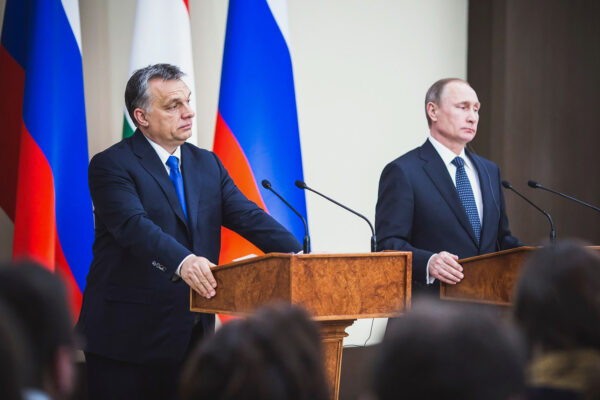
    Hungarian prime minister Viktor Orbán and Russian president Vladimir Putin answer questions from reporters in Moscow, February 17, 2016 (Facebook/Viktor Orbán)

    Sometimes in politics everything is exactly what it looks like.

    This was the case when the prime minister of Hungary, Viktor Orbán, visited Moscow last week, extended a gas contract with Russia and told the Russian president that the period when the EU automatically extended sanctions against Russia was “behind us.”

    The moment of honesty came when Vladimir Putin and Viktor Orbán got to compliment each other on their Syria and refugee-related policies. “We value greatly the efforts made to resolve this problem [of Middle Eastern refugees],” said Orbán, adding, “We wish you great success in your international initiatives.” Putin then said, “Our people has sympathy for the position taken by the Hungarian government” on the refugee crisis.

    And yes, in a perverse way, the two policies do indeed work very well together — that is, to suit the needs of the two leaders: Russia’s intervention in Syria aggravated the war and the refugee crisis. Which, in turn, strengthened Orbán’s position in Hungary and in Europe. Which, in turn, helped far-right parties and Putin allies and weakened the EU.

    This unspoken but existing alliance, ultimately, against the EU and against the solution of a refugee crisis that benefits them both, was behind the chumminess that the Hungarian prime minister and the Russian president showed in Moscow.

    The Russian pro-government press could hardly hide its joy over the visit. Izvestia wrote about a meeting of “not only partners, but friends on principles,” noting that Orbán was the first foreign leader whom Putin met in the new working building at his Novo-Ogaryovo residence. But calling Orbán and Putin friends is an exaggeration. Just as Orbán himself declared last year, Putin “is not a man who has a known personality,” which largely rules out making friends with fellow leaders. Even on principles. (more…)

  • Why European Nationalism Is Back

    Berlin Germany
    Skyline of Berlin, Germany, December 31, 2005 (Max Braun)

    The continent that gave us two world wars is rousing.

    The litany of nationalist events is long: a near-miss Scottish secession, a looming Catalonian one, the rise of the United Kingdom Independence Party, the relative success of France’s National Front and now, following the mass attacks on women in Cologne and other German cities on New Year’s Eve, a sudden public shift against migration in Germany. A continent that once embarked upon the transnational European Union aiming to end nationalism is now turned rightwards.

    There is a tale to tell here. Let’s begin. (more…)

  • UK Independence Party Appeals to Right-Wing Voters

    Could 2012 be the year that the United Kingdom Independence Party breaks into the British political system as more than a Euroskeptic platform? The scenario looks more likely after last week’s local elections. Nigel Farage’s party averaged 13 percent of the vote.

    In the last month, according to a YouGov poll, UKIP was the third most popular party in the United Kingdom. They have doubled their support since last year and surpassed the Liberal Democrats, currently in government with the Conservatives, by 1 percentage point. (more…)

  • Hungary’s New and Dangerous Constitution

    In the last few months the Western European press was full of news about Hungary. Not the most flattering news. It slowly dawned on people outside of the country that something was wrong with the new Hungarian government that won a landslide electoral victory almost a year ago.

    Signs of trouble, at least for those who live in Hungary or those who follow political events in the country, were evident from the very beginning. Prime Minister Viktor Orbán’s Fidesz party, an acronym of sorts for “young democrats,” is neither young nor democratic anymore. Sometime in 1993 the party under the guidance of Orbán, who was then a thirty year-old liberal, edged slowly but surely toward the right. Whether Orbán was always attracted to right-wing ideology or whether he decided to switch sides for political expediency is a topic of debate among political analysts.

    Today Fidesz is a nationalist party with a rightist ideology that eerily resembles that of Gyula Gömbös, Hungary’s prime minister between 1932 and 1936.

    Gömbös tried to introduce a political system in Hungary that mimicked Benito Mussolini’s fascism. It was only his early death that prevented him from succeeding.

    Western readers often find Orbán’s Fidesz described as “conservative” or “right of center.” I would like to correct that wholly inaccurate label. Fidesz under the leadership of Viktor Orbán is moving far to the right.

    This week, Adam Michnik, former Polish dissident and chief editor of Gazeta Wyborcza, warned Orbán, his old comrade in arms: “Viktor, this road leads to dictatorship.”

    What has happened since the election last April? A lot, unfortunately. Fidesz won 53 percent of the vote but because of the pecularities of the Hungarian electoral system, the party managed to attain over two-thirds of the parliamentary seats. The Fidesz members of parliament were all hand picked by the new prime minister. Potential opponents were set aside. They became members of the European Parliament or were paid off with some lucrative job. Anyone who has since made what Orbán deemed to be a political mistake has been thrown out of the party or demoted.

    Under the current Hungarian constitution a party with a two-thirds majority can do practically anything. So Orbán undertook the complete reworking of the Hungarian political system. He put his own men into important “independent” positions including the Accounting Office that supposedly supervises the government’s finances and the Office of the Chief Prosecutor. Right now he is working on doing the same to the Office of the Chief Justice. If he didn’t like a particular ruling of the Constitutional Court, his two-thirds majority voting bloc simply stripped the court of some of its powers. The President’s Office was filled with a man of limited intelligence who is a servile puppet. One could continue.

    About all this the outside world knew little until Orbán made the mistake of drafting a media law that would muzzle the written and electronic press. The attack on the freedom of journalists resonated across the world. What is more, Orbán introduced his legislation at the very end of December of last year, mere weeks before Hungary assumed the rotating presidency of the European Union.

    Then came two solid months of wrangling over the media law between the European Commission and the Hungarian government. Orbán initially insisted that the would not allow any changes in the law but eventually had to relent. Under European pressure, some changes were made and voted on only recently, but the European Parliament remained dissatisfied. Once again, Hungary has insisted that it will not change a word in the legislation but it might not be the end of the story.

    Since the media law was enacted, Fidesz and its ally the Jobbik party have worked on rewriting their country’s constitution. While other opposition parties originally sent delegates to the committee entrusted with drafting the Constitution, it soon became clear that not one of their suggestions would be included in the final draft. They determined, moreover, that their participation could be injurious to their own interests. Let Fidesz with the assistance of the far-right Jobbik come up with a constitution and it will be very difficult to convince the world that it is anything more than a party document that cannot serve the interests of the entire nation.

    Fidesz leaders have in recent weeks tried to convince the green liberal LMP to join them in the effort after all. Although LMP can’t always decide whether they hate the socialists or Fidesz more, their leaders refused to budge.

    Before 1949 Hungary had no written constitution. The Hungarian legal system functioned very much like that of Great Britain. In 1949, during the Rákosi period, a Hungarian version of the Stalinist Soviet constitution was adopted. With the change of regime in 1989-1990 something had to be done in a hurry. Thus liberal minded constitutional lawyers began rewriting the 1949 document. Their rewrite was so thorough that only a few sentences remained from the Stalinist version. Yet the 1949 date remained. This “oversight” allowed Orbán to claim that the current charter is in fact a communist one.

    If one had asked the leaders of Fidesz whether they favored drafting a new constitution from scratch just several years ago, most would probably have said “no.” Orbán himself only complained about the preamble which he didn’t think was dignified enough. But then came the overwhelming electoral victory and Orbán discovered that there was a “revolution in the voting booths.” A revolution that demanded a new foundation.

    There was a lot of confusion about when the work on the new constitution should start and how long it would take to draft a new basic law. Orbán at first talked about two years, then one year and suddenly the nation was told that the new constitution had to be done by Easter Monday. This is very much in line with Orbán’s image of himself and his work. A few years ago he borrowed the words of Jesus Christ sending his disciplines forth to spread the faith.

    The text of the Constitution was almost entirely written by a single Fidesz parliamentarian whose only knowledge of constitutional law derives from having attended law school with his friend Viktor Orbán.

    The preamble, which Fidesz politicians insist on calling “the national creed,” is a verbose and confused account of Hungarian history and a nationalistic wish list for a glorious future. The body of the Constitution still needs a lot of scrutiny but at first glance it seems that this constitution’s importance lies in making sure that the present government and Fidesz can remain in power for at least twelve more years.

    A Hungarian political philosopher who is not known for his optimism said that while the old constitution served the country for some twenty years, the new one is unlikely to be around for long. He may well be right. A year after the stunning Fidesz victory, this week, during Hungary’s national holiday celebrating the revolution of 1848, more people demonstrated against the government than listened to Viktor Orbán’s speech telling the European Union to get lost.

    For more, read “The first draft of the new Hungarian constitution, Parts I, II and III” at the author’s blog, Hungarian Spectrum.

  • The Far Right’s Revival in France

    One of the things that was taken out of the 2007 French presidential election was the collapse of the far right (the Front national or FN), the same far right which five years earlier had shocked the world and France by placing second in the presidential race with 16.9 percent of the vote. Its poor 10.4 percent showing in 2007 was followed by a drubbing in subsequent legislative elections and an equally weak showing in the 2009 European elections.

    It has rightfully been said that Nicolas Sarkozy took a lot of the far-right vote in 2007 with his tough law and order platform and populist rhetoric. It helped him with working-class voters, many of whom had supported the FN in 2002 despite their left-wing roots.

    Following the party’s collapse, which put it on the verge of bankruptcy and forced it to sell off its headquarters in an affluent Parisian suburb, the far right was buried. Sarkozy and the traditional right had permanently integrated most of the FN’s electorate, and it would collapse following the inevitable retirement of its historical lider maximo, Jean-Marie Le Pen.

    It turns out that the far right was buried far too early and the party that passed for dead or at least moribund four years ago is roaring back with a vengeance. (more…)

  • Hungary on the World Stage

    Hungarians often complain that the world knows so little about them. Foreigners mix up Budapest with Bucharest. Some people think that Hungarian is a Slavic language. They don’t know that Hungary was a superpower in the fifteenth century. They are ignorant of how Hungary saved Christian Europe from the wrath of the Ottoman Empire. And one could go on and on.

    Well, right now Hungarians can’t complain. The country became world-famous practically overnight. It took only a few words from Hungarian leaders to weaken the euro and create turmoil in the world’s financial markets. That was no small feat, although I’m not sure whether this is the kind of fame Hungarians dreamed of. (more…)