Remi Adekoya explains in Foreign Affairs how Poland’s ruling Law and Justice party has been able to remain popular despite truncating democratic norms and institutions and antagonizing the EU:
It has raised social spending, specifically for poor rural families with children.
It portrays its domestic opponents as corrupt elites fighting to preserve their influence.
It portrays its European critics as fanatical multiculturalists and militant secularists who are so obsessed with political correctness they have lost all sense of self-preservation. (more…)
Italy’s Northern League would rather go into coalition with the populist Five Star Movement than the mainstream center-left, its leader, Matteo Salvini, has said.
Speaking in Palermo on Monday, the conservative lamented that the Five Stars are “showing their incompetence where they govern.”
But, he added, “if I were to call someone, I wouldn’t call Renzi or Alfano” — referring to Democratic Party leader Matteo Renzi and Foreign Minister Angelino Alfano, the leader of the small center-right Popular Alternative.
Renzi’s Democrats are polling neck and neck with the Five Star Movement. Salvini’s Northern League is vying with former prime minister Silvio Berlusconi’s Forza Italia to become the largest party on the right. Support for the Popular Alternative is in the single digits. (more…)
French National Front leader Marine Le Pen listens to a debate in the European Parliament in Strasbourg, July 1, 2014 (Wikimedia Commons/Claude Truong-Ngoc)
Florian Philippot’s ouster from the National Front makes political sense.
Philippot was for years Marine Le Pen’s right-hand man. Together they transformed the reactionary party, which has deep roots in the French Algerian exile community, into a broad Euroskeptic and nativist force that could appeal to rust-belt voters.
They de-demonized the National Front. Le Pen won 34 percent support in this year’s presidential election, doubling her father’s record from fifteen years ago.
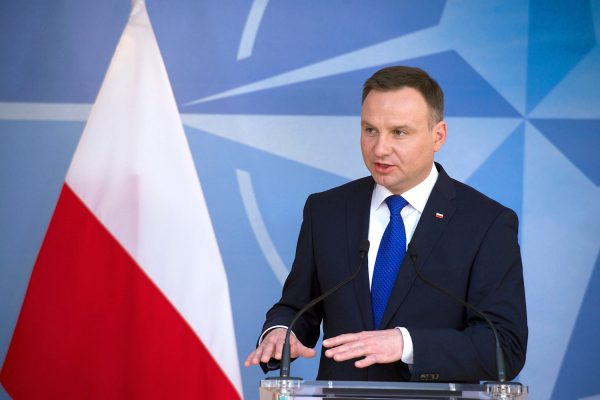
Polish president Andrzej Duda answers questions from reporters at NATO headquarters in Brussels, January 18, 2016 (NATO)
Poland’s president, Andrzej Duda, has surprised observers by vetoing legislation from his own Law and Justice party that would have defanged the judiciary.
Closer scrutiny suggests Duda’s opposition is less meaningful than it is made out to be, though.
The president has said he will sign the bills if they are amended and Leonid Bershidsky argues at Bloomberg View that his proposed changes don’t deviate from the legislation’s objective: “to put the judiciary, which the party argues has turned into an elitist caste, under more political control.” (more…)
Poland’s ruling Law and Justice party pushed through more changes to the court system on Wednesday:
One bill takes power to appoint members to the National Judicial Council, which is responsible for appointing lower-level judges, away from the judiciary itself and gives it to parliament, where Law and Justice has a majority.
The same law removes fifteen of the 25 judges currently serving on the National Judicial Council.
A second bill gives the justice minister the power to unilaterally replace court presidents. (more…)
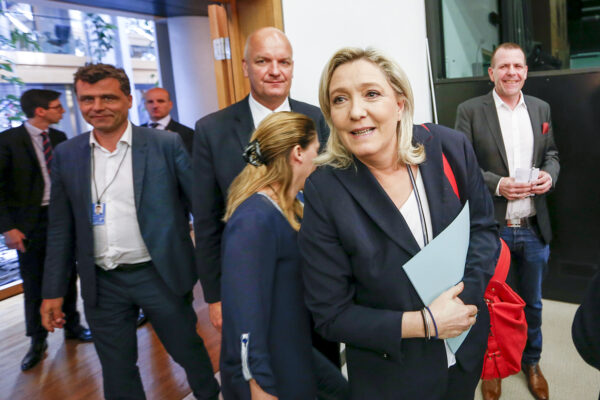
French party leader Marine Le Pen makes her way to a news conference in Strasbourg, May 11, 2016 (European Parliament/Fred Marvaux)
France’s National Front will have to reinvent itself after a disappointing election result on Sunday.
The nationalists were hoping to get 40 percent support or more in the presidential runoff, but Marine Le Pen got stuck at 34 percent. Still double her father’s performance when he qualified for the second voting round in 2002, but a letdown nonetheless.
In her concession speech, Le Pen promised voters “profound reform” of her party in order to create “a new political force” for all French “patriots” who oppose the globalism of Emmanuel Macron, the incoming president.
Whether this means starting a new party or rebranding the National Front remains to be seen, but change is in the air. With it could come a struggle for the movement’s identity. (more…)
With five months to go before parliamentary elections, Germany’s nationalist party is imploding.
Frauke Petry, the charismatic leader of the Alternative für Deutschland, has said she will not lead the election campaign in the fall, in effect conceding defeat in a long-running power struggle.
Petry is officially one of two party leaders, but she sought to become its sole candidate for the chancellorship.
Even if the Alternative would have stood little chance of prevailing in September’s election anyway, a role as Spitzenkandidat could have given Petry more influence.
Her opponents argued for a team of leading contenders representing the various tendencies in the party. (more…)
View of Paris, France from Montmartre, October 2, 2016 (Unsplash/Colin Maynard)
And why is it so critical? Nothing less than the European Union is at stake — and with it, the geopolitical contract that has bound Germany and France together since World War II.
After the defeat of anti-Islam populist Geert Wilders early this month in the Netherlands, it is reasonable to ask if populism as shaped by the alt-right has hit its limit. Europeans have watched the confusion in Britain over Brexit and the rise of Donald Trump. Now they are revisiting both their Euroskepticism and their willingness to gamble on ideologies not yet fully tested.
Yet France is subject to powerful forces quite different than the Netherlands, which has only a fraction of its population and international obligations. A large, unassimilated Muslim and African population simmers; an aging, conservative voter base roils; a discredited, weakened left wavers; and nobody knows what to do with the neoliberal threads that hold together the European Union yet impoverish just about anyone not in the upper classes.
All these factors make France a combustible mix of alt-right populism, weakened mainstream parties, terror cells, angry youth and dithering establishment elites. If we were shocked by Brexit, we should be less shocked by whatever happens next month as the French go to vote. France is as upended as everyone else. 2017 compares to the turmoil of the collapse of the Fourth Republic in 1958. (more…)
Far-right party leaders Matteo Salvini of Italy, Marine Le Pen of France, Harald Vilimsky of Austria and Michał Marusik of Poland give a news conference in Strasbourg, May 11, 2016 (European Parliament/Fred Marvaux)
When I was a teenager, I had to drive my older brother to downtown Phoenix. He couldn’t drive himself; he’d made a series of poor life choices, so it fell to me, the relatively responsible one, to ferry him about.
As we drove, he ranted to me about blacks, Mexicans and Jews, using all the tried and true tropes of the traditional white-supremacist right — tossing in, for my “education,” that the Bible had given blacks over to whites as slave-animals. When we pulled up to our destination, a Mexican guy was hanging out on the Phoenix equivalent of a stoop; my brother would have to pass by the guy. I asked him, in that teenaged point-blank manner, what he thought of the man.
“Oh no,” my brother replied. “He’s one of the good ones.” Switching off from racist extraordinaire, he proceeded to carry out his errand and have a light, polite chat with the very man whose race he’d spent much of our journey together trashing.
It was my first encounter with the doublethink that would swirl to become the alt-right. (more…)
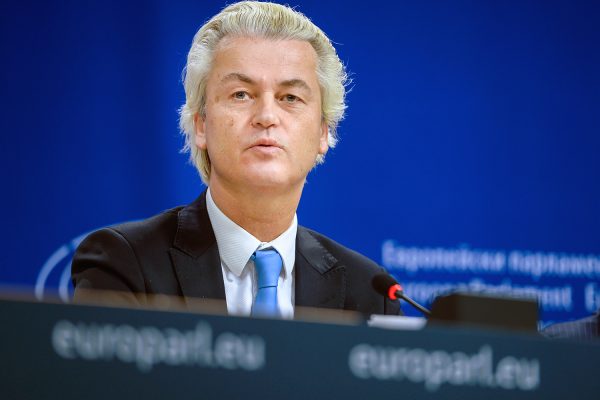
Dutch Freedom Party leader Geert Wilders gives a news conference in Brussels, June 16, 2015 (European Parliament)
The absence of a serious manifesto did not suggest that the Netherlands’ Geert Wilders had any intention of governing after the election on Wednesday. Now two former elected officials of his Freedom Party have confirmed that he isn’t interested in power — especially the responsibility that comes with it.
Jhim van Bemmel, who sat in parliament from 2010 to 2012, told the broadcaster Human that Wilders pulled out of accord with center-right parties that year for fear of losing popularity.
For two years, Wilders had supported a minority government led by his center-right rival, Mark Rutte. He walked out when the ruling parties proposed more austerity.
Wilders to this day maintains that he quit in order to protect pensioners from cuts. Van Bemmel disputed that assertion as “total nonsense”.
Other Freedom Party dissidents have made similar claims. (more…)
Dutch Freedom Party leader Geert Wilders gives a news conference in Brussels, June 16, 2015 (European Parliament)
Geert Wilders’ strategy of not showing up isn’t doing his Freedom Party much good.
Support for the party, which wants to take the Netherlands out of the European Union and stop immigration from Muslim countries, has gone down in the polls from a 21-percent high in December to 16 percent today.
Prime Minister Mark Rutte’s liberals are on track to surpass the Freedom Party as the single largest. In some surveys, they already have.
Even if the Freedom Party does place first, it is unlikely to join a coalition government. All other major parties have ruled out an accord. (more…)
Dutch Freedom Party leader Geert Wilders gives a news conference in Brussels, June 16, 2015 (European Parliament)
The reason even right-wing parties in the Netherlands have ruled out forming a government with the nativist Freedom Party after the election next month is that they tried to make it work before — and failed.
Polls suggest the anti-EU and anti-immigrant party led by Geert Wilders could become the single largest with around 20 percent support. But it’s unlikely to come to power.
Prime Minister Mark Rutte, whose liberal party is polling in second place, has said there is “zero” chance he will do another deal with Wilders after the Freedom Party leader walked out the last time they worked together.
There may be a lesson here for Republicans in the United States, who think they can co-opt Donald Trump, and Conservatives in Britain, who think they might harness the nationalist passions unleashed by Brexit. The Dutch experience suggests attempts to co-opt populism are unlikely to last and can easily backfire. (more…)
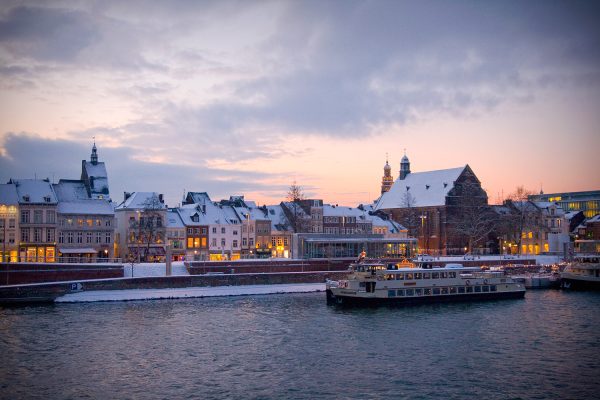
Evening falls in Maastricht, the Netherlands, January 5, 2009 (Bert Kaufmann)
Support for the nationalist Freedom Party rises the farther away one travels from the commercial and political heartland of the Netherlands on the North Sea coast, a recent survey shows.
The anti-EU and anti-immigrant party led by Geert Wilders receives around 20 percent support nationwide, but there are regional differences.
I&O Research found that the party is most popular in the border regions of Groningen, Limburg and Zeeland.
In Noord-Brabant, the country’s third largest province and home to technology hubs Eindhoven and Tilburg, Freedom Party support hovers around 15 percent.
The party struggles to get more than 10 percent support in the rest of the country. It is least popular in the “Randstad” provinces of Noord-Holland, Zuid-Holland and Utrecht, which is where the major cities are located. (more…)
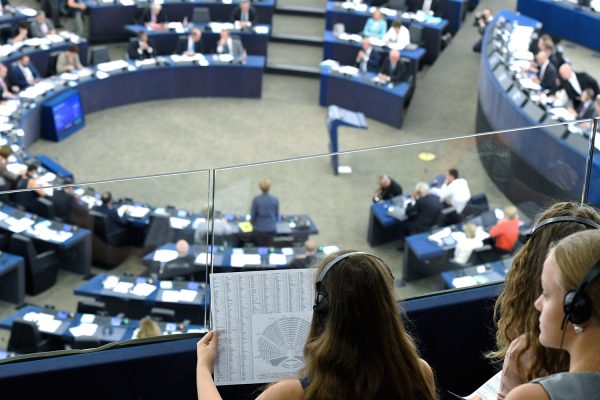
Three young women listen to a debate in the European Parliament in Strasbourg, September 14, 2016 (European Parliament)
Italy’s Euroskeptic Five Star Movement is leaving Nigel Farage’s group in the European Parliament and applying to join the Alliance of Liberals and Democrats (ALDE) instead, Beppe Grillo announced on Monday.
In a vaguely-worded blog post, the former comedian and Five Star Movement leader argues that by joining the liberal bloc, “we think we can deal with more concentration both, you and us, the next challenges.”
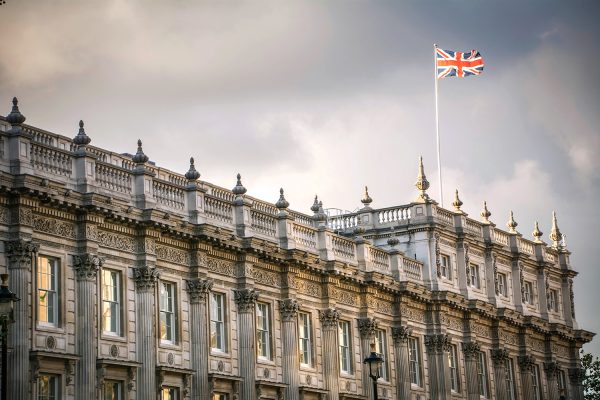
The British flag flies over the Cabinet Office in London, England (Shutterstock/Willy Barton)
Brexit’s erosive effect on British democracy continues.
Consider this recent story in The Telegraph, which takes the entire civil service to task for refusing to make Britain’s exit from the European Union a success.
The reality is that Britain’s civil servants are among the world’s most capable and that leaving the EU is going to be painful. There is no way to make Brexit a “success” by any objective measure.
As recently as a few months ago, serious Brexiteers recognized as much. They admitted that leaving the EU would have a negative effect on the economy, at least in the short term. But, they argued, independence from Brussels would make up for it in spirit.
Now even such admissions are taboo in Euroskeptic circles and civil servants who dare state the obvious are considered traitors to the cause. (more…)