Minister Presidents Horst Seehofer of Bavaria and Winfried Kretschmann of Baden-Württemberg speak in the Federal Council in Berlin, October 10, 2014 (Bundesrat/Henning Schacht)
Bavaria’s ruling Christian Social Union (CSU) is gearing up for a change in leadership after Horst Seehofer, the state premier, announced his resignation on Monday.
Markus Söder, the state’s finance minister, will take Seehofer’s place at the head of the Bavarian government.
Seehofer remains party chief for now, at least until coalition talks for a national government are completed.
But it seems only a matter of time before he will have to give up that post as well. (more…)
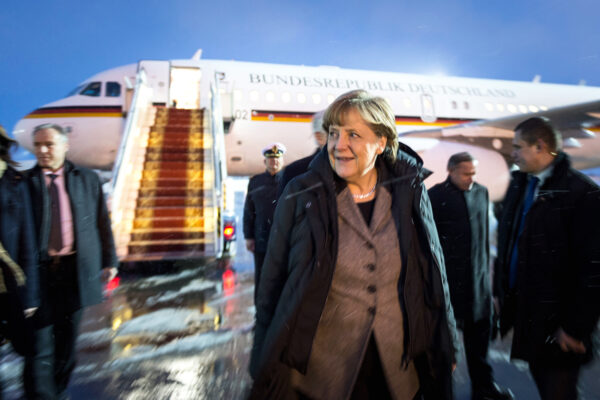
German chancellor Angela Merkel arrives in Kiev, Ukraine, February 5, 2015 (Bundesregierung/Steffen Kugler)
Angela Merkel’s answer to the defection of right-wing voters is — counterintuitively — to shift further to the left.
Der Spiegel reports that the German chancellor recently told members of her Christian Democratic party (CDU) they need to do better on pay, pensions and housing.
They were expecting a harder line on immigration, which is the issue that galvanized the Alternative for Germany’s voters.
This new far-right party placed third in last month’s election with nearly 13 percent support.
Merkel’s Christian Democrats still won, but with only 33 percent support — their lowest vote share in over half a century. (more…)
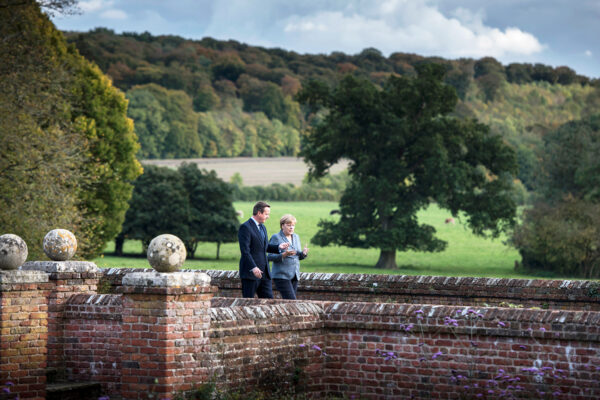
British prime minister David Cameron walks with German chancellor Angela Merkel outside his Chequers country residence in Buckinghamshire, England, October 9, 2015 (Bundesregierung/Guido Bergmann)
A three-party “Jamaica” coalition in Germany may not be so bad for Europe as observers fear, writes Guntram Wolff of the Bruegel think tank in the Financial Times.
He recognizes that the liberal Free Democrats are more Euroskeptic than Angela Merkel’s Christian Democrats and the Greens. They have opposed Greek debt relief, are wary of a common eurozone budget and argue for strict enforcement the bloc’s fiscal rules.
But that also applies to Wolfgang Schäuble, the outgoing finance minister. His likely Free Democratic successor could hardly be more hawkish.
A Jamaica coalition (named for the colors of the three parties, which match the Caribbean nation’s flag) would be open to some of the other EU reform proposals French president Emmanuel Macron made this week, from enhancing defense cooperation to creating a single European asylum policy. (more…)
Center-right voters in Germany hope Angela Merkel’s next coalition government will unite her Christian Democrats and the liberal Free Democrats. But if the Greens are needed for a majority, they could live with that, the latest Deutschlandtrend poll shows.
Green party voters are less interested in a three-party coalition but surprisingly supportive of a deal with the right: 68 percent would join a Merkel-led administration.
The Christian Democrats are almost certain to remain the largest party, but it’s unclear from the polls if the Free Democrats will win enough seats to form a two-party government.
The Social Democrats, the second largest party, aren’t desperate for another “grand coalition”. Half their voters would prefer to go into opposition rather than share power with Merkel for another four years. (more…)
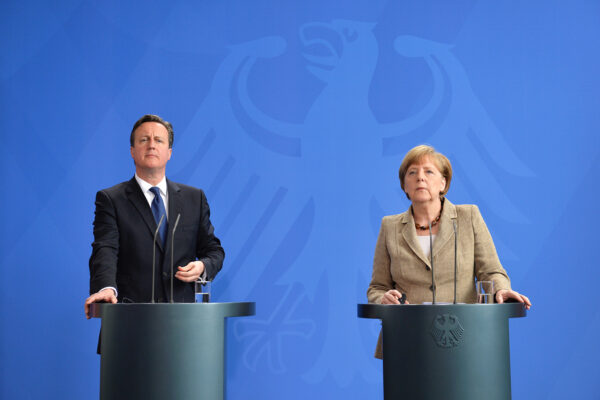
British prime minister David Cameron and German chancellor Angela Merkel answer questions from reporters in Berlin, May 29, 2015 (10 Downing Street/Arron Hoare)
Comparing the platforms of the six parties competing in the German election reveals two divides:
The first is between the traditional left and right on spending and taxes. The Social Democrats, Greens and far-left Die Linke want higher taxes on the wealthy to fund public investment. The Christian Democrats, liberal Free Democrats and nativist Alternative argue for tax cuts.
The second divide is between the four mainstream parties and the extremes on defense and foreign policy. The Christian Democrats, Social Democrats, Greens and Free Democrats all support closer European integration and NATO. The Alternative wants out of the euro. Die Linke would swap NATO for a security pact with Russia.
Here is a closer look at where the parties stand on defense, Europe, immigration, spending and taxes. (more…)
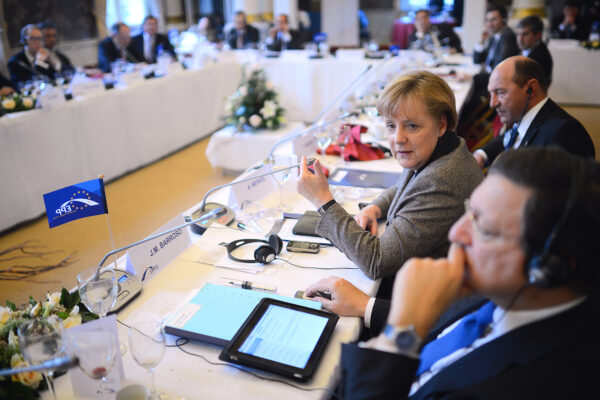
German chancellor Angela Merkel attends a meeting with other European conservative party leaders in Brussels, December 13, 2012 (EPP)
Germany’s Christian Democrats are so far ahead in the opinion polls that the only question seems to be who will govern with them after the election?
Support for Angela Merkel’s party has been just short of 40 percent since May. The Social Democrats, who briefly polled neck and neck with the conservatives earlier in the year, are down to 25 percent.
The Greens, liberal Free Democrats, far-left Die Linke and far-right Alternative für Deutschland would split the remainder of the vote.
Unless the numbers change dramatically between now and September, Merkel would have three ways to stay in power:
A continuation of her “grand coalition” with the Social Democrats;
A center-right coalition with the Free Democrats; or
A center-left coalition with the Greens.
A right-wing pact with the Alternative can be ruled out. (more…)
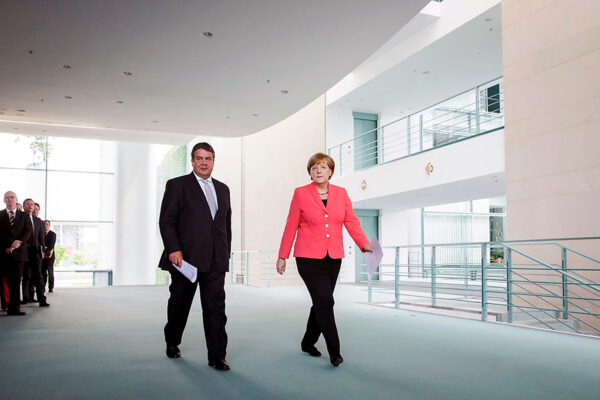
German party leaders Sigmar Gabriel and Angela Merkel walk to a news conference in Berlin, June 29, 2015 (Bundesregierung)
German chancellor Angela Merkel’s party promises long-overdue investments in its election manifesto, but a plan for attracting high-skilled migrants is unconvincing.
The Christian Democrats, who are projected to win the most votes in September’s election, pledge to sustain recent increases in spending on digitalization and infrastructure and raise spending on research and development from 3 to 3.5 percent of the economy.
German public investment has languished for years as the Christian Democrats prioritized deficit reduction. The Dutch and Swedes invest twice as much in everything from electricity grids to roads. (more…)
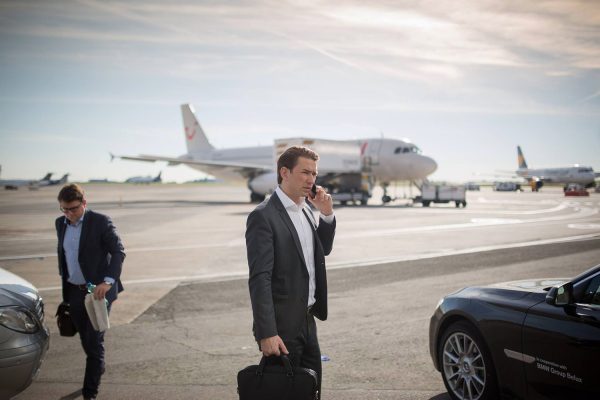
Austrian foreign minister Sebastian Kurz takes a phone call at Brussels Airport, Belgium, May 22 (ÖVP)
Center-right parties in Western Europe are responding to competition from the nativist right in radically different ways.
Whereas Dutch prime minister and liberal party leader Mark Rutte argued against the “pessimism” of the nationalist Freedom Party in the March election and won, conservative leaders in Austria and the United Kingdom have chosen to appease reactionary voters.
Sebastian Kurz, the Austrian foreign minister, has been elected leader of the Christian democratic People’s Party because he appeals to voters who might switch to the far right.
Kurz made his name writing an Islam Law for Austria that, among other things, prohibits foreign funding of mosques.
He also took a hard line in last year’s refugee crisis, going behind Europe’s back to do a deal with neighboring Balkan countries to control the influx of people.
Other leaders were dismayed, but Austrian voters seem to approve.
A year ago, the Freedom Party was faraway the country’s most popular with around 32 percent support in the polls. Support for the ruling Social Democrats and People’s Party languished in the low twenties. Now the three are neck and neck. There is a good chance Kurz will be the next chancellor. (more…)
British prime minister David Cameron and German chancellor Angela Merkel answer questions from reporters in Berlin, May 29, 2015 (10 Downing Street/Arron Hoare)
Twelve years into the Merkel era, Germans are ready for a change.
A Politbarometer poll conducted for ZDF television found that one in two voters want Martin Schulz, the Social Democrat, to become chancellor after the election in September.
Angela Merkel’s proposal to ban the burqa has caught some of her foreign admirers by surprise.
A headline at the left-leaning Vox reads, “Germany’s famously tolerant chancellor just proposed a burqa ban,” implying it is both intolerant and out of character for Merkel.
Vox is right when it argues the timing is political. Merkel recently announced she will seek a fourth term as chancellor next year and is facing criticism of her immigration policy from the right.
But this is not an about-face. If anything, her open-doors immigration policy was. (more…)
German chancellor Angela Merkel answers questions from reporters in Berlin, November 9 (Bundesregierung)
“The people in Germany have never had it so good,” Angela Merkel said on Wednesday — and she exhorted them to stay the course that has brought them this far.
In a speech to parliament that was seen as heralding her campaign to seek a fourth term as chancellor next year, the German leader called for unity on “multilateralism” and “shaping globalization together with others.”
“Openness will bring us more security than isolation,” she said.
That’s quite a reversal for the Christian Democrat, who only a few years ago said Multikulti had failed. (more…)
German chancellor Angela Merkel meets with other European conservative party leaders in Brussels, December 13, 2012 (EPP)
Polls predict that German chancellor Angela Merkel will cruise to a comfortable victory in this week’s parliamentary elections. We would welcome her reelection.
Although the liberal Free Democrats, who emphasize economic freedom and individual responsibility, are more aligned with the Atlantic Sentinel‘s views, their leader, economy minister Philipp Rösler, looks unfit for the chancellorship. Merkel, by contrast, has proven herself to be a wise leader since she first assumed office in 2005 — sometimes pragmatic, otherwise steadfast. (more…)
When German voters decide the new composition of the Bundestag in the fall of this year, one thing seems almost inevitable: Angela Merkel will remain chancellor, unless all three parties left of center agree to form a coalition government of their own.
Although the scenario seems highly improbable, Merkel will be presented with a tough choice of her own. While it is too early to put too much faith in opinion polls, the current numbers are startling: Merkel’s conservatives are consistently breaking the 40 percent mark while the Social Democrats led by Peer Steinbrück can barely meet 30 percent of voter approval.
But Merkel’s present coalition partners, the liberal Free Democrats, are caught in a battle for political survival, failing to meet the necessary 5 percent mark to be represented in parliament in almost every poll. In recent weeks it has become clear that the Christian Democrats are already taking the possibility of a new coalition partner into their calculations, showing a dwindling support for the liberals in upcoming provincial elections. This strategy is painful for the liberals but makes sense from Angela Merkel’s point of view. Why rely on a razor’s edge majority on the right when a more comfortable margin could be reached with the Social Democrats or the Greens? (more…)