Author: Daniel DePetris

  • Condemnations of Syrian War Crimes Have Little Impact

    While much of the world is focused on the dismantling of Syria’s chemical weapons program, the United Nations Human Rights Council is devoting serious resources to another major issue in the Syrian Civil War: the lack of accountability for those who are engaged in atrocities.

    In a speech to reporters in Geneva, Switzerland, the international body’s top human rights official, Navi Pillay, disclosed that her colleagues had uncovered numerous incidents in the fighting that amounted to war crimes or crimes against humanity.

    Observers of the Syrian Civil War, which is now in its third years, might not be surprised. Reports of what can well be considered crimes against humanity have regularly surfaced. Syrian military forces deliberately bomb densely populated areas, regardless of how many civilians are in the vicinity. Entire neighborhoods have been destroyed by the regime’s use of fighter aircraft, heavy artillery and helicopter gunships. Cluster munitions and barrel bombs that explode on impact, covering wider areas than regular munitions, have been used throughout the year. Bakeries, schools and power stations have all been targeted — if not to destroy rebel supplies and command centers, than to frighten civilians into thinking twice about supporting the opposition.

    But in a twist that could potentially add renewed urgency to the humanitarian crisis in the country, Pillay singled out President Bashar Assad for either ordering or condoning these abuses. (more…)

  • Karzai Jeopardizes Afghanistan Security Pact

    After a year of negotiations and what was reportedly a tense telephone conversation with Secretary of State John Kerry last week, it looked as though Afghanistan’s president Hamid Karzai was about to finalize a security pact with the United States that allowed for a residual troop presence post 2014. Yet despite agreeing to the terms of the deal, Karzai vowed on Sunday not to sign it until after the presidential elections of April next year.

    In a speech to some 2,500 tribal elders who had gathered in Kabul to discuss the security agreement — which would provide American troops with access to nine military bases and enable them to continue intelligence gathering and training activities — Karzai accused the United States of undermining his presidency through a campaign of disinformation. He intimated that the Americans could not be trusted, even after the tribal assembly had urged him to ratify the agreement next month.

    Sources close to the Afghan president claim that he is perfectly willing to fight the United States on this issue. According to The Washington Post, Karzai believes the Obama Administration is bluffing when it threatens to pull out all remaining troops by the time NATO’s mandate expires in 2014 unless an agreement is ratified before the end of the year. That may turn out to be a fatal miscalculation on his part.

    Why should Karzai put the brakes on a defense relationship that benefits both his government and the United States? And why does he insist on embarrassing an ally that put him in power, kept the Taliban insurgency at bay and poured billions of dollars of aid into his administration’s coffers? (more…)

  • Senate Threatens More Sanctions as Iran Talks Resume

    For the second time in nearly three weeks, America’s secretary of state, John Kerry, changed his travel schedule on Friday to attend nuclear talks with Iran in Switzerland. At home, lawmakers were growing restless.

    The last time Kerry attended the negotiations in Geneva between the world’s major powers and Iran, a deal seemed at hand but failed to materialize when the five permanent members of the United Nations Security Council plus Germany refused to recognize Iran’s right to enrich uranium. France also walked out, reportedly because the closure of a key plutonium plant was not part of the agreement. (more…)

  • After Years of Friction, Afghan Pact Rests with Tribal Leaders

    After a lengthy negotiation that lasted nearly a year and contained a number of near breakdowns, Afghanistan and the United States agreed in principle to an agreement that would allow NATO forces to remain in the South Asian country after their mandate expires in 2014.

    The deal, referred to as the Security and Defense Cooperation Agreement, is an ambitious document that attempts to lay down the rules and regulations that would govern any future foreign troop presence in the country. It is one that has long topped the agenda of Afghanistan’s president, Hamid Karzai.

    Although the two countries have managed to strike a commonality on what the agreement says, the wording could change considerably over the next several weeks, depending on whether the Afghan tribal assembly and parliament chose to amend it. (more…)

  • Parties Critical of Obama’s Iran Strategy

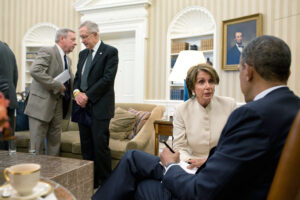
    Dick Durbin Harry Reid Nancy Pelosi Barack Obama
    Democratic leaders Dick Durbin, Harry Reid and Nancy Pelosi meet with President Barack Obama in the Oval Office of the White House in Washington DC, July 11, 2012 (White House/Pete Souza)

    When America’s secretary of state, John Kerry, made an unexpected trip to Geneva, Switzerland last weekend, there was hope in the international community that Iran and the world’s major powers were close to a nuclear deal. A successful agreement, however short-term, would have been seen as a big political victory for the Obama Administration at a time when its foreign policy credentials have been challenged by a host of shimmering conflicts abroad, from the civil war in Syria to a moribund Israeli-Palestinian peace process.

    It turned out the deal that many thought possible was beyond the grasp of negotiators last weekend. It is not exactly clear who scuttled the momentum. Some reports point to the French who appeared to insist on more restrictions. Others blame the Iranians for failing to budge on some of their core demands involving the right to enrich uranium.

    In the long run, whoever was to blame matters little. What matters is what impact the failed talks will have on the diplomatic process that the Obama Administration is now so dearly invested in. (more…)

  • Kerry Tries to Rescue Stalled Israeli-Palestinian Peace Talks

    America’s secretary of state, John Kerry, has a lot on his plate, from the upcoming round of nuclear negotiations with Iran to the global effort in Syria to verify and destroy Bashar al-Assad’s chemical weapons. Yet on Wednesday, he added another item to his “to do” list — spending a full day traveling between Israel and the West Bank to resurrect a peace process that both parties believe is on the brink of collapsing.

    After six months of persistent contact with the Israeli prime minister, Benjamin Netanyahu, and the Palestinian Authority president, Mahmoud Abbas, Kerry achieved a breakthrough in the conflict that had eluded American officials the previous three years. That is, Israeli and Palestinian officials agreed to relaunch direct negotiations within a strict nine month timeframe. Given the enormous mistrust between Israel and the Palestinians over the core issues of the conflict, getting both men back to the negotiating table was a major obstacle. But by with sheer force of his personality, Kerry at least broke through that roadblock.

    Three months into the talks, however, it is becoming increasingly obvious that the process is failing to produce any concrete results. Nor is it building the diplomatic momentum that is required to sustain the dialogue for another six months. (more…)

  • Terrorist Leader’s Death Sours American-Pakistani Relations

    By all indications, Hakimullah Mehsud was a terrorist. Despite his relative inexperience as a youthful, if determined, low level fighter, the Pakistani impressed his superiors so much that in just a few short years, he became the head of a major branch of Tehrik-i-Taliban Pakistan, the country’s largest and most feared terrorist group. After a American drone strike killed its top commander, Baitullah Mehsud, in the summer of 2009, the Pakistani Taliban’s leader met and selected the younger Mehsud to guide the group through a very challenging time in its history.

    Through the use of suicide bombers, large-scale car bombings and coordinated attacks against Pakistan’s army and security forces, Mehsud’s status soon rose to an elite level within the jihadist ranks. While Pakistanis were his primary victims, he quickly gained the attention of the United States as well when a young Jordanian who was thought to be a promising intelligence asset for the CIA blew himself up inside of an agency base in eastern Afghanistan. That strike killed seven intelligence agents and was the worst attack leveled against the intelligence agency since the 1983 bombing of the United States’ marine barracks in Beirut.

    So after four years of searching, a feeling of relief swept over the American counterterrorism community when a drone finally caught up to the Taliban leader on Friday and hit the vehicle he was riding in. (more…)

  • Iraq’s Maliki Deserves Some Tough Love from Obama

    Twenty-three months ago, Americans and Iraqis alike celebrated a milestone they had both long waited for: an end to a bloody and hard fought occupation. Iraq, at least when compared to its more violent days, was slowly stabilizing, with an Al Qaeda terrorist network struggling to sustain itself and a thriving oil sector pouring tens of billions of dollars into the country’s economy. President Barack Obama, who had considered the invasion of Iraq a “dumb war,” announced on national television that all America’s troops were coming home and that its involvement in the war was finally over.

    Fast forward to today and it is clear that whatever hopes Iraqis had for a future have come apart at the seams. (more…)

  • Syrian Regime Withholding Food, Medicine from Rebel Areas

    When the United Nations Security Council united last month and passed a resolution authorizing the destruction of Syria’s chemical weapons, the reaction among Syrians was a mix of highs and lows, of jubilation and dismay.

    For the survivors of a sarin gas attack that killed hundreds of civilians on the outskirts of Damascus in August, the news that those very weapons would be dismantled was a breath of fresh air.

    But for those who are still trapped in besieged neighborhoods as well as the millions who have had to flee their homes, getting rid of the country’s large chemical weapons arsenal was the least the international community could do.

    Indeed, as the war stretches closer to its fourth year with every passing month, more and more Syrians have resigned to the fact that the bloodshed and wholesale slaughter of entire families will continue for a long time, whether or not poison gasses are destroyed. (more…)

  • Maliki Can Learn Counterinsurgency Lessons from Americans

    For the millions of Iraqis who are still trying to recover from a decade of war, terrorism is nothing new. Ten years of warfare and insurgency have not only brought about the partial destruction of Iraq as a strong state but also the deaths of hundreds of thousands of civilians while millions more were made refugees in their own country.

    So when American troops finally withdrew in December 2011 after officially declaring that coalition military operations were over, Iraqis of all sects and religions were hopeful that their lives would get better — or at the very least, more peaceful.

    Nearly two years after that withdrawal, however, the security situation in Iraq has deteriorated to a point that even the most pessimistic Iraqi had not predicted. The scope and scale of terrorism that is devastating the Middle Eastern country this year is on a level not seen since 2008 when the sectarian civil war that tore Iraq’s social fabric apart was finally burning itself out. (more…)

  • In Shocking Move, Saudi Arabia Declines Security Council Seat

    Most of the 193 countries that are part of the United Nations consider winning a temporary spot on Security Council a great honor. As the body’s sole authority on debating issues of international peace and security, countries in every region of the world are often quick to put themselves in the running in hopes of joining the exclusive club.

    Not, it seems, Saudi Arabia. (more…)

  • Egypt Aid Suspension Worries America’s Arab Allies, Israel

    With a civil war raging in Syria, the Israeli-Palestinian peace process at a deadlock and Iraq returning to sectarian violence, the last thing the United States seem to need is another diplomatic headache in the Middle East. Yet now the Obama Administration has announced that it will suspend hundreds of millions of dollars in yearly military aid to Egypt, this is precisely what America may get.

    After a lengthy and at times confusing process that was designed to review America’s assistance to Egypt after the military removed Muslim Brotherhood president Mohamed Morsi from office in July, the administration finally rolled out its new policy: most of the aid for Egypt’s armed forces is suspended until an inclusive democracy is restored to the country.

    The decision caught many lawmakers in Washington DC off guard, some of whom had vocally pressed the administration to continue sending Egypt’s military the equipment and funding it has received since it signed a peace accord with Israel in 1979, despite the ongoing crackdown against Muslim Brotherhood activists and officials.

    Others, including Vermont senator Patrick Leahy, the chairman of the committee responsible for funding the State Department, complained that the policy shift did not go far enough. (more…)

  • Authorities on Edge After Al Qaeda Leader Captured in Libya

    Al Qaeda’s core network of operatives was struck another dramatic blow on Saturday when American commandos executed a flawless operation in the Libyan capital against a man that has been on the United States’ most wanted list for the past fifteen years.

    Nazih Abdul-Hamed Nabih al-Ruqai’i, known by his alias Abu Anas al-Liby, may not be a household name like the terror network’s former chief, Osama bin Laden, or its current head, Ayman al-Zawahiri, but he is held responsible for plotting the 1998 bombings of two American embassies in Kenya and Tanzania. The attacks, which claimed 224 lives, including twelve Americans, marked the beginning of what would become America’s war on terrorism. For Americans, it was Al Qaeda’s most audacious and brutal terrorist attacks until September 11, 2001, when it crash three commercial airplanes into New York’s World Trade Center and the Pentagon in Washington DC. (more…)

  • Hardliners Let Obama-Rouhani Diplomacy Play Out, For Now

    The recent rhetorical goodwill between Iran and the United States seems to have dampened the animosity and mistrust that existed between the two nations for 34 years. But unless the diplomatic opening achieves clear results, hardliners may yet close the door on talks.

    A relatively conciliatory speech from Iran’s new president, Hassan Rouhani, before the United Nations set the stage for a preliminary discussion between Secretary of State John Kerry and his Iranian counterpart, Mohammad Javad Zarif, on the sidelines of the annual General Assembly meeting last week. Rouhani’s first trip to New York as Iran’s leader ended in a dramatic fashion — with a brief but historic phone call with President Barack Obama on his way to the airport.

    However, as commentators and officials keep repeating, words are one thing; actions and concessions are something else entirely. (more…)

  • Obama, Rouhani Try Telephone Diplomacy, Lawmakers Skeptical

    After their respective speeches to the United Nations General Assembly in New York, Presidents Barack Obama of the United States and Hassan Rouhani of Iran returned to their own corners without the historic handshake that observers were hoping for. Given the constant speculation in the media of an informal meeting between the two leaders, the news that a handshake would not occur came as a disappointment. Some saw Rouhani’s refusal to meet Obama as a snub. Others labeled it a missed opportunity.

    It appears that Obama and Rouhani had something else in mind. Just as an American-Iranian détente threatened to unravel, Obama stepped behind the White House podium and stated, to everyone’s surprise, that he had spoken directly with Iran’s new president on the phone. “Going forward,” Obama said, “President Rouhani and I have directed our teams to continue working expeditiously to pursue an agreement” on Iran’s nuclear enrichment program.

    More so then a public handshake, the phone call between Obama and Rouhani is an historic moment. As Susan Rice, Obama’s national security advisor, later reiterated on CNN, this was the first direct American-Iranian contact between heads of state since the 1979 revolution that deposed the shah. (more…)